La marca fabricante de chips, NVIDIA se ha encontrado con un serio obstáculo en su camino al no poder vender sus dispositivos más destacados en china. Sin embargo, esto no ha representado un problema tan serio para la compañía, ya que se ha habilitado un mercado alternativo que puede compensar la situación. Con la intención de ganar un lugar en el mercado de inteligencia artificial, India se ha mostrado interesado en colaborar con NVIDIA, quienes serán sus proveedores principales de chips.
Como es sabido, para poder lograr un buen posicionamiento en este ámbito, se requiere de un poder de cómputo bastante significativo. Este es un trabajo en el que NVIDIA cuenta con una vasta experiencia, así que es una oportunidad dorada que no puede dejar pasar. No es un secreto para nadie que las potencias más relevantes del mundo se encuentran en una contienda por el manejo y control de una inteligencia artificial de gran alcance.
Las GPU de la marca NVIDIA tienen un reconocimiento tremendo en este segmento, así que no es sorpresivo el movimiento de India. La capacidad de cálculo que se requiere para poder potenciar estos sistemas es un recurso que no todos los fabricantes de chips pueden cubrir. Los modelos de inteligencia artificial pueden trabajar mucho mejor y ofrecer una precisión mayor a través del uso de los recursos que provee este fabricante. Es por esto que NVIDIA ha aumentado considerablemente sus ingresos en los últimos años ante la demanda de chips.
La razón por la que NVIDIA no podrá posicionarse sus chips en China se vincula a las sanciones, lo que los ha llevado a estrechar lazos con otros mercados como el de India. Las proyecciones de ventas de modelos de GPU A800 y H800 ascendían a los 5 millones de dólares para 2024, pero el veto de las exportaciones ha oscurecido un poco el futuro de a empresa.
Sin embargo, ha hecho un movimiento audaz al aliarse con India. Un informe revela que hay firmas tecnológicas de India han establecido acuerdos con NVIDIA para adquirir tarjetas gráficas de última generación para potenciar el desarrollo de la inteligencia artificial en la región.
Uno de los procesadores más poderosos que tiene Samsung en su catálogo será incorporado en los nuevos televisores de la marca. Se trata del modelo NQ8 AI Gen 3, el cual será capaz de duplicar la capacidad de procesamiento de la versión anterior. Así lo ha informado la empresa, la cual se prepara para deslumbrar a los consumidores durante el desarrollo de la CES 2024.
En el marco de una de las ferias tecnológicas más relevantes del sector, la empresa surcoreana tiene todo para convertirse en uno de los grandes protagonistas. Este televisor, con tecnología Micro LED transparente sobre el cual se han revelado muy pocos detalles, tiene toda la pinta de ser el buque insignia de la compañía en este segmento, el cual estaría diseñado para ofrecer una experiencia visual mucho más atractiva.
Lo que promete Samsung es una imagen mucho más brillante y con un detalle muy superior a lo que habían ofrecido hasta el momento. Aunque llegan con más de un televisor incorporado en su catálogo, es el modelo S95D el que mayores expectativas despierta. Parte de los informes que se conocen al respecto aseguran que se ha conseguido incrementar en un 20’% la cantidad de brillo.
Como resultado, se ha tenido que modificar el panel QHD-OLED, lo que permitirá disfrutar de una imagen mucho más definida. Otro punto importante que se puede destacar y que ha sido revelado recientemente es que los televisores inteligentes de Samsung integrarán una nueva característica llamada OLED Glare Free. El objetivo de este es la reducción de los reflejos, además de garantizar una mayor precisión en el color.
Se habla de que la tasa de refresco de este SmartTV será de 144 Hz, lo que representa una prestación muy interesante, permitiendo una mayor calidad en eventos deportivos y videojuegos. Tras el aumento de las redes neuronales en el procesador, se ha conseguido pasar de 64 a 512, ofreciendo una calidad de imagen de hasta 8K.
Arrancamos el año con algunos de los eventos tecnológicos más importantes, siendo Unpacked uno de los más esperados. Es la oportunidad de Samsung de mostrarnos lo que tienen en su arsenal, y las sorpresas parecen estar orientadas en gran medida a la inclusión de inteligencia artificial. Por otro lado, la llegada del Samsung Galaxy S24 es un potente generador de incertidumbre, y aunque ya ha habido un par de filtraciones, solo es cuestión de días para conocer lo que la compañía surcoreana prepara.
La fecha definida para el Samsung Unpacked 2024 es el 17 de enero, y se ha confirmado oficialmente que el nuevo buque insignia de la marca será presentado ese día. Como en años anteriores, Samsung demuestra una tendencia a utilizar esta ocasión para revelar sus dispositivos más importantes. Así pues, conoceremos las características de la gama alta que promete llevar la batuta durante este 2024. Ante la llegada del sucesor del Galaxy S23, el mercado se ha mantenido a la expectativa, ya que las innovaciones pueden estar orientadas a mejor calidad en el procesamiento, optimización de pagos y la posibilidad de plegarse.
Los móviles con inteligencia artificial son una tendencia que puede cobrar fuerza para Samsung en este año, lo que representaría una importante evolución para los Smartphones. Por ejemplo, se ha hablado de Galaxy AI, una tecnología que nos presenta la empresa y de la que poco se sabe. Sin embargo, algunos datos revelados indican que al menos el uso del Zoom en las cámaras podría estar vinculado con un análisis mucho mas provechoso y potente por parte de esta tecnología captar imágenes más impresionantes.
Samsung no solo planea lanzar un nuevo teléfono, según los informes, sino que espera ingresar en el mercado un dispositivo que transformará completamente la manera en que interactuamos con ellos. Solo queda esperar al 17 de enero para conocer lo que nos depara el futuro de Samsung a través de su línea Galaxy S.
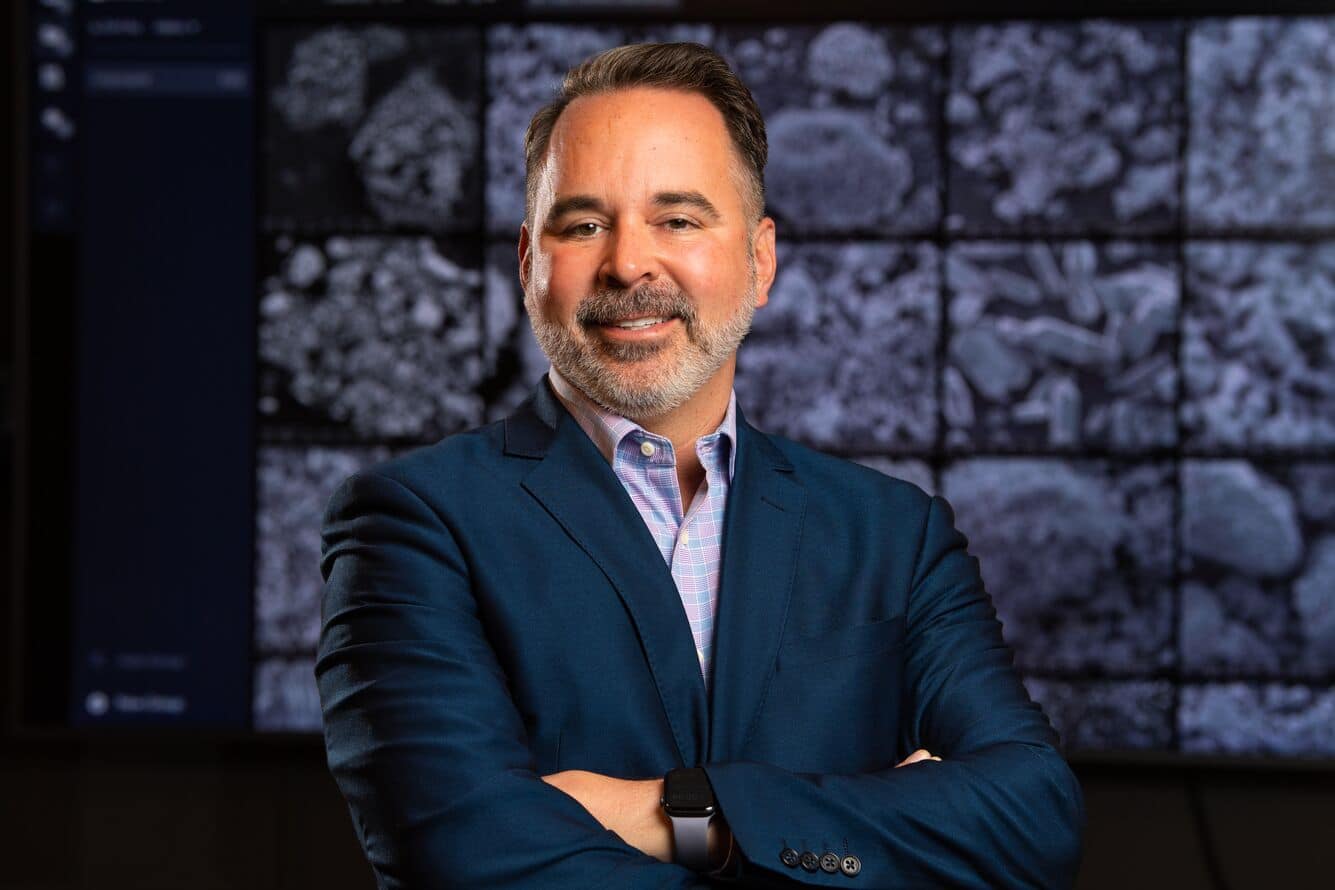
Court Corley leads the Center for AI @PNNL. (Pacific Northwest National Laboratory Photo / Andrea Starr)
Bringing artificial intelligence to bear on issues relating to nuclear weapons might sound like the stuff of a scary sci-fi movie — but at the Department of Energy’s Pacific Northwest National Laboratory, it’s just one of the items on the to-do list.
One of PNNL’s research priorities is to identify and combat complex threats to national security, and AI can help meet that priority by detecting attempts to acquire nuclear weapons or associated technology.
Nuclear proliferation detection is one of the potential applications that could get an assist from the Center for AI @PNNL, a newly announced effort to coordinate research that makes use of AI tools — including the generative AI tools that have captured the attention of the tech world over the past year or two.
“For decades we’ve been doing artificial intelligence,” center director Court Corley, PNNL’s chief scientist for AI, told GeekWire in a recent interview. “What we’re seeing now, though, is an exceptional phase shift in where AI is being used and how it’s being used.”
Historically, PNNL’s researchers have made use of data analytics in specific domains to provide deeper insights into special types of challenges, “But in the past 10 years since we started using modern AI, which includes deep learning and now generative AI and deep reinforcement learning, the number of our scientists and engineers that are using it in their day-to-day work has just continued to grow,” Corley said.
Corley said one-fifth of PNNL’s thousands of scientists and engineers are using AI. “These are power systems engineers working on electricity grid resilience, and scientists working to decode the biomolecular universe and understand biological function, and so many domains in between — where previously, the application of AI was challenged because either it wasn’t robust or it wasn’t resilient, but now it’s really beginning to work well,” he said.
The Center for AI @PNNL is meant to optimize how AI tools are employed at the national laboratory, which is based in Richland, Wash., but also has researchers working in Seattle and Sequim in Washington state, plus Portland, Ore., and even College Park, Md. Corley and his staff have the job of coordinating AI projects and championing technological innovations across the organization.
Among the AI-centric projects PNNL’s researchers have been working on are initiatives to speed up materials development for energy storage systems; to engineer microbes to produce next-generation biofuels; and to make use of a technique called autonomous experimentation to create new types of alloys.
“There are pockets of AI research and AI engineering all across the laboratory, and we’re at a point now to be able to aggregate our collective expertise and really champion our work,” he said. “It makes sense to bring everybody together in a virtual research hub. That way, we can have an entity that’s greater than the sum of its parts. We can better prioritize infrastructure, prioritize resources, prioritize tooling, upskilling, training and so forth.”
Corley is well-suited for his new role as the center’s director: He received his Ph.D. in computer science and engineering from the University of North Texas in 2009 and has been focusing on data analytics and AI research at PNNL ever since. Here’s a selections of quotes from our interview, edited for brevity and clarity.
On efforts to ensure the safe and secure use of AI for national security applications: “There’s a huge call-out in the executive order about AI that was issued by the president recently. It delves into how we as a nation can protect against revealing dangerous information — for example, recognizing the ability to extract dangerous information from these systems as to how they’re used, and building a response to that. Right now, the government is on a very short timetable to respond to those concerns. It’s a whole-of-government effort with many organizations involved, not just national labs like PNNL. We need to answer those specific questions: What are the safeguards? What are the mechanisms by which we’ll protect our infrastructure and high-consequence systems?”
On working with tech partners to make AI safer: “Tech companies are going to develop their own roadmap. But the folks from the tech companies are very clear. They say, ‘We shouldn’t be the one only ones developing safe and secure methods for these systems. We really need the government support.’ And you see that in Washington now. They’re having conversations with many organizations about partnerships to make sure these systems are developed in a safe, secure manner.”
On how generative AI being used at PNNL: “We’re in an exploratory phase right now. We’re trying to see where generative AI will have the most impact in the missions that we support. We have a new effort, using some of the tools provided by our hyperscalers, like Microsoft or Amazon, to see whether those tools are sufficient to do both computational chemistry and AI workloads. We have other efforts that we are just starting with the Department of Energy — for example, to accelerate permitting processes. The process for getting environmental permits for different types of electricity use is a very paper-heavy process. And so we have an exploratory project right now to see if can we accelerate that process, to remove some of the barriers to accessing government resources.”
On using AI for research in Earth science and biological sciences: “There are two applications there. One is speeding up the complexity of our climate models and our atmospheric models to get a better understanding of how climate change is affecting the United States. In the biological sciences, we’re thinking about how we can understand biological function in a way that we’ve never been able to before, by having an ‘-omics’ view that goes beyond genomics — by looking at the proteomics, metabolomics and all these other -omics, and integrating them in a way that hasn’t been possible before because of the sheer complexity. This is another area where we’re trying to bring AI into the fold.”
On areas of research where AI and quantum computing can work together: “One of the areas is in materials. If we can design better materials that can operate in the regimes that are needed for quantum computing, I think that’ll be game-changing. And we’re seeing that machine learning can be used in quantum chemistry. So, I would say the No. 1 area where AI is probably going to have an impact is in that materials chemistry space — which is where quantum computing is, because of the temperatures at which it needs to run and the types of materials it needs for its design.”
On the ways in which PNNL is improving how AI is done: “One example that we have worked on is in an area called scientific machine learning. It’s where we incorporate physics into deep learning itself, so you can constrain it or provide it with explainability and interpretability by saying, ‘Here are known governing laws about the physical universe.’ By constraining our models based on that, we add a layer of reducing the cost of training and computation time and data. We’re also increasing how interpretable AI is for the end users, because now it’s not an unbounded system, but it’s bounded by the laws of physics.”
On whether autonomous experimentation will ever replace human researchers: “The only thing that AI is going to do is accelerate the process. We still absolutely have to have human ingenuity in the loop for a lot of the designs and experiments. To have a deep theoretical understanding of the domain in addition to the ability to partner or use a co-pilot of some sort, I think is really going to be the game-changer for this autonomous experimentation.
“The only ones who will be left behind are those who don’t adopt the use of AI in some way. We’re still exploring where it should be used. But there are many applications that go beyond automation, where you’re just getting a repetitive process that’s done, maybe not in an intelligent way, and then you add some intelligence on top of it that says, ‘OK, now you could perform this next experiment based on the hypothesis that you just tested.’”
On the AI applications from PNNL that could be the first to change daily life: “In the next five to 10 years, we’re going to see a complete transformation in energy generation because of the ability to bring on new types of resources. The only way to do that in a reliable manner is through the use of AI, because now we’re talking about generation sources that are variable. They’re not consistent. They’re not dispatched easily. There’s a lot of operational control that needs to happen. AI is probably one of the solutions that will be used to help us get there.”
La lucha por desarrollar el mejor chat de Inteligencia artificial continúa en su máximo apogeo, y esta vez, Microsoft es la empresa protagonista. Luego de saltar a este mercado con “Bing Chat” la empresa tecnológica ha decidido cambiar el nombre de esta herramienta a Microsoft “Copilot”, un chat al que se le puede preguntar casi cualquier cosa y obtener respuestas de gran precisión.
Se trata de una tecnología que nos resulta bastante familiar, ya que empresas como OpenAI se han dado a la tarea de posicionar este recurso como uno de los que mayor interés ha despertado en 2023. Lo interesante es que Microsoft no entra como un competidor, sino como un colaborador en esta carrera por la creación de un chatbot potente, puesto que se ha asociado con OpenAI para la creación de Copilot.
Pero antes que nada, es importante comprender el alcance y potencial de este software de inteligencia artificial, que no es más que un modelo conversacional. Es un modelo de lenguaje similar al que se emplea en ChatGPT, donde se incluyen recursos de GPT-4. Por ende, si quieres aprovechar parte del potencial que ofrece esta tecnología de manera gratuita, Copilot sin duda ofrece un desempeño bastante significativo en comparación con otros similares.
Para su funcionamiento, Copilot está conectado constantemente a la red, lo que evita que se comparta información desactualizada. Como resultado, Microsoft ha logrado crear una herramienta capaz de ofrecer datos actualizados en función a las referencias obtenidas en la internet.
Otro punto importante que hay que mencionar es el hecho de que Microsoft ha integrado en Copilot la herramienta DALL-E 3, a través de la cual se pueden generar imágenes. Es un punto favorable que solo requiere de texto para crear imágenes completamente originales. Con este arsenal de funciones, Copilot se perfila como una de las herramientas que dará mucho de que hablar en este año 2024.
Stephiney Foley, founder and CEO of Yuzi, with her husband Harper Foley, who is also a Yuzi co-founder and chief technology officer, and their children. (Yuzi Photo)
Yuzi founder Stephiney Foley graduated from West Point and worked for the U.S. Army for more than seven years, serving as a platoon leader in Afghanistan and Hawaii and a supply chain and operations officer in California.
When it comes to war, Foley said, the expectation is that it’s going to be tough and you need to brace yourself. That’s not the message for new parents.
“With motherhood, the media, movies, everything out there says it’s a rosy, beautiful thing — which it is — but our society doesn’t talk about the messiness of motherhood and parenthood,” Foley said.
Seattle-based Yuzi is a wellness startup aiming to support families during the exhausting, challenging days that follow childbirth. Yuzi launched in September and the team is bootstrapping the effort while starting fundraising. The target customers include some of the parents of the more than 3.6 million babies born in America annually.
Foley is also working at Amazon as president of Asians@Amazon, the tech giant’s largest employee resource group, and was previously head of product for subscription services. She has been with the company since 2018. Foley began thinking about the need for better postpartum care following the birth of her second child. She and her husband were working full time, taking care of a toddler, and their families lived across the country in Texas and Florida.
“With motherhood, the media, movies, everything out there says it’s a rosy, beautiful thing — which it is — but our society doesn’t talk about the messiness of motherhood and parenthood.”
– Stephiney Foley, founder and CEO of Yuzi
“I was really at my wits’ end,” Foley recalled.
The U.S. medical system emphasizes healthcare for expectant mothers and well-baby visits for infants, but does little for women following delivery. America’s maternal death rates are 10-times higher than some other wealthy nations and have increased dramatically in recent years. After delivering a baby, mothers can experience postpartum depression, struggles with nursing, anxiety, sleep deprivation, and damage to their pelvic floor, among other issues.
Yuzi is preparing to release its first product, which is a post-delivery retreat where mothers receive meals, support from specialists in taking care of new babies, and an opportunity to heal. Foley said they’re working to finalize a hotel partner in the Seattle area to host families, and the retreats should launch in May. The experience will include an app to coordinate resources during and after the retreat.
The ultimate goal for Yuzi is to create a platform that will be a clearinghouse for reliable, trusted information on the postpartum experience and create a community for new parents.
The startup is named after “zuo yuezi” — a Chinese practice that translates to “sitting the month,” which is a period of 30-40 days after childbirth when a mother isolates, rests and bonds with her baby.
There are other businesses offering luxury postpartum retreats at hotels in Asian cities and New York City, as well as night nurses who provide care to mothers and their newborns.
The support is expensive across the board. The Yuzi retreat costs from $899 to $1,199 per night depending on the length of stay, with a five-night minimum. It includes a luxury hotel room, three meals per day for mothers, 24-hour care, lactation support, and newborn care educational programming. Partners are also able to attend.
Foley, who worked briefly at Tesla, said her approach is akin to the electric car manufacturer, initially targeting affluent consumers and eventually expanding her product base to reach a wider audience. She hopes that Yuzi can ultimately establish postpartum retreat programs around the country and provide more resources in general to families of newborns.
To reach all new moms in America, “it requires legislation changes in our state and our country as well as employer support,” Foley said, which she would like to advocate for.
In addition to her bachelor’s degree from West Point, Foley has an MBA from the Tuck School of Business at Dartmouth College and a master’s degree from Norwich University in diplomacy and commerce.
Multiple programs supporting startups have selected Yuzi to participate in their cohorts. That includes the Washington Technology Industry Association (WTIA), which has a program providing seed-stage founders with coaching on new company basics as well as $10,000 worth of Amazon Web Services credits. Yuzi is also part of the Dartmouth consumer incubator and Bunker Labs, a program benefiting military veterans.
Foley was the co-founder of a gaming-related NFT consulting company that operated until August, and is a board member of Athena Angels, which supports women entrepreneurs from West Point.
The Yuzi team includes Foley’s husband, Harper Foley, who is a co-founder and chief technology officer; co-founder and Chief Operating Officer Michelle Homan; and Chief Wellness Officer Dr. Tiffany Chen.
Editor’s note: This story was updated to correct that Stephiney Foley is still with Amazon.
Desafortunadamente, un Airbus A350-900 de Japan Airlines se accidentó y se incendió en la pista del aeropuerto de Haneda, en Tokio, después de colisionar con un Dash 8 turbohélice de la guardia costera que transportaba ayuda humanitaria para los afectados por el terremoto que sacudió la costa occidental del país en el inicio del nuevo año.
Cinco de los seis tripulantes del pequeño avión de la autoridad de protección marítima de Japón murieron. Por su parte, las 379 personas que iban a bordo de la aeronave comercial salieron con vida del terrible accidente. Esto último ha sido calificado como “milagroso” por expertos de seguridad aérea, según Reuters. La prensa internacional también recalca los avances en tecnología y seguridad que se implementan en las aeronaves modernas, cuyo estándar debe ser de 90 segundos para una evacuación total.
Airbus A350, un avión que abrazó la innovación
Las causas del accidente producido este martes por la noche (horario local) todavía no están claras, aunque en este momento las autoridades están llevando a cabo una investigación exhaustiva. Uno de los ejes de la misma tiene que ver con la comunicación entre la torre de tráfico aéreo y los aviones.
Se sabe, además, que Airbus ha enviado un equipo de especialistas para colaborar mientras se desarrolle la investigación. Cabe señalar que, como suele ocurrir en estos casos, las conclusiones preliminares del accidente no llegarán en lo inmediato, por lo que tendremos que tener paciencia para saber más sobre lo sucedido.
No obstante, podemos enfocarnos en la información que sí tenemos a nuestro alcance, como las características del Airbus A-350-900 de Japan Airlines. Es que se trata de uno de los aviones más modernos y avanzados que operan en la actualidad. Veamos qué hay detrás de esta familia de aviones que empezó a volar en 2015.
Cuando hablamos del Airbus A350 hacemos referencia a un avión relativamente nuevo. Si bien el fabricante europeo tenía en sus planes desarrollar un avión de estas características desde hace tiempo, el proyecto recibió su impulso definitivo en 2006. Después de mucho tiempo de trabajo, el primer prototipo despegó de Toulouse, Francia, en 2013.
Un año más tarde llegaron las certificaciones de la Agencia Europea de Seguridad Aérea (EASA) y de la Administración Federal de Aviación (FAA), elementos clave para empezar a operar. Esta nueva familia de Airbus debutó en enero de 2015 de la mano de Qatar Airways que puso en el aire un Airbus A350-900, una variante capaz de transportar hasta 350 pasajeros.
Fue la misma aerolínea la que en 2018 también desplegó un Airbus A350-1000, una variante un poco más ambiciosa diseñada para transportar hasta 410 pasajeros y alcanzar un alcance máximo de 16.000 kilómetros frente a los 15.000 kilómetros de la versión anterior. Desde ese entonces, ambas variantes han sido incorporadas por diferentes aerolíneas.
Airbus cuenta en la página de producto del A350 que tanto pilotos como aerolíneas participaron de la etapa de desarrollo de la aeronave. Esta estrecha colaboración dio como resultado un producto mejor orientado para los futuros propietarios. En la cabina destacan seis grandes pantallas táctiles ideadas para mejorar la operatividad de los pilotos.
El Airbus A350 es el primer avión comercial en llegar con un sistema de Descenso Automático de Emergencia (AED, por su siglas en inglés). En un caso de despresurización donde la tripulación deja de responder al quedar inconsciente, el sistema se encarga de descender automáticamente la aeronave a una altitud segura.
Se trata también del primer avión de Airbus construido mayormente con materiales compuestos. Esta apuesta, según el fabricante, presenta muchas ventajas. Por un lado, el avión es más liviano, lo que se traduce en menor consumo de combustible y mayor autonomía, y por otro lado también es más resistente a la fatiga y la corrosión. Como podemos ver en la imagen inferior, todo el fuselaje y los revestimientos de las alas están compuestos por fibra de carbono.
Airbus afirma que esta técnica innovadora también llega acompañada de beneficios a nivel de seguridad. “Los materiales compuestos también proporcionan algunos beneficios adicionales en términos de comportamiento al fuego: polímeros con fibra de carbono (CFRP) es autoextinguible y más resistente a las quemaduras que el aluminio”, señala el fabricante.
Es preciso señalar que la utilización de materiales compuestos no es completamente nueva dentro de Airbus. La firma con sede en Blagnac lleva desarrollando este enfoque desde 1983, con el A310-200, que tenía el spoiler y el timón de CFRP. Otros modelos como los A310 y A320 también ha utilizado materiales compuestos, aunque el A350 lo lleva al siguiente nivel.
Si hablamos del sistema propulsor, el Airbus A350 se mueve gracias a un conjunto de motores Rolls-Royce Trent XWB diseñados específicamente para este modelo. Prometen ofrecer un 25% menos de consumo de combustible. Según sus diseñadores, es el “motor aeronáutico grande más eficiente del mundo en servicio”.
No podemos cerrar este artículo sin mencionar las comodidades que estas aeronaves, específicamente las configuradas por Japan Airlines, ofrecen a los pasajeros. Cada asiento cuenta con puertos USB y tomas de corriente para cargar ordenadores portátiles y otros dispositivos. Además, las ventanas tienen unos generosos 42 cm de alto por 27 cm de ancho.
Los compartimentos de almacenamiento superiores son más espaciosos que los convencionales. Los asientos tienen unas fundas que utilizan una combinación de dos tipos de tela diferentes para dar una sensación visual de amplitud. Los espacios de clase superior están rodeados de unas carcasas grandes y reposabrazos que buscan ofrece espacios privados.
Clockwise, from top left: Kellan Carter of Fuse; Madin Akpo-Esambe of Tacoma Venture Fund; Maria Gilfoyle of Madrona Venture Group; Greg Gottesman of Pioneer Square Labs; and Sheila Gulati of Tola Capital.
The pace of AI-related innovation accelerated, to say the least, in 2023.
Expect the same this year — or even more.
That’s the word from a group of Seattle-area tech investors who shared their top prediction for the new year. Read on for their takes.
Madin Akpo-Esambe, investor at Tacoma Venture Fund
“Next year will bring an unprecedented wave of startup acquisitions and wind downs, but we’ll start to see the early innings of the next wave of future unicorns with proven applied AI innovations emerge. The genie is certainly out of the bottle on AI as a fundamental platform shift and it’s here to stay. Similar to the 2008 and 2009 wave of applications that rode the wave of mobile, new technologies that are cracking tangible applied-use cases of AI will start to pick up steam in 2024.”
Sheila Gulati, managing director at Tola Capital
“The integration of multi-modal models is set to unveil fresh opportunities at the application layer while simultaneously introducing new challenges and innovation prospects at the infrastructure layer. The remarkable speed at which open source models have matched, and in some cases surpassed, their proprietary counterparts in terms of performance is truly noteworthy. Looking ahead to 2024, the rapid pace will persist, accompanied by the rise of specialized vertical and domain-specific models entering the market, alongside the more generalized, pre-trained models. Brace for a year where innovation and specialization intersect to shape the future of model development.”
Greg Gottesman, managing director at Pioneer Square Labs
“By the end of 2024, machines will write more than half of the new code generated globally.”
Maria Gilfoyle, investor at MadronaVenture Group
“We will see innovative AI tools designed to meet users where they already are — in their workflow. The distribution of AI tools will become more critical than the model used under the application, as long as the model functions correctly. Additionally, for startups, I predict a shift away from text/chat-based UX for AI-native applications in 2024. The future lies in apps that take a multi-modal approach to perform tasks like updating records, scheduling events, booking a restaurant, editing paragraphs, leaving comments, and completing action items after approval from the user.”
Kellan Carter, founding partner at Fuse
“Large platforms will continue to innovate at a rapid pace and capture much of the AI momentum. It will continue to force Washington, D.C., to take notice, but likely nothing of regulatory substance given how new the category is.”
Get caught up on the latest technology and startup news from the past week. Here are the most popular stories on GeekWire for the week of Dec. 24, 2023.
Sign up to receive these updates every Sunday in your inbox by subscribing to our GeekWire Weekly email newsletter.
Most popular stories on GeekWire
Valve Software dropped a surprise last month when it unveiled a new version of its handheld PC gaming device, the Steam Deck OLED. … Read More
Thanks to tectonic shifts in technology and training, Olympic-level rowing has come a long way since the University of Washington’s eight-man crew pulled off the ultimate underdog win at the 1936 Olympics in Nazi Germany — the achievement celebrated in the brand-new movie adaptation of “The Boys in the Boat.” On paper, the performance of the rowers at the center of the movie — and at the center of the bestselling book on which the movie is based — pales in comparison with current Olympic and world records. … Read More
Amazon has set the date for when it will introduce ad breaks to streaming content on Prime Video: Jan. … Read More
In the five years since Joseph Williams advised Gov. … Read More
Tech startup investments continued to retreat in 2023 as venture capitalists tightened their belts and companies trimmed costs amid uncertainty about the broader economy. … Read More
My whippet Roxy is smart. She understands dozens of words and phrases well beyond sit and stay. … Read More
Citing new ordinances recently passed in Seattle that aim to help gig workers, the Target-owned delivery service Shipt informed customers this week that it will pause operations in the city starting Jan. … Read More
If 2022 was packed with headline-grabbing aerospace developments — including the first pictures from the James Webb Telescope and the first launch of NASA’s giant moon rocket — 2023 was what you might call a rebuilding year. … Read More
After years of hype, virtual reality still hasn’t achieved mainstream consumer adoption. … Read More
The New York Times filed a lawsuit Wednesday against OpenAI and Microsoft, accusing the companies of copyright infringement for training artificial intelligence models on millions of articles published by the newspaper. … Read More
Image created by AI in Microsoft Designer, based on the prompt, “Generate an image reflecting the rise of AI in 2023 and what’s next in the field.”
“The biggest surprise is that AI used to be narrow. … And when you went from one application to the other, you had to redo it all from scratch. What’s really surprised us is the emergence of general tools. … It’s almost the love child of a search engine, like Google, which you can talk to about anything, with the somewhat limited but very real intelligence of AI systems.”
AI2 technical director Oren Etzioni. (AI2 Photo)
That’s computer scientist and entrepreneur Oren Etzioni, our guest this week on the GeekWire Podcast, reflecting on the past year in AI, and looking ahead to what’s next.
Etzioni, an AI leader for many decades, is professor emeritus at the University of Washington, Allen Institute for AI (AI2) board member, AI2 Incubator technical director, and Madrona Venture Group venture partner.
Among other roles, he served on the National AI Research Resource Task Force, which advised the White House on policy issues, and he’s working on a project to combat AI-related misinformation in the upcoming elections.
In the first segment of the show, my colleague John Cook and I discuss the big AI news of the week: The New York Times Co.’s lawsuit against Microsoft and OpenAI over their use of its articles in GPT-4 and other AI models.
Listen below, or subscribe to GeekWire in Apple Podcasts, Google Podcasts, Spotify or wherever you listen, and keep reading for key takeaways.
Highlights from Oren Etzioni’s comments, edited for clarity and length:
The evolution of AI in the past year: “It’s really been a wake-up call. … I like to say our overnight success has been decades in the making. And a lot of us have been aware of the potential of AI for a while. I don’t think any of us anticipated just how quickly and how dramatically, it would come in the shape of ChatGPT, and so on. But we all knew that it was coming. Now, it turns out that the rest of the world, literally, is catching up. That includes the politicians, that includes the kids, that includes the teachers. It’s now changing every aspect of society.”
The role of AI in our work and lives: “Copilot might not even be the right phrase. Maybe an assistant. And an assistant is often only as good as the tasks that you’re able to give it. We cannot delegate some things, we delegate badly, and they’re ill-specified. … I think we have here the potential of finding the drudgery, finding the things you don’t like to do, and having AI give you a big help with those.”
The “toothbrush test” for AI: “What happens next in 2024, is what somebody once called the toothbrush test. So how many times a day do you use the technology. For most of us, toothbrush is two to three times. So I think that in 2024, the toothbrush test for AI is going to explode. We’re going to find that we’re using it two, three, 10, 20 times a day. And I’m not even talking about its implicit use where you’re doing speech recognition in your car, or the Google search engine is using it to re-rank things. I’m talking about us interacting with AI systems, with our music, and our art, or in our job. I think it’s going to be easily 10 times a day on average.”
The need for strong open-source models: “The consolidation of power in AI is a huge risk. And we’ve seen some of that with the top corporations. The countervailing forces are, number one, open source models. A great analogy here is what we’ve seen in operating systems. We had Windows, which billions and billions and dollars went into. But we also had Linux, which the open-source movement championed. So I hope that we will have a Linux of language models, a Linux of AI. And I also think that the government has a role to play in making resources available.
The risks of AI-fueled misinformation: “We’ve already seen it in previous elections, but it’s gotten cheaper, easier to do with generative AI, and I am terrified of its effect on the November election … on the primaries, on the election itself, the potential for distrust, and so on. And I am determined to do something about it to help figure out how generative AI doesn’t become the Achilles heel of democracy.”
What it will take to combat AI misinformation: “I think we need strong regulations. I think we need education. People need to understand how to critically evaluate what they’re hearing, particularly over social media. … In addition, we do need watermarking, authentication, provenance, so we know where things come from. And in addition to all that, we need the ability to detect. So when I see a video, when I hear audio, I have to be able to ask, ‘Was this altered? Was this manipulated? Was this automatically generated by AI?’ With those pieces, I think we have hope to have a robust system. Without any of them, I think we are seeing some major risks.”
The prospects for AI startups: “Some people have the perception that right now, it’s hard to launch a successful startup because of the huge amount of compute power required for these massive models. I think nothing could be further from the truth. We’re at a moment of disruption, and disruption creates a lot of opportunities.”
Advice for aspiring computer scientists: “One, study the fundamentals. Math, statistics, the basic ideas of computer science, those have not changed. Those are the building blocks on which we’re building the latest technology. …
“The second thing I want to say is, follow your passion. So often, people are worried or trying to game the future. Well, I should study this because I could get that job and I should do this. You’re young, the world is changing quickly. Follow your passion, enjoy the educational process, enjoy learning what what you need to do, and these things will take care of themselves.”
Groups of up to six people can play various games inside Sandbox VR arcade locations around the world. (Sandbox VR Photo)
After years of hype, virtual reality still hasn’t achieved mainstream consumer adoption. But it sure helped my group of friends have a ton of fun earlier this month.
We spent a weeknight at Sandbox VR in Seattle, one of more than 45 locations worldwide where the San Francisco-based startup offers virtual reality experiences for groups of 2-to-6 people.
VR arcades are not new, though the technology has improved over the years. Sandbox survived the pandemic shutdowns and is now growing quickly after raising $37 million two years ago. It added 12 locations this year with plans for more in 2024. Its investors include firms such as Andreessen Horowitz and celeb investors including Justin Timberlake, Katy Perry, and Kevin Durant.
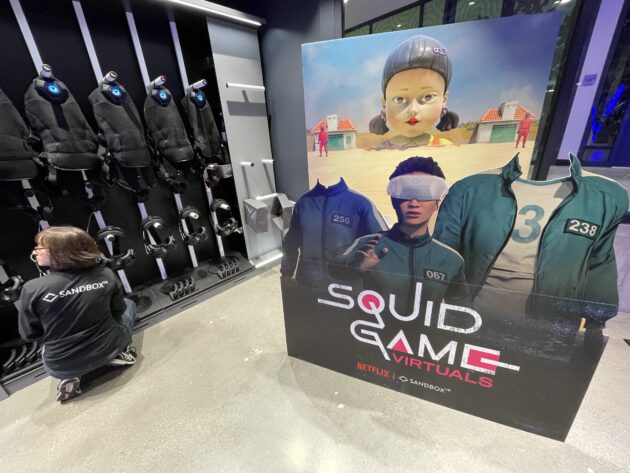
Inside the Seattle-based Sandbox VR location, where customers can experience the hit Netflix show “Squid Games” as a VR game. (GeekWire Photo / Taylor Soper)
After our group arrived at the South Lake Union location in Seattle, we spent 15 minutes for training and setup. It takes some time to strap on motion sensors to your wrists and ankles, and get comfortable wearing the vest and headset, all powered by HTC technology.
We moved into an empty room lined with overhead sensors. We strapped on our headsets and soon saw each other as virtual avatars. We laughed and commented on how trippy it was to be together in a physical space but interact in this “metaverse” of sorts.
Sandbox offers an array of games it develops in-house, including “Squid Game Virtuals,” one of the company’s newer experiences based on the hit Netflix show. It launched in September and quickly gained popularity, generating $4.5 million in revenue for Sandbox in two months.
“Squid Game Virtuals” runs through various mini-competitions, just like in the show, though instead of being eliminated you get to respawn if you happen to move excessively in “Red Light, Green Light” or fall through the glass bridge.
There was a slight glitch to start but a few minutes later, the Squid Game began.
Players collect points throughout the experience and a winner is crowned at the end. There’s a fun element of both teamwork and potential sabotage that keeps things interesting.
The motion-capture tech worked pretty well, accurately sensing your body movements — key for something like this to really work.
After 30 minutes of gameplay, we took off the headsets and watched video replays of our experience. We had a lot of fun — which seems to be a common review, according to Mason McKean, a Sandbox employee who helped our group.
“My favorite part is seeing people come in from tech companies that are mainly introverts or typically more reserved, and seeing them come out of the experience with this big smile on their face,” McKean said. “You can tell that they’re elated and relaxed and unwound a little bit, which is wonderful.”
(Sandbox VR Photo)
I would love to come back and try all the other games Sandbox offers. But I probably won’t.
Sandbox typically charges $50 to $55 per person for just 30 minutes of play. (Editor’s note: GeekWire received complimentary admission for purposes of this review.)
This might make sense for companies looking for a team-building event, or big groups celebrating birthdays or bachelor/bachelorette parties, as advertised on the company’s website.
But for me, it’s just too steep a price for too little return. The VR is definitely cool, but $50 could go a long way at a traditional arcade, pinball joint, or other forms of live entertainment. Or, I could invest in my own VR headset and play at home.
Whether Sandbox keeps growing remains to be seen. There are several competitors in the Seattle region, including Hive VR, Dimension XR, and Zero Latency.
Tim Harader, a longtime Seattle tech exec, founded a VR arcade company called Portal with his wife in 2017. The company, which had locations in Ballard and Bellevue, announced plans to shut down earlier this year.
Portal’s business was growing and reached profitability just before the pandemic began in 2020, which hit physical retail and entertainment venues hard given restrictions on indoor gathering.
Portal founder Tim Harader (right), circa 2018, inside his VR arcade that shut down this year. (GeekWire File Photo / Taylor Soper)
Harader cited other pandemic-driven impacts — people staying at home more and the shift to remote work — as well as increasing labor costs that contributed to Portal’s demise.
He isn’t sure if the VR arcade business is sustainable moving forward.
“For location-based entertainment venues, it’s a balance of reaching your maximum capacity versus your operating expenses,” he said. “It may work in some places but not others.”
Offering food and beverage could help boost revenue, he added.
Other Seattle-area venues offering VR arcades have shut down in recent years, including VR Go, Virtual Sports, and Odyssey Virtual Reality.
Harader, a former longtime Microsoft exec, is now a vice president at Librestream, which develops augmented reality technology for industrial companies.
While there are some established enterprise use cases for VR and AR, the consumer market still lacks a breakout app and headset sales dropped nearly 40% this year, according to CNBC.
Even with Apple set to release its Vision Pro headset next year and Meta continuing to invest heavily in the sector, Harader believes we’re still years away from mainstream consumer adoption. The technology just isn’t good enough, he said.
“When you think about the required power and battery life and visual clarity you need for a device that you’re going to wear for more than an hour or two — nothing is there yet,” he said. “They still have to develop better battery technology, better display technology, and more powerful compute.”
In the meantime, companies such as Sandbox — which opened a new development studio in Vancouver, B.C., this year — will try to draw customers into their locations. In a statement to GeekWire, Sandbox CEO Steve Zhao said people are “gravitating towards immersive experiences and VR is a conduit to that.”
“You see companies continue to invest in VR,” he said. “There are a lot of folks everywhere hedging on this bet because immersion is something that gamers want, and is a natural progression.”
The New York Times headquarters in Manhattan. The newspaper’s lawsuit this week against Microsoft and OpenAI asks a federal judge to order the destruction of all AI large language models trained on its copyrighted material. (GeekWire Photo / Kurt Schlosser)
“Who can afford to do professional work for nothing?”
Bill Gates wrote those words in a landmark open letter in February 1976, calling on personal computer hobbyists to stop stealing software produced by the scrappy young “Micro-Soft” team without paying for it.
Five decades later, the same sentiment sums up The New York Times Co.’s lawsuit against Microsoft and OpenAI this week. The suit alleges that the companies wrongly used vast amounts of copyrighted material from the newspaper to train the large language models that power ChatGPT and other artificial intelligence models.
Microsoft and OpenAI “seek to free-ride on The Times’s massive investment in its journalism by using it to build substitutive products without permission or payment,” the Times Co. alleges in the introduction to the suit.
In other words, a company that built a technology empire on intellectual property rights now faces allegations that it’s flouting them in pursuit of its next phase of innovation and growth.
That irony is one of a few thoughts that came to mind while reading through the 69-page complaint filed by The Times Co. against Microsoft and OpenAI in federal court in New York City on Wednesday.
With the lawsuit, the Times Co. is drawing a legal line in the sand for the new era of AI. In addition to pursuing unspecified financial damages, the suit seeks an injunction against Microsoft and OpenAI to halt the alleged practice of using the Times’ copyrighted material, and a court order for the destruction “of all GPT or other LLM models and training sets” that incorporate its copyrighted work.
The lawsuit also delves into the implications of AI for journalism and democracy.
“Producing Times journalism is a creative and deeply human endeavor,” the suit says, adding later, “If The Times and other news organizations cannot produce and protect their independent journalism, there will be a vacuum that no computer or artificial intelligence can fill.”
The claims cover not just the alleged use of New York Times articles to train large language models, but also answers provided by ChatGPT and Microsoft Bing Chat to users. Several examples in the suit show how different prompts cause GPT-4, ChatGPT, and Bing Chat to reproduce large chunks of text, verbatim, from the newspaper’s articles.
An exhibit in the New York Times Co. lawsuit, with verbatim text in red. (Via U.S. District Court for the Southern District of New York.)
In other cases, the suit cites instances in which the AI attributes information to the Times incorrectly.
In one example, the suit says, Bing Chat “confidently purported to reproduce the sixth paragraph” from a widely cited 2015 New York Times article, Inside Amazon: Wrestling Big Ideas in a Bruising Workplace.
“Had Bing Chat actually done so, it would have committed copyright infringement,” the suit says. “But in this instance, Bing Chat completely fabricated a paragraph, including specific quotes attributed to Steve Forbes’s daughter Moira Forbes, that appear nowhere in The Times article in question or anywhere else on the internet.”
“In AI parlance, this is called a ‘hallucination.’ In plain English, it’s misinformation,” the suit says, generally referencing these types of instances.
This is one of numerous suits that promise to lay the groundwork for U.S. courts to establish precedents that could define the economics of artificial intelligence. Media consultant Dick Tofel told the New York Times in its own coverage of the lawsuit that a Supreme Court ruling on the issue is “essentially inevitable.”
Here is OpenAI’s statement.
“We respect the rights of content creators and owners and are committed to working with them to ensure they benefit from AI technology and new revenue models. Our ongoing conversations with the New York Times have been productive and moving forward constructively, so we are surprised and disappointed with this development. We’re hopeful that we will find a mutually beneficial way to work together, as we are doing with many other publishers.”
On the off chance that Microsoft tries to distance itself from OpenAI, the suit makes extensive use of comments from Microsoft CEO Satya Nadella to illustrate its instrumental role in developing and distributing the technologies in question — including statements he made to reassure investors and customers when OpenAI CEO Sam Altman was briefly ousted from the role in November.
Microsoft has not commented on the suit as of Thursday morning Pacific time.
Citing new ordinances recently passed in Seattle that aim to help gig workers, the Target-owned delivery service Shipt informed customers this week that it will pause operations in the city starting Jan. 10.
Birmingham, Ala.-based Shipt works like same-day delivery companies such as DoorDash and Instacart, employing gig workers to pick and/or deliver groceries and other items. Target acquired Shipt in 2017 for $550 million.
In an emailed statement to GeekWire, Shipt said action taken by the Seattle City Council will impose significant operational challenges that would impact its ability to be compliant and continue providing value and service.
The company said it has repeatedly expressed its concerns to the City over the policies.
The Seattle Times first reported the news.
The ordinances aimed at app-based delivery platforms include a 10-cent per-order fee for online deliveries in Seattle starting in 2025, approved by the Council in November. The revenue generated by the fee will help pay for the implementation and enforcement of the City’s “PayUp” gig worker protection laws in Seattle. One law sets minimum wage policies, another is related to regulations for the worker deactivation process.
Seattle Councilmember Lisa Herbold, who is departing her seat at the end of the year, was lead sponsor of the bill, CB 120706, that imposes the 10-cent fee.
“These vulnerable workers in this under-regulated industry are calling out for us to put our money where our mouth is and fund the enforcement of the protections we have approved as a council,” Herbold previously said.
Herbold said last month that the average customer will pay an additional $5.20 per year if companies pass the fee to customers — “which they don’t have to do,” she said during a Nov. 22 council meeting.
In a statement to GeekWire last month, Instacart said the bill “forces residents to foot the bill for an ill-advised ordinance amid record inflation and tightened budgets.”
GeekWire reached out to Herbold and the Council for additional comment on Shipt’s decision and we’ll update this story when we hear back. Update: Here’s a comment Herbold shared with GeekWire:
“Shipt had more than 18 months to figure out how to comply with the minimum wage requirements. While we hope they will comply with the law, the era of app-based companies paying workers less than the minimum wage is over. I’m proud to have co-sponsored this legislation. Seattle has become a national model in app-worker protections. New York City followed in our footsteps, adopting a similar law earlier this year.”
— Seattle councilmember Lisa Herbold
News of Shipt’s pause riled some commenters in the r/Seattle community on Reddit:
“Really upset about this — I’m a university student without a car and I’ve been using Shipt to get groceries delivered as there isn’t a store near me.” — PicklePotomous
“They haven’t figured out how they can successfully under pay their workers and over pay their executives here so they are shutting down.” — Slackerdc
“Apparently service is only available where the company can profit off the backs of sub-minimum wage delivery workers, and/or avoid reasonable labor standards by delivering with contractors.” — Sea_Tack
Shipt operates its membership-based platform across the U.S., making deliveries from stores including Target, Petco, QFC, Fred Meyer, Safeway and more. At the end of 2022, Shipt was partnering with 200 different retailers — a much smaller operation compared to Instacart, which says it partners with 1,400 retailers.
Shipt cut 3.5% of its filled positions and eliminated many job openings during layoffs in October, citing a dramatically changed business and industry landscape.
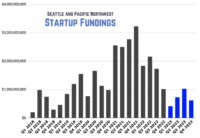
Funding to PNW startups fell nearly 60% year-over-year in 2023. Data from GeekWire’s funding list.
Tech startup investments continued to retreat in 2023 as venture capitalists tightened their belts and companies trimmed costs amid uncertainty about the broader economy.
Total funding to Pacific Northwest startups fell nearly 60% year-over-year in 2023, according to GeekWire’s funding list. And not a single unicorn was crowned this year — after nine reached the $1 billion valuation threshold in 2021.
But there were still a handful of startups across the region that raised sizable funding rounds to fuel growth in the months and years ahead.
Biotech, health tech, and aerospace companies reeled in some of the biggest chunks of cash. Enterprise software startups, a core strength of Seattle’s tech ecosystem, and also landed money.
Here’s a look at the top funding rounds of 2023.
Avalyn Pharma
The Seattle biotech firm, founded 2011, is developing inhalation therapies for rare pulmonary diseases. It raised a $175 million Series C round in September. Read more.
Pivotal Commware
The Bill Gates-backed company develops millimeter-wave 5G network infrastructure products. Gates Frontier and Tracker Capital led a $102 million Series D round in August. Read more.
Stoke Space
The Kent, Wash.-based company, founded by Blue Origin vets in 2019, is on a quest to create reusable rockets. Industrious Ventures led a $100 million Series B round in October. Read more.
Viome Life Sciences
The Seattle-area health tech startup, led by Naveen Jain, closed a $86.5 million Series C round in August co-led by Khosla Ventures and Bold Capital. It also announced a deal with CVS to sell its gut microbiome test in 200 CVS locations across the U.S. Read more.
Aspect Biosystems
The 10-year-old Vancouver, B.C.-based biotech company inked a partnership worth potentially more than $2.6 billion with Danish biopharma giant Novo Nordisk to develop “bioprinted” tissue therapeutics. The deal included $75 million in upfront payments, research funding and a convertible note investment. Read more.
Temporal
The Seattle startup, founded in 2019 by former Uber engineers, raised $75 million in February, pushing total funding past $200 million. Its software helps companies write and run cloud applications. Read more.
DexCare
The 7-year-old Seattle startup, which spun out of Providence, offers a healthcare patient demand and access platform. Iconiq Growth led a $75 million Series C round in June. Read more.
Inrix
The longtime Seattle-area transportation analytics provider raised $70 million in a credit facility from investment funds managed by Morgan Stanley Expansion Capital and Morgan Stanley Tactical Value in August. It previously raised a $55 million equity round in 2014 from the Porsche family. Read more.
Chainguard
The 2-year-old startup based in Kirkland, Wash., aims to help customers secure their “software supply chain,” a term used to describe a company’s software production line. Spark Capital led a $61 million Series B round last month. Read more.
Wrench
The 8-year-old Seattle startup offers a mobile car repair service. It raised $40 million in debt and $14.2 million equity in August. Read more.
AltPep
The University of Washington spinout is developing tests and treatments for Alzheimer’s and Parkinson’s disease. Senator Investment Group led a $52.9 million Series B funding round in June. Read more.
MotherDuck
The Seattle software startup, founded last year, bills itself as a “collaborative serverless analytics platform.” Felicis led a $52.5 million Series B round in September at a valuation north of $400 million. Read more.
Parse Biosciences
The Seattle biotech startup, another UW spinout, develops single cell sequencing products used by more than 1,000 labs worldwide. It raised $50 million as part of a Series C equity round led by Soleus Capital and a debt facility. Read more.
Procurify
The Vancouver, B.C.-based business spend software company raised a $50 million Series C round led by Ten Coves Capital in October. Read more.
EigenLayer
Founded in 2021, the crypto startup describes itself as a “restaking collective for Ethereum.” Blockchain Capital led a $50 million Series A round in March. Read more.
Carbon Robotics
The Seattle-based makers of a weed-zapping machine powered by artificial intelligence and computer vision technology raised $43 million as part of a Series C round. Total funding for the 5-year-old company is $80 million. Read more.
Proprio
The UW spinout raised a $43 million Series B round in July following FDA clearance for its surgical navigation platform that allows clinicians to see key structures on a screen in three dimensions in real time. Read more.
Pulumi
The Seattle startup helps developers build underlying cloud computing infrastructure using general purpose languages such as JavaScript and Python. Madrona Venture Group led a $41 million Series C round in October. Read more.
United Launch Alliance’s Atlas V rocket lifts off with two prototype Amazon satellites on Oct. 6. (ULA Photo)
If 2022 was packed with headline-grabbing aerospace developments — including the first pictures from the James Webb Telescope and the first launch of NASA’s giant moon rocket — 2023 was what you might call a rebuilding year.
This year began with high hopes for aerospace companies with a significant presence in the Seattle area, ranging from Boeing to Blue Origin to SpaceX. A lot of those hopes had to be put on hold, basically because everything in the space industry takes longer than expected. Nevertheless, there were plenty of developments worthy of note in the aerospace world, including a milestone for the tech industry: the first launch for Amazon’s Project Kuiper satellite program.
To mark the transition from 2023 to 2024, I’m serving up my top five aerospace stories from the past year, plus the top five developments to watch for in the year ahead. If all goes according to plan, 2024 could be one of the biggest years since I started writing “Year in Space” roundups in 1997. But if there’s one thing that the past 26 years have taught me, it’s that all doesn’t go according to plan.
Looking back at 2023
Amazon’s first satellites go into orbit: Two prototype satellites for Amazon’s Project Kuiper, which aims to provide broadband internet service for millions of people around the world, were sent into space by United Launch Alliance’s Atlas V rocket in October.
The laser-equipped KuiperSats aced their orbital tests, and mass production of the satellites has begun at Kuiper’s HQ in Redmond, Wash. An Amazon spokesperson told me that manufacturing will make the transition to a factory in nearby Kirkland, Wash., during the first quarter of 2024. That should set the stage for satellite launches and the start of service tests by the end of next year.
The big question: Can Amazon’s Project Kuiper catch up with SpaceX’s Starlink network, which also relies on satellites built at a manufacturing complex in Redmond? And speaking of SpaceX…
SpaceX tries, tries again with Starship: The company founded by controversial tech leader Elon Musk conducted two test launches of its Starship / Super Heavy launch system in South Texas during 2023. Both tests fell short of complete success, but they marked significant progress toward proving out Starship as a juggernaut capable of putting scores of next-generation Starlink satellites in orbit at a time.
Once Starship is ready for prime time, that’ll smooth the way for SpaceX to provide satellite-to-mobile phone service via Starlink in partnership with T-Mobile. Starship’s successes will also reassure NASA that SpaceX’s lunar lander program is on track.
Airplanes get a lift from hydrogen: ZeroAvia and Universal Hydrogen both demonstrated hydrogen-powered propulsion systems for aircraft during 2023. Both aerospace companies have Washington state connections: ZeroAvia has a research and development facility in Everett, and is partnering with Seattle-based Alaska Airlines. Meanwhile, Everett-based MagniX is working with Universal Hydrogen on an electric propulsion system that was put to the test during March’s demonstration flight at Moses Lake, Wash.
NASA and the military get serious about UFOs: When a Chinese spy balloon flew over the U.S. in January, that set off alarm bells across the country, including in the halls of Congress and the Pentagon. The potential security threat from such intrusions led policymakers to pay more attention to reports of unidentified flying objects — now known as unidentified aerial phenomena or UAP. The Department of Defense set up a web portal for UAP reports, while an independent panel created by NASA issued its own set of recommendations for dealing with such reports.
NASA brings back an asteroid haul: After a years-long space odyssey, NASA’s OSIRIS-REx probe dropped off a capsule containing precious bits of material that were blasted away from a near-Earth asteroid. The sample is expected to provide fresh insights into the origins of the solar system, plus hints as to what resources could be gleaned from space rocks. One little problem: The mission team hasn’t yet managed to get the capsule completely open. Fortunately, scientists are able to study surplus material that was found outside the capsule.
Also notable: Stoke Space put a test rocket through a successful hop in Moses Lake, Wash., in September. … Tukwila, Wash.-based Starfish Space had its Otter Pup orbital tug launched in June to demonstrate a satellite rendezvous, but an in-space anomaly forced a change of plan. … Virgin Galactic resumed suborbital space trips, India put a robotic lander on the moon, and Firefly Aerospace acquired Bellevue, Wash.-based Spaceflight Inc.
Looking ahead to 2024
In addition to Amazon’s continued progress on Project Kuiper and SpaceX’s continued progress on Starship, here are five other aerospace developments worth watching for:
Will this be Blue Origin’s big year? Because of a launch anomaly in 2022, Blue Origin was grounded for nearly all of 2023. But Jeff Bezos’ space venture returned to flight last week with an uncrewed suborbital launch of its New Shepard rocket ship, and crewed flights seem likely to resume early next year. Bezos’ fiancée, Lauren Sanchez, says she’ll lead one of those flights, Also next year, launches of Blue Origin’s orbital-class New Glenn rocket are scheduled to begin, with a pair of Mars probes among the first payloads. Can Blue Origin stick to its schedule? That’s one of the top missions for the company’s new CEO, former Amazon executive Dave Limp.
Will there be a boom in supersonic flight? Faster-than-sound air travel seems to be making a comeback: During 2024, NASA is scheduled to test a super-quiet supersonic aircraft known as the X-59. Meanwhile, Boom Supersonic is conducting ground tests of its XB-1 demonstrator jet in Mojave, Calif. “We expect to fly XB-1 as soon as additional ground tests are safely and successfully completed,” Boom told GeekWire in an email. On a different front, Stratolaunch — the aerospace company founded by the late Seattle software billionaire and philanthropist Paul Allen — is preparing for the first flight of its Talon-A hypersonic test vehicle.
How many moon missions will get off the ground? Commercial robotic missions to the lunar surface is due to begin in January with the launch of Astrobotic’s Peregrine lander on United Launch Alliance’s first Vulcan rocket. (That mission will also mark the first use of Blue Origin’s BE-4 rocket engines on Vulcan.) NASA’s VIPER rover is due to reach the moon’s south polar region in late 2024 — and that’s also the time frame for NASA’s Artemis 2 mission, which involves sending four astronauts around the moon and back. Stay tuned to see whether the missions earmarked for “late 2024” are actually ready to go by the end of next year.
When will Boeing’s Starliner carry its first crew? The Starliner space taxi program got off the ground four years ago with an uncrewed test flight that fell short of its objectives, and it turned into a billion-dollar headache for Boeing. The current schedule calls for a crew of astronauts to give the fixed-up Starliner a test drive to the International Space Station in the April time frame — but that schedule could change, as it has several times before.
Will the solar eclipse live up to the hype? Six and a half years after the “Great American Eclipse” of 2017, another total solar eclipse will sweep across the U.S. on April 8. Fair warning: The weather outlook in early spring may not be quite as sunny as it was during the summer of 2017. Folks in the Pacific Northwest will have to go to the Southwest, Midwest or Northeast to experience full daytime darkness, but the partial phase will be visible from almost anywhere in North America. (Sorry, Alaska!) Just to be safe, grab some eclipse glasses before they’re gone.
Also notable: Axiom Space’s third commercial mission to the International Space Station is set for launch no earlier than Jan. 17. … Redmond, Wash.-based Xplore could have its first Xcraft multi-sensor satellite sent to Earth orbit as soon as March. … Polaris Dawn, a free-flying spacewalk mission funded by billionaire Jared Isaacman, is due for liftoff no earlier than April. … And NASA’s Europa Clipper is scheduled to begin its trip to a mysterious ice-covered moon of Jupiter this fall.
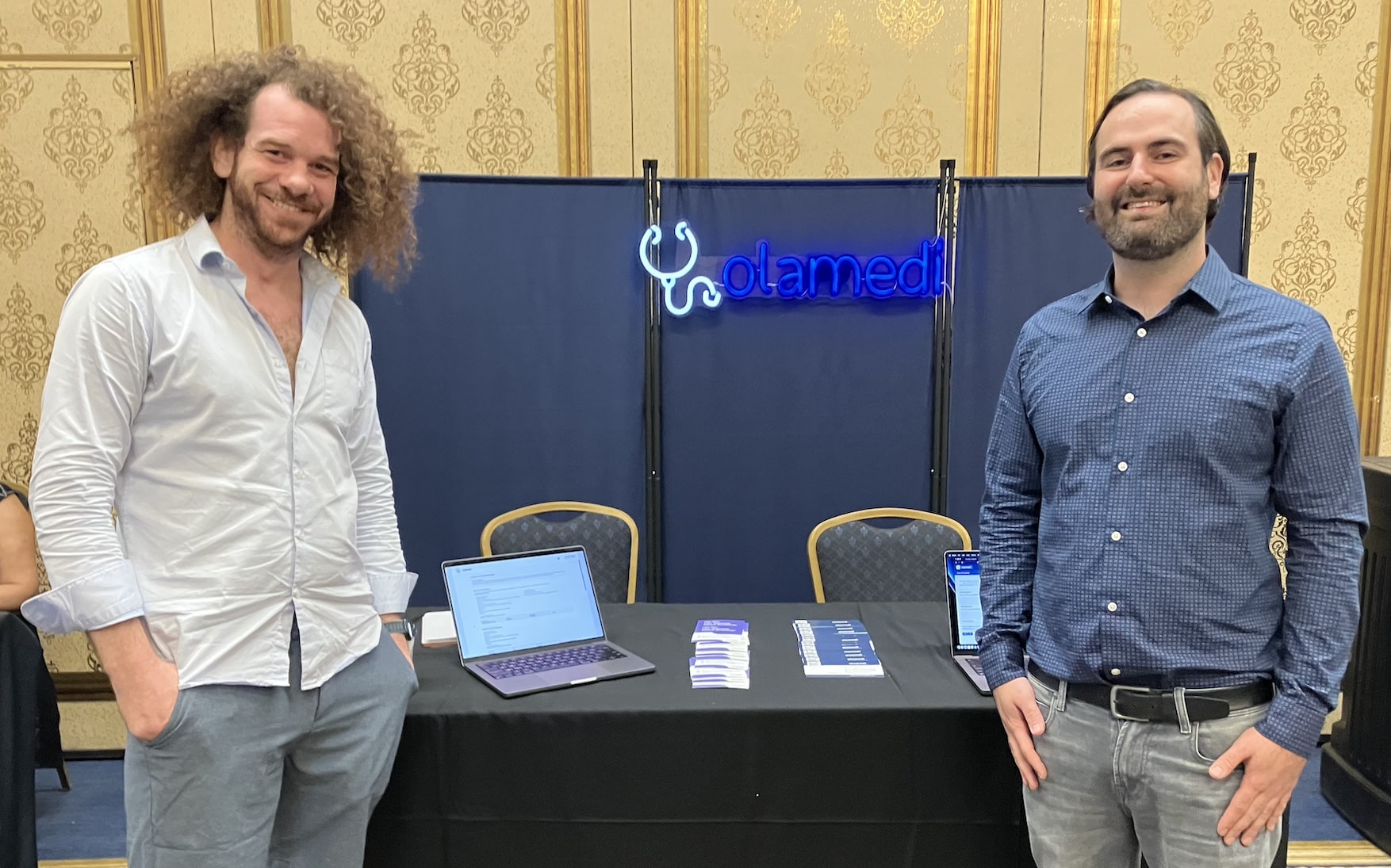
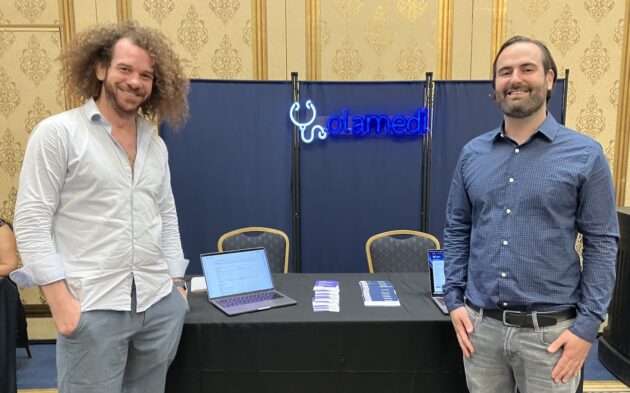
Olamedi co-founders Daniel Sarfati, left, and Noah Loudon. (Photo courtesy of Olamedi)
A new Seattle startup led by co-founders with experience in health tech is aiming to automate communication processes for healthcare clinics with its software platform.
Olamedi is a year-old company co-founded by CEO Daniel Sarfati and COO Noah Loudon.
Sarfati spent two years at Amazon and two at home-selling platform Knock as a software developer. He was most recently the co-founder and CTO at Mexico City-based health tech platform HelloDoctor, which has since shut down.
Loudon is a University of Washington graduate who previously spent 10 years at swag maker Kotis Design. He was most recently VP of sales at HelloDoctor.
Olamedi helps automate patient communication and track long-term outcomes from a single platform. The software enables clinics to use a unified interface without making changes to existing software or record management systems, and it replaces front-desk conversations with smart questionnaires and modular workflows.
The startup just raised $80,000 via a SAFE financing round led by angel investors including Jamie McAvity, CEO of Cormint Data Systems and a prior investor in Knock. Sarfati and Loudon have put $400,000 of their own capital into the company.
The founders say they are currently working with partners to develop and test their platform and intend to launch in Q4 of 2024.
Zillow Group and ShowingTime have announced a new lawsuit against the Arizona Regional Multiple Listing Service (ARMLS) and Wisconsin’s Metro Multiple Listing Service (Metro MLS) over what the tech giant claims is an unfair and anticompetitive practice that freezes out ShowingTime in favor of a proprietary, MLS-developed tour appointment tool.
Who is involved? The suit, filed on Dec. 22, names ARMLS, Metro MLS and MLS Aligned as defendants. The Arizona and Wisconsin MLSs, along with five other MLSs, are part of the MLS Aligned network that serves tens of thousands of agents across the country.
The other member MLSs in the MLS Aligned network — RMLS in Oregon, Northern Nevada Regional MLS, UtahRealEstate.com, MLSListings in Northern California and BeachesMLS in Florida — were not listed as defendants in Zillow’s complaint.
In both Zillow Group’s formal legal complaint and a blog post from Chief Industry Development Officer Errol Samuelson, the company singles out ARMLS and Metro MLS for their plans to remove ShowingTime integration and only provide agents the use of a competing product developed by MLS Aligned.
What does the suit allege? One of the functions of MLS Aligned is to develop products for agents in partner MLSs. The suit targets one of the network’s specific products, Aligned Showings, which was initially offered alongside ShowingTime.
Zillow Group alleges that “rather than competing on the merits,” MLS Aligned and its members conspired to remove the ShowingTime integration and “create a monopoly in their regions for their own showing management platform.” The complaint, which describes how Zillow offered ShowingTime access for free, refers to the removal as “anticompetitive and exclusionary.”
Zillow’s complaint also noted that ARMLS removed the ShowingTime integration in its member portal on Dec. 27 while Metro MLS would do so in February.
What did Zillow say? In his blog post, Samuelson provides additional context to the action and said the company had tried to work with the two MLSs on a solution before filing suit.
Zillow Group “made numerous attempts to convince these two MLSs to keep the seamless ShowingTime integration active as an additional option for their agent members, as other MLSs in the consortium have done,” said Samuelson, but ARMLS and Metro MLS “declined all offered alternatives and resolutions, leaving their agent members with no choice.”
Samuelson describes MLSs as “rulemaking bodies and local monopolies” which have a particularly important duty to avoid conflicts of interest. He said that Zillow is taking this action to protect individual agents’ choice to decide which products and digital tools they use for their business.
The New York Times building in Manhattan. The newspaper accused OpenAI and Microsoft of “unlawful copying and use of The Times’s uniquely valuable works.” (GeekWire File Photo / Kurt Schlosser)
The New York Times filed a lawsuit Wednesday against OpenAI and Microsoft, accusing the companies of copyright infringement for training artificial intelligence models on millions of articles published by the newspaper.
The suit, filed in Federal District Court in Manhattan, accuses OpenAI and Microsoft of “using The Times’s content without payment to create products that substitute for The Times and steal audiences away from it.”
“Defendants seek to free-ride on The Times’s massive investment in its journalism,” the complaint says, as reported by The Times.
OpenAI, makers of ChatGPT, and Microsoft have yet to respond to the legal action. GeekWire reached out to Microsoft for comment and we’ll update this story when we hear back.
Microsoft has invested billions in OpenAI, and incorporates its technology into various products including Bing and Windows.
The Times reported that while the suit does not include an exact monetary demand, it says the defendants should be held responsible for “billions of dollars in statutory and actual damages” related to the “unlawful copying and use of The Times’s uniquely valuable works.”
The suit calls for the companies to destroy any large language chatbot models and training data that use copyrighted material from The Times.
Among various examples, the lawsuit alleges that Microsoft’s “Browse with Bing” feature reproduces content from the Times’s product recommendation site Wirecutter “through substantial verbatim copying” and “substantial direct copying.” It also accuses OpenAI’s GPT-4 of falsely attributing recommendations to Wirecutter.
“Wirecutter does not receive affiliate referral revenue if a user purchases the Wirecutter-recommended product through a link on Defendants’ platforms,” the lawsuit states. “As with The Times’s other products, decreases in traffic to Wirecutter also impact its advertising and subscription revenue.”
Entrepreneur and investor Jason Calacanis called the suit “Open AI’s Napster moment” in a post on X, adding, “You must get permission to create a new, commercial product based on someone else’s IP — just like Spotify did, and Napster didn’t.” And Kieran Snyder, co-founder and CEO of Seattle augmented writing startup Textio, called the suit “the future of IP rights” in a post on LinkedIn.
Sam Altman greets Microsoft CEO Satya Nadella at OpenAI DevDay in San Francisco on Nov. 6. (GeekWire Photo / Todd Bishop)
The New York Times is among an increasing number of news outlets that have blocked OpenAI’s web crawler. The BBC, CNN and Reuters made similar moves, The Verge reported in October.
Comedian and author Sarah Silverman has also joined a class-action lawsuit against OpenAI and Meta for copyright infringement.
Creators of all types, from writers to musicians to artists and photographers, are grappling with how generative AI technology could impact their fields and the protection of their works.
Meanwhile, some outlets have struck deals with OpenAI to allow for the use of their materials. Global news publisher Axel Springer struck a deal to allow the use of content from Business Insider, Politico and other outlets earlier this month. OpenAI previously reached a deal to license stories from the archive of The Associated Press.
OpenAI started as a nonprofit but later created a for-profit subsidiary buoyed by the release of ChatGPT last year and the partnership with Microsoft. Microsoft invested an initial $1 billion in OpenAI in 2019, and added at least $10 billion more in January.
The relationship weathered a bizarre turn of events in November, when OpenAI CEO Sam Altman was ousted and then reinstated as the company’s leader.
“We look forward to building on our strong partnership and delivering the value of this next generation of AI to our customers and partners,” Microsoft CEO Satya Nadella said at the time.
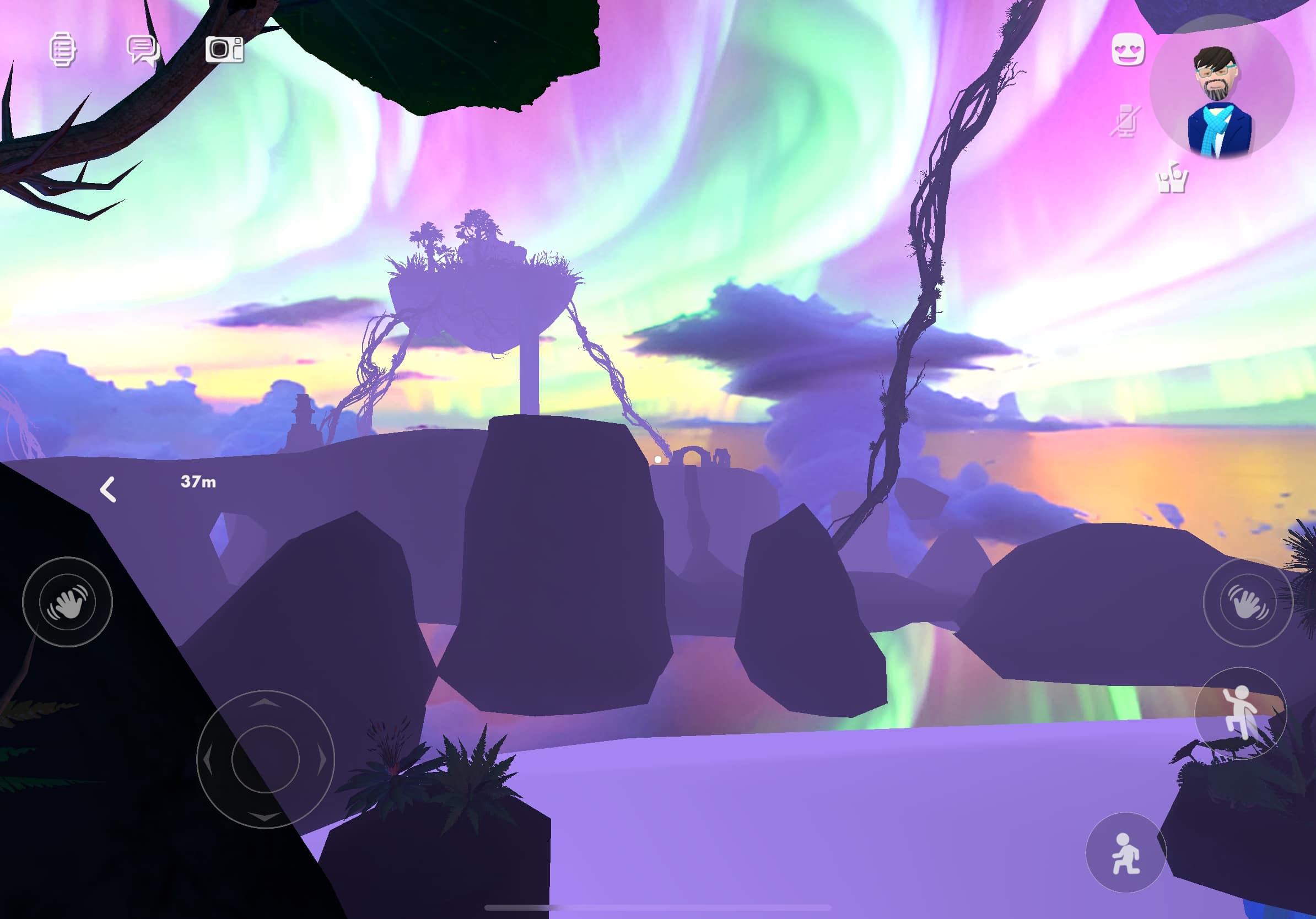
The view from inside Fractura, an alien world in Rec Room that was made from scratch using various AI tools. (Rec Room screenshot)
Video game companies are dipping their toes into the rapidly-evolving world of generative AI with behind-the-scenes development. It may soon be applied to actual gameplay.
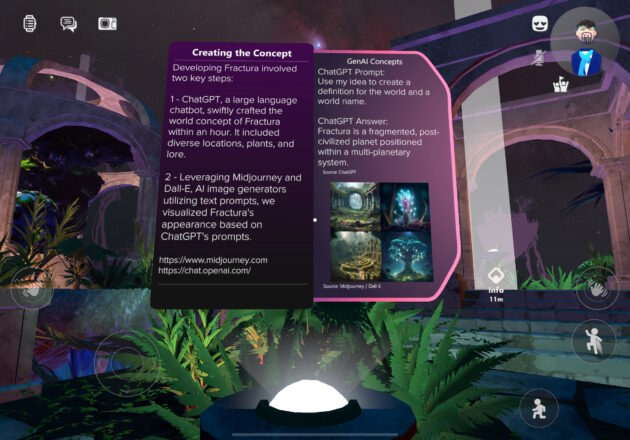
A recent example came earlier this month from the Seattle-based creators of the popular social app Rec Room, which debuted Fractura, an in-game room created as a “research project” to demonstrate how players can use generative AI to create their own content for Rec Room.
The Seattle startup evaluated more than 20 different tools in the process of designing Fractura, such as ChatGPT to develop and iterate on their ideas, including the creation of a “bible” for Fractura’s backstory. It visualized ideas via Midjourney and DALL-E, and turned the resulting images into 3D assets with CSM and Shap-E. Finally, Fractura’s alien skies were built out with Skybox, an AI tool from Blockade Labs.
“Despite some challenges,” Rec Room wrote in a blog post, “the future for 3D GenAI looks bright, and the team looks forward to further explorations!”
Like anywhere else in tech, the debate over AI has been one of the running themes of 2023 in the games industry. Much of that debate, however, has been crowded out of the limelight by other concerns, such as a year-long wave of layoffs that has cost roughly 10,000 developers their jobs since January.
When work in the field is already unstable, no developer that I’ve spoken to has been enthusiastic about the advent of technology that could be (read: inevitably will be) used to automate and eliminate somebody’s position.
However, generative AI is already helping some studios behind the scenes.
(RoboSquad Image)
By giving ChatGPT access to the code base for its free-to-play arena shooter RoboSquad, New York-based Zorans Resistance has turned it into a useful assistant for playtesting, training, code analysis, and integrating new programs.
Zorans also trained AI to go through its recorded gameplay footage and pick out particular clips based upon recognizable keywords, such as “bug” or “Steam Play.” The AI can then organize a list and assign the potential issue to the most relevant members of the team.
“It’s definitely helped with our productivity in general, so we don’t have to watch and rewatch our gameplay videos,” said Joey Thigpen, co-lead developer.
There is an important distinction to be made between using generative AI to accelerate development processes, and using the technology to make a game with content generated by AI, said David Ryan Hunt, CEO of Noodle Cat Games in Salt Lake City.
“We’ve put a lot of attention on, ‘Oh, I made a cool picture by typing a few words!’” said Hunt. “But the reality of game development is that the majority of the work that goes into making a product is unseen.”
As Hunt notes, AI art and prose are what get all the attention in this conversation, and they also carry legal and ethical challenges.
Plagiarism stew
Generative AI tools are trained on data, much of which is scraped from publicly available online sources, which can include identifiable snippets from copyrighted work. Despite how it looks, and how it’s sold, publicly available AI isn’t creating anything; it’s grabbing everything it can find and boiling it for soup.
Professional artists such as Greg Rutkowski have discovered their online portfolios have been “harvested” by AI tools, which has flooded the internet with artwork that vaguely resembles their own styles. Some have gone so far as to fight back with tools like Nightshade, which “poisons” online artwork in ways that disrupt AI models using it as training data.
Several companies have preemptively banned AI tools for use in related projects. Valve Software made a few headlines in June when it rejected a game that was submitted for publication via its online storefront Steam, on the basis that it had been made using AI.
The game developer took to Reddit to complain on the subject, which spurred a public statement from Valve in response. According to Valve, it wasn’t the AI tools themselves, but rather, the significant risk that material produced with those tools has likely violated someone’s copyright.
“The introduction of AI can sometimes make it harder to show a developer has sufficient rights in using AI to create assets, including images, text, and music,” a Valve representative told GeekWire in July.
Valve continued: “In particular, there is some legal uncertainty relating to data used to train AI models. It is the developer’s responsibility to make sure they have the appropriate rights to ship their game. …While developers can use these AI technologies in their work with appropriate commercial licenses, they can not infringe on existing copyrights.”
Bellevue, Wash.-based Valve has consistently taken a zero-tolerance stance on any new technologies that could cause legal issues. It previously banned “play-to-earn” games on Steam in 2021, in which users could generate small amounts of cryptocurrency or collect special NFT drops by playing games.
Meanwhile, one of Steam’s competitors, the Epic Games Store, has stepped in as a storefront that will take Web3 projects, and as of September, may also be open to hosting AI-developed games.
AI content generation
An image from the pre-alpha version of Adventure Forge‘s built-in game setting, Tales of Fortunata. (Endless Adventures Image)
It’s worth restating: the problem with generative AI in video games, at least for the time being, isn’t inherent to the tools. It’s typically with the data that’s been used to train those tools, and how the tools regurgitate that data. An AI that’s simply trained using whatever data it can find can pose some serious risks, up to and including the possibility of having illegal material in its dataset.
If best practices are pursued, though, generative AI has a number of potential applications in game design, particularly in the field of content created by users.
Microsoft made headlines earlier this fall through its partnership with Inworld.AI, which promises to bring unspecified “AI-powered” upgrades to future Xbox games. In theory, AI could remove certain current limitations in game narrative, such as removing the need for generic NPC dialogue. Instead of having a few scripted lines and coded behaviors, AI-driven characters could react realistically to whatever happens to or around them.
For a more specific example, there’s Adventure Forge, scheduled for release on Steam Early Access in early 2024. It’s a no-code toolset by Seattle-area company Endless Adventures, which players can use to create their own original games, ranging from dungeon crawlers to visual novels.
This includes a built-in Stable Diffusion system by Scenario.GG that has only been trained on art assets that were created for the project by Endless Adventures. Everything that could be created for Adventure Forge with its built-in generative AI, such as new maps or in-game props, would thus fall under Endless Adventures’ copyright.
Adventure Forge will ship with over 1,500 environmental assets for players to use in their games, such as floors, walls, and furniture. In previous generations of homebrew software, those assets would be all users had to work with for the duration. With Scenario.GG’s system, though, players can simply create new Adventure Forge assets on the spot.
“This is not technology for technology’s sake,” Endless Adventures CEO Jordan Weisman told GeekWire. “This is from people whose whole lives have been about storytelling, and we want to empower storytelling, but we want to do it in a responsible way.”
Reality check
In Rec Room, visitors to Fractura can take an in-app tour that details the process by which Rec Room designed the experience, including a list of tools. (Rec Room screenshot)
The advancements from generative AI for game studios, for now, may not be massive.
“A lot of the capabilities that we have now are not very far removed from procedural generation and various types of algorithms that we’ve been using in games for decades,” said Hunt.
You’ve likely played a video game that uses procedural generation. These are created with a number of handcrafted assets, which are assembled algorithmically into a randomized order. The most famous example may be the dungeons in Blizzard’s action-RPG series Diablo, which are different every time you play the game.
The distinction between procedural generation and generative AI may seem academic from a player’s perspective, but under the hood, they’re doing two very different things. If you picture game design as a set of building blocks, then procedural generation rearranges building blocks according to a pre-programmed algorithm. Generative AI tries to create new blocks there on the spot, based on the data it’s accumulated on how blocks are supposed to work.
“We automate all sorts of different pieces of development,” said Hunt, who previously worked on Fortnite at Epic Games. “It’s not specific to AI. It’s just how the industry works.”
Current generative AI, from Hunt’s perspective, is a more advanced version of automated technologies that have already been in use in game development. Under the hood, many of the use cases for AI in game development are a simple step up from understood best practices, he said.
“There’s a big gap to me,” Hunt said, “between the discourse around AI and the practical reality of what it’s likely to look like over time.”
Over the course of the last year, bad actors have used various AI/LLM tools to create everything from quick cash-grabs, such as churning out nonsensical children’s books or flooding a sci-fi magazine with submissions, to scams that involve cloning someone’s voice in order to extort money out of their relatives.
In the games industry, there are already stories of people using the same tools to turn out simple games in a week or less. The concern is that we’re on the verge of a dark age of auto-generated machine garbage, in a business where many open storefronts already have real issues with “troll games.”
It’s likely that as its usage increases, many of the problems with AI will get worse before they get better. In the meantime, that only makes it more important to find ways to filter the signal from the noise.