“Nobody cares about your AI…customers don’t care about your AI. They care about the problem that you’re solving and that you’re doing it 10 times better or 10 times more efficiently…An AI just enables a new set of challenges and tasks to be tackled organically in a way that maybe wasn’t before.”
That’s one of the insights from Kirby Winfield, founding general partner at Ascend.vc, on this episode of Shift AI, a show that explores what it takes to thrive and adapt to the changing workplace in the digital age of remote work and AI.
We discuss Winfield’s experience as a serial entrepreneur and his transition to a Seattle venture capitalist investing in some of the most innovative new AI companies in the Pacific Northwest.
Listen below, and continue reading for highlights from his comments, edited for context and clarity. Subscribe to Shift AI and hear more episodes at ShiftAIPodcast.com.
The early years and first job: My first job was hocking strawberry shortcakes at summer festivals. It was my first sales job and you can’t have a whole lot of shame if you’re selling shortcakes. I quickly realized I wasn’t comfortable with outbound sales, but the initial thing that helped me was thinking about the value that I was providing to people. It’s a lot easier to sell shortcake at a summer festival than it is to sell software as a service to a midsize enterprise. It’s all about time to value and the time to value for shortcake is very short.
Investing thesis on AI at Ascend: We like to say we’re the most prolific pre-seed investor in the Pacific Northwest. We invest in software and B2B and a vast majority touches in some way on artificial intelligence, machine learning, data, or vertical software. I think applied AI is basically vertical software 3.0. It’s software as a service (SaaS)…it’s just a better technology to do SaaS.
Framework for evaluating AI opportunities: I think our framework really forces you to ask a couple basic questions about artificial intelligence as an investor. Is it an applied AI opportunity or is it a structural AI opportunity? If it’s applying a new technique, or novel technology approach to an existing workflow or problem, then you have to think really hard about how it differentiates and how it maintains an advantage over time. The question just becomes how can you differentiate and solve the problem better than others, what data advantage do you have, what feedback loop and fine tuning advantage do you have and what brand and user experience advantage do you have?
Portfolio companies: Overland AI is trying to tackle the autonomous software stack for off-road vehicles. Specifically, the go-to-market is in defense and robotic control vehicles. We’ve had drones in the air for a long time, but you haven’t had autonomous movers of material supporting troops on the ground. We are excited about that opportunity and we are seeing a lot of traction.
Clarity, another one of our portfolio companies, is a team of incredible software engineers and cyber warriors out of the 8200 Division of the IDF who are creating cutting-edge technology to identify and prevent the proliferation of deepfakes. It’s hard to imagine a world where deepfakes are not an immense problem and so it’s exciting to be a small part of trying to solve it, or at least prevent harm.
Incumbent tech companies and AI: If you think about what’s happening at the enterprise today, companies are changing the way they’re behaving and new companies are being built with entirely different fabric and structure with regards to how code is written, how goals are managed and how communications happen internally. Anyone who is active in investing in artificial intelligence would tell you that an enterprise operating today is going to look entirely different 20 years from now. It will be unrecognizable. And so the question is how can you create a solution today that’s impactful enough, and durable enough to grow with those enterprises as they become this next generation of technology company.
Seattle’s potential as a tech hub: I think the opportunity has never been brighter. Seattle has more AI software engineers than anyone else in the U.S. outside of the Bay Area and our talent pool is extremely deep. We have centers for excellence, like the Allen Institute forArtificial Intelligence (AI2) and we have a top research university in the University of Washington. This point in time is an inflection point for Seattle as a startup ecosystem. We now have the ingredients we had lacked for decades that kept our big outcomes sort of sporadic.
Mentors and influences: My father-in-law was my first big influence. He grew up in Kansas, his parents owned a grocery store, he worked there since he was a kid and he went on to start a title insurance company that’s now the largest privately held title company west of the Mississippi. He was the one to teach me that you have to ask the question that no one else is asking.
John Keister is probably the most powerful mentor I’ve ever had. During the time I worked for him at Go2Net he tirelessly redlined my work, walked me through it, let me go rebuild it, redlined it again, and walked me through it again. He took me into meetings I had no right to be in, gave me responsibility that I probably hadn’t earned and cared for me as a friend, first and foremost.
Future of work and AI: I think that we have infinite potential for freeing ourselves from a lot of the shackles of the work that we are doing today. Things are going to get incredibly more efficient and as a society we will be able to do higher order work that will yield things that we can’t understand because they don’t exist yet. We’re living in the future right now…we just don’t see it because the future happens slowly, but in retrospect, very, very quickly. I think it’s an incredible time to be alive and investing in this technology.
Listen to the full episode of Shift AI with Kirby Winfield here.
In the new 2024 Player’s Handbook, all of the core character classes in Dungeons & Dragons will get full-color illustrations like this one, which depicts a fighter. (Nestor Ossandón for Wizards of the Coast)
In response to social media criticism, Wizards of the Coast has released a statement that further clarifies its stance on the use of generative AI in material for the Dungeons & Dragons tabletop game.
The statement, made via a post on the digital storefront D&D Beyond, indicates that all creative contributors to D&D will be required “to refrain from using AI generative tools to create final D&D products.”
This comes four months after an incident in August where an artist admitted he’d used AI tools to “polish” several illustrations that he’d contributed to a new D&D sourcebook. In response, Wizards pledged to amend its artistic guidelines to prohibit creators from using generative AI.
Today’s updated statement appears to come as a response to an online discussion. On Dec. 1, a piece of artwork appeared on the official Dungeons & Dragons X (formerly Twitter) account to tease the upcoming 2024 rules update for D&D, which will include brand-new editions of the game’s 3 core rulebooks.
The artwork in question, by Chilean illustrator Nestor Ossandón, depicts a dwarf warrior. It’s one of many new illustrations that are planned to run in the updated D&D Player’s Handbook, and made its public debut earlier this month at a panel at the Penny Arcade Expo Unplugged in Philadelphia.
In response to the teaser, many fans wondered if it had been created using AI tools, citing issues such as the seeming absence of the dwarf’s left arm. Wizards first responded on Dec. 18 via the official D&D Beyond X account, saying that it had checked with the original artist to ensure that no generative AI had been used.
Wizards further clarified its stance on Tuesday by announcing its blanket prohibition.
“We work with some of the most talented artists and creatives in the world,” according to the blog post, “and we believe those people are what makes D&D great.”
The response comes a week after reports that multiple workers at Renton, Wash.-based Wizards of the Coast had been impacted by a round of layoffs instituted by parent company Hasbro, including several senior employees who worked on both Dungeons & Dragons and Magic: The Gathering.
Call choices on the HiSanta.ai website include, from left, Santa, Rudolph, Bad Santa and The Grouch. (Screen grabs via HiSanta.ai)
If artificial intelligence is indeed coming for people’s jobs, this week would be a good time to start, to help out the busiest guy on the planet.
Fixie, a Seattle-based startup that helps companies fuse large language models into their software stack, has created HiSanta.ai, a web experience that allows people to have real-time AI voice calls with Santa Claus, Rudolph, Mrs. Claus and other characters.
‘We’ve given it explicit instructions not to answer any questions about the reality of Santa. This is a very important thing.’
— Fixie co-founder Matt Welsh
Visitors to the site simply choose a character they want to speak with, click the call button and then have a conversation about holiday wish lists and just about anything else. Santa, for instance, is quick to reply and he talks back with what sounds like a British accent.
“We thought it would be fun,” said Matt Welsh, Fixie’s chief architect and one of the startup’s co-founders. “It was one of these things that we built out mainly as a technology demonstration.”
The core technology being demonstrated is Fixie’s platform that helps companies integrate large language model tech into their own products. With a recent focus on real-time voice interaction, Welsh said Fixie has worked hard to get multiple models — speech-to-text, a language model like OpenAI’s ChatGPT-3, and text-to-speech — working seamlessly together.
“When you try to build something like that, there’s a lot of engineering work that has to be done to make it really fast,” Welsh said. “So we had put a ton of effort into making it real time and interactive, and we think the performance is pretty good.”
Speed matters when a little kid is waiting for Santa to react to whatever Christmas present that kid just asked for. Fixie didn’t want any lag in response time, or kids would lose interest. The answers are also pretty clever, and Santa and the other characters are rather engaging.
I asked Santa for a new truck for Christmas and he kindly balked at the luxurious nature of such a request. When he followed up asking what else might be on my list, I asked for world peace, and Santa was delighted to let me know how he appreciated that wish.
Watch how it works in this video from Fixie:
Users can choose between nice characters — Santa, Mrs. Claus, Rudolph, Elfie, or your own creation — and naughty ones — Bad Santa, The Grouch, Karen Claus, and Bad Elfie.
During my conversation with a snippy Bad Santa, I asked him to be a little nicer.
“You must have me confused with that other jolly old elf,” Bad Santa said. “I’m the one who tells it like it is. You want nice? Go write a letter to the Easter Bunny.”
HiSanta launched last week and Welsh said they’ve had more than 10,000 conversations happen so far, with about 20 hours of conversation a day, in aggregate across all users.
Most people talk for a minute or two, but some have tried to keep Santa rambling and Welsh has seen conversations stretch past 30 minutes.
The tool’s builders have also put AI Santa through the paces, trying hard to break it and make it admit or say things that wouldn’t be well suited for Christmas believers.
“My kids stress-tested this quite extensively to try to get these models just to go off the rails, and we couldn’t get it to happen,” Welsh said. “We’ve given it explicit instructions not to answer any questions about the reality of Santa. This is a very important thing. We didn’t want the model saying anything about that.”
Fixie co-founders, from left: Hessam Bagherinezhad, Matt Welsh, Justin Uberti, Zach Koch. (Fixie Photo)
Ditching the handwritten letter to the North Pole and using the phone to call a Santa line or the web to keep track of his movements is not new. The North American Aerospace Defense Command has tracked Santa’s sleigh on Christmas Eve for more than 60 years. But chatbots, such as ChatGPT’s Santa communicator, and AI are rapidly changing the conversation game.
Welsh said Fixie views HiSanta as a showpiece for what you can do with his company’s tech. A lot has already changed in the quickly moving field of AI since Fixie emerged in the spring, and Welsh said that while excitement in the technology has not waned, people are now becoming aware of the range of technical problems you have to solve to use the tech in any application setting.
“We’ve been focused on not just enabling people to put together the quick and dirty demos, but to get them to production where they’re feeling really good about the results,” he said. “And that’s proven harder than we expected it to be.”
Fixie’s other co-founders include CTO Justin Uberti, a longtime engineering leader who spent more than 14 years at Google; CEO Zach Koch who was most recently director of product management at Shopify; and Chief AI Officer Hessam Bagherinezhad also worked at Xnor.ai, as head of machine learning.
The company raised a $17 million seed round in March.
Kaspien CEO Brock Kowalchuk. (Kaspien/LinkedIn Photo)
Kaspien Holdings, a publicly traded company that helps online brands boost sales on Amazon and other e-commerce platforms, is closing up shop.
The Spokane, Wash-based company said in a filing this week that it has initiated a plan to wind down operations and complete a shutdown by May 1 of next year, following an assessment of its cash and liquidity position and near-term debt maturities.
Earlier this month the company said it planned to lay off its workforce with the exception of a “core group of employees” by the end of January. Kaspien has less than 100 employees, according to LinkedIn.
Kaspien’s third quarter earnings report shows revenue of $26.4 million for the 13-week period ending Oct. 28, down 9.3% year-over-year, and a net loss of $1.8 million.
The company reported a net loss of $5.1 million for the 39-week period ending Oct. 28. It previously reported negative cash flows from operations in fiscal 2022 and 2021.
As of Oct. 28 the company had $400,000 in cash and cash equivalents.
A number of other agencies that work with Amazon sellers have also faced recent struggles, including Benitago and Thrasio.
Kaspien is led by CEO Brock Kowalchuk, who joined the company in 2018 after a 7-year stint with Goldman Sachs. He was previously CFO and became interim CEO in March 2022.
The company traces its roots to a largely bootstrapped Spokane startup called Etailz that was acquired by Trans World Entertainment in 2016 for $75 million in cash and stock.
Etailz rebranded to Kaspien in 2020, and Trans World also changed its name to Kaspien Holdings at the time. Trans World originally launched in 1972.
Kunal Chopra, who led the company as CEO from 2019 to 2022, said on LinkedIn that he was “sad” to see Kaspien going out of business.
“Companies that do not innovate are bound to fail,” he wrote in the post. “In a fast-paced, competitive world, getting outcompeted is just a matter of time.”
Hannah Sandmeyer, director of sales and business development, commented on Chopra’s post, saying that the company “simply ran out of runway” and “now so many have lost their jobs right before the holidays and are scared.”
“The business is a tough one, so many dark corners, margins so thin, and with such a big sail, it was hard one to pivot fast enough,” Sandmeyer wrote.
Kaspien’s stock surged at the beginning of 2021, reaching a peak of $46 per share. But it has gone downhill from there, trading at around $0.05/share on Tuesday. The company said it expects the delisting of its common stock from the OTCQB to be effective on or around Jan. 8.
Kaspien’s board of directors include W. Michael Reickert, managing member of Independent Family Office LLC; Jonathan Marcus, CEO of Alimco Re Ltd; Tom Simpson, an angel investor who helped start Etailz with Josh and Sarah Neblett in 2008; and Mark Holliday, president of Goshawk Capital Corp.
We reached out to the company for comment and we’ll update this story if we hear back.
Google Play Store users in Washington state are eligible for a share of a multistate $700 million antitrust lawsuit settlement reached against the tech giant.
Filed in July 2021 by Washington Attorney General Bob Ferguson, the lawsuit accused Google of using anticompetitive practices to insulate its app distribution service, Google Play Store, from competition. The practice forced Android app developers to raise app prices for users in order to pay Google’s exorbitant fees, according to the suit.
Eligible consumers in Washington will receive at least $2, with additional payments depending on how much they spent in the Play Store between August 2016 and September 2023.
An estimated 2.9 million Washingtonians have Android phones, though only those who paid for apps through the Play Store, or paid for in-app purchases, are eligible, the AG’s office said.
“This resolution stops Google from rigging the system and creates a more level playing field,” Ferguson said in a statement.
The lawsuit asserted that Google’s anticompetitive tactics included, among others, blocking non-Google Play Store apps from advertising on Google’s search platforms. Ferguson argued that those practices have helped Google dominate the Android app distribution market, with well over 90% of all Android apps downloaded from Google Play Store.
In addition to paying $700 million, Google is also required to make changes to how it operates Play Store. The Verge reported that, “If you add it all up, it does make for a slightly different Google app store landscape than we’ve experienced over the past decade and change.” But the concessions have expiration dates, and many are not real concessions, The Verge noted. Full details on the changes can also be read on the attorney general’s website.
Google’s payment to states will include $630 million for consumer reimbursements through the states’ case and private consumers who filed a separate lawsuit. The remaining $70 million will be split between the original group of 38 states and Washington, D.C., that filed the lawsuit, for civil penalties and to pay for costs and fees associated with the case.
Blue Origin’s New Shepard booster touches down at the end of an uncrewed flight. (Blue Origin via YouTube)
Jeff Bezos’ Blue Origin space venture today sent its New Shepard rocket ship on its first suborbital trip to space in 15 months — and although no people were aboard the craft this time, the research mission boosted confidence that crewed flights will resume in the new year.
“Following a thorough review of today’s mission, we look forward to flying our next crewed flight soon,” launch commentator Erika Wagner said as she wrapped up Blue Origin’s streaming-video coverage.
Her fellow commentator, Eddie Seyffert, said everything looked good during the 10-minute-long flight. “I would call this the best day at work for me,” he said.
The flight from Blue Origin’s Launch Site One in West Texas followed the profile that the New Shepard program has used for 23 previous missions over the past nine years — including six crewed flights. Liftoff came at 10:42 a.m. CT (8:42 a.m. PT), and the rocket booster sent the capsule toward the 100-kilometer (62-mile) line that marks the internationally accepted space boundary.
Capsule separation took place a little more than two minutes after launch. The reusable booster landed itself on a pad not far from where it was launched. Meanwhile, New Shepard’s capsule rose to a height of 65.8 miles (106 kilometers) above ground level, and then descended to its own parachute-assisted landing in the Texas desert.
This mission, known as NS24, carried 33 science payloads in the crew capsule, providing a few minutes of zero gravity to study the effects on samples and hardware. It was essentially a do-over for a flight in September 2022 that ended prematurely due to a malfunction of the New Shepard booster’s hydrogen-fueled rocket engine.
As was the case today, no crew members were aboard New Shepard for that NS23 mission. No injuries were reported on the ground, and New Shepard’s escape system worked as designed to push the capsule away from the booster for a safe landing. Nevertheless, the anomaly led to the suspension of Blue Origin launches and a yearlong investigation overseen by the Federal Aviation Administration.
This September, the FAA closed the investigation and required Blue Origin to take 21 corrective actions — including a redesign of the booster’s engine and nozzle as well as changes in procedures. Blue Origin began making the fixes even before the FAA issued the investigation’s findings, setting the stage for NS24.
An initial launch attempt on Monday was scrubbed due to a ground system issue that needed troubleshooting. In contrast, no major issues were reported today — although a couple of holds added a few minutes to the countdown.
More than half of the science payloads that flew on NS24 were developed with support from NASA. Others were built by schools, universities and other education-oriented organizations. Among the reflown NS23 payloads were an experiment from Honeybee Robotics, a subsidiary of Blue Origin, which studied the strength of planetary soils under different gravity conditions; and a fuel cell that’s being tested by Infinity Fuel Cells for space power applications.
The New Shepard capsule also carried 38,000 postcards that have been submitted — on paper and online — by students through a program organized by the Club for the Future, Blue Origin’s educational nonprofit group.
“A special thank you to all of our customers who flew important science today and the students who contributed postcards to advance our future of living and working in space for the benefit of Earth,” Phil Joyce, senior vice president for New Shepard, said in a news release. “Demand for New Shepard flights continues to grow and we’re looking forward to increasing our flight cadence in 2024.”
Blue Origin didn’t immediately announce a schedule for future crewed flights, but the company has been making extensive preparations to resume flying people — and it’s seeking to attract new customers. For example, an elevator was recently added to New Shepard’s launch tower, supplementing seven flights of stairs.
“We added the elevator to make New Shepard more accessible to people with disabilities, and more people in general,” Blue Origin’s Wagner explained. Seyffert said the change was the result of discussions conducted with New Hawking, a business resource group that deals with disability issues (and apparently takes its name from Stephen Hawking, the wheelchair-using physicist who died in 2018).
Since mid-2021, 31 people — including notables such as Star Trek actor William Shatner and Jeff Bezos himself — have taken suborbital space trips without incident. Bezos’ fiancée, Lauren Sanchez, has said that she hopes to lead an all-woman space mission early next year.
New Shepard’s return to flight comes amid an organizational handoff at Blue Origin, with veteran aerospace executive Bob Smith passing the CEO reins to former Amazon executive Dave Limp. Bezos has said Limp will help him accelerate Blue Origin’s progress in the year ahead — especially on development of the company’s orbital-class New Glenn rocket.
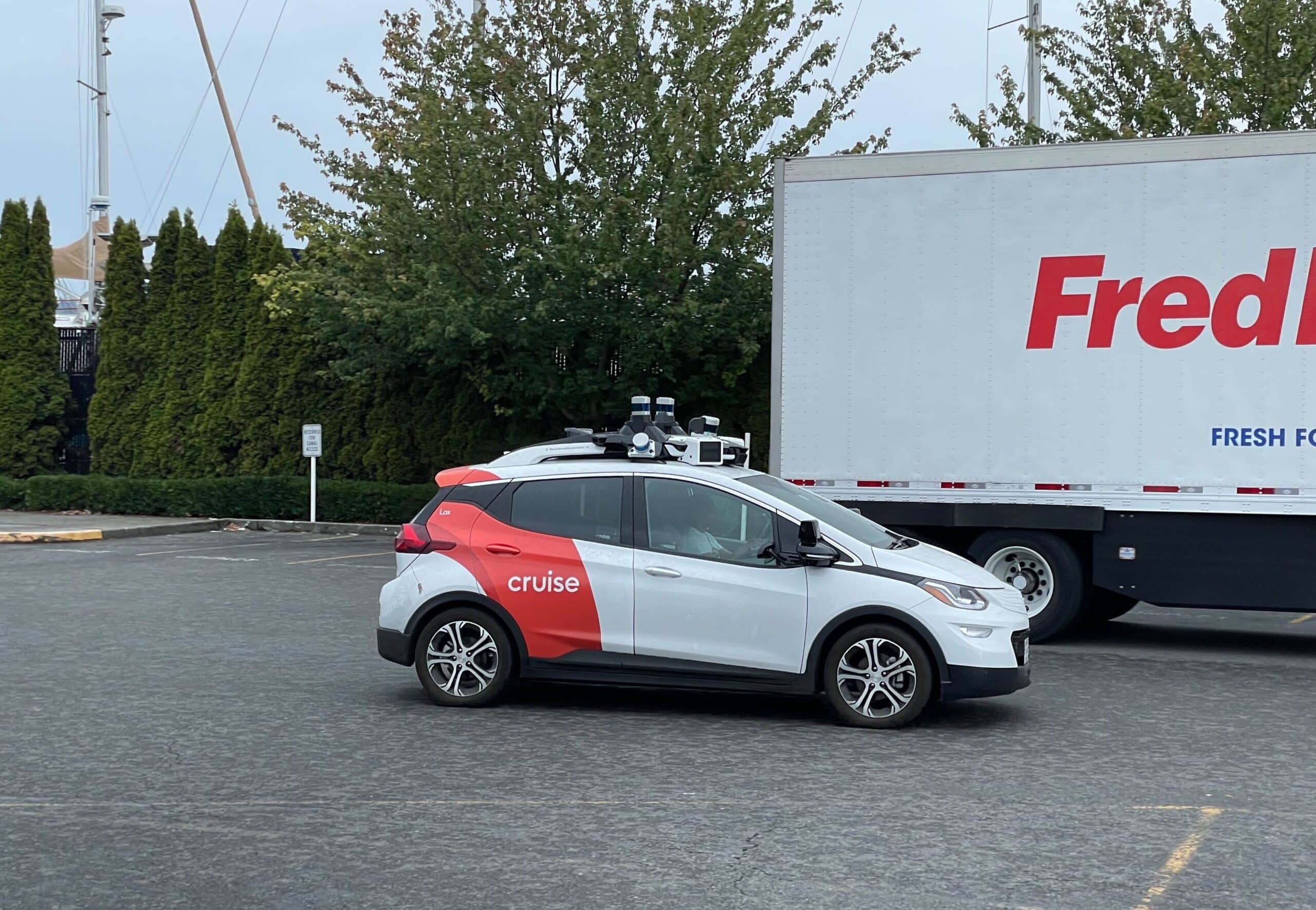
A Cruise vehicle at the Fred Meyer store in Seattle’s Ballard neighborhood after using an EV charging station at the grocery store. (GeekWire Photo / Curt Milton)
Self-driving technology company Cruise is laying off 67 employees at its Bellevue, Wash., engineering center, part of widespread cuts at the GM-backed firm.
Cruise on Monday submitted a WARN notification to Washington’s Employment Security Department (ESD), stating that 67 people were laid off at the Bellevue office, which opened in 2019. The company has around 300 employees in the Seattle area, according to LinkedIn.
Cruise is laying off 24% of its workforce, or about 900 employees, across the company, as it deals with the fallout of an incident in October in which a pedestrian was run over by one of its self-driving cars. The California DMV suspended the company’s self-driving permits after the incident.
Since then, the company’s CEO and co-founder Kyle Vogt resigned, and other executives were dismissed by the board following a safety review.
The company was already dealing with safety issues before the Oct. 2 incident, including two collisions with other vehicles in San Francisco, where it had permission to operate cars without human drivers.
Cruise began testing its cars in Seattle — with human drivers — in August, joining other self-driving vehicle companies currently testing in Seattle, including Zoox and NVIDIA, both of which received permits from the Seattle Department of Transportation under its Autonomous Vehicle Testing Permit program. SDOT’s permit requires a human driver in the vehicle who is monitoring and ready to take control if the need arises.
Cruise was founded in 2013 and has raised a total of $10 billion. Microsoft was part of a $2 billion investment in Cruise in 2019, joining GM and Honda and other key investors, including Walmart, and T. Rowe Price.
Update: Cruise plans to shut down the Bellevue office, at 3180 139th Ave SE, on Dec. 22. The closure was a previously planned decision independent from the broader layoffs announced last week, and was made due to low office usage, the company confirmed to GeekWire.
Insignia of the U.S. Treasury Department’s Financial Crimes Enforcement Network (FinCEN).
Startup and small business owners take note: if your company has 20 or fewer full-time employees and gross annual sales of less than $5 million, there’s a new federal filing requirement that you need to know about.
Next year a key component of the Corporate Transparency Act comes into effect, requiring companies to report to the U.S. Treasury Department the names of their “beneficial owners.” The primary goal of the rules is to bring transparency to anonymous shell companies used to hide money laundering, finance terrorism and engage in other illegal activities.
Congress passed the legislation in 2021 and the reporting requirements are estimated to apply to some 30 million entities. The data will reside in a confidential database kept by Treasury’s Financial Crimes Enforcement Network, or FinCEN. Law enforcement will have access to the information in the pursuit of criminals.
The U.S., it appears, is overdue for shining some light into shady business dealings. Last year the nation was ranked “the most secretive financial jurisdiction in the world,” according to the 2022 Financial Secrecy Index.
The new rules could be a start to improving that standing.
“A lot of people either forget or don’t realize that the U.K. and other countries already have similar types of information gathering, so the U.S. is just catching up,” said Gary Kocher, an attorney with Seattle’s K&L Gates.
Reporting companies include most entities that register with a state, such as limited liability companies (LLCs), limited partnerships and corporations. There are 23 categories of exemptions, including larger businesses, nonprofits, banks and credit unions; many of these are excluded because their ownership information is captured through other means.
At a high level, the reporting requirements are simple, but for some individuals and organizations it gets tricky. Here’s a summary of how the rules work:
Companies that form in 2024 will have 90 days to report essential information on their beneficial owners. Existing companies will have until Jan. 1, 2025 to report. (Update: Eighty members of the House and Senate sent a letter this week to Secretary of the Treasury Janet Yellen and FinCEN Director Andrea Gackirequesting they delay by one year the implementation of the rules.)
Companies must report their beneficial owners, which includes individuals in leadership who have “substantial control” over a company or individuals who own or control at least 25% of the company.
For each beneficial owner, the companies must provide their name, birth date, current residential address, and a unique identifying number from a document such as a driver’s license or passport, plus a copy of that document.
When that information changes — someone moves, is hired or fired, etc. — the company has 30 days to file an update.
Non-compliance can trigger penalties of $500 per day up to a maximum of $10,000, and criminal penalties of up to two years’ imprisonment. However, enforcement is focused on “willful violations,” as opposed to unintended filing errors and those making an effort to comply.
Supporters tout the Corporate Transparency Act as important to safeguarding national security.
Sen. Sherrod Brown of Ohio hailed its passage, saying in a statement that it “will provide new tools to crack down on opioid and human traffickers, terrorists, weapons dealers, and others who use anonymous shell companies to launder the proceeds of their crimes, and on big banks that enable criminals or have lax anti-money laundering compliance programs.”
Critics are less sure of its likely impact.
“I think mostly it’s going to catch people who have small businesses who didn’t know about filing obligations or forgot about them or couldn’t afford lawyers to get advice on how to comply,” said Joseph Wallin, an attorney with Seattle’s Carney Badley Spellman.
“I think it’s far more likely to catch those people than oligarchs and money launderers,” he added. “But we’ll see.”
Seattle startup SingleFile has a banner on its homepage alerting companies to the upcoming Corporate Transparency Act, or CTA, requirements.
The rules could get challenging for people involved with multiple entities, who perhaps own property through LLCs or have significant investments in multiple companies. It could also be unclear in some circumstances as to who qualifies as a beneficial owner.
But the issue that seems to draw the biggest worries is the requirement for filing updates within 30 days of a change.
Most reporting requirements occur on an annual basis, said Aaron Finn, CEO of SingleFile, a Seattle startup that automates the process of managing and submitting corporate filings. But under these requirements, he said, if a beneficial owner moves, if their driver’s license or passport expires, or if a businesses’ revenue goes above or below $5 million, that triggers a filing.
The Corporate Transparency Act, Finn said, “is unique in the fact that [filing] doesn’t just happen on a regular basis, that it happens at any change. And so what we believe is technology is really going to have to be the one that solves this monitoring.”
SingleFile is preparing a compliance tool that aims to automatically monitor a customer’s administrative and other information to detect changes in addresses and leadership positions and trigger a prompt for an update. The Treasury Department has yet to finalize some important pieces on its end, so SingleFile and others are not yet able to complete their products.
And there will likely be tweaks and clarifications by regulators in how the reporting rules work.
“It’s going to be a learning process,” said Wallin. “People are probably going to miss some things, people are going to forget… There’s obviously going to be things that happen during the rollout of this that take people by surprise.”
The New Shepard rocket ship is readied for launch from Launch Site One in West Texas. (Blue Origin Photo)
Jeff Bezos’ Blue Origin space venture is heading back to the launch pad again early Tuesday to send its New Shepard rocket ship on an uncrewed space mission for the first time in 15 months.
Monday’s first launch attempt ended with a postponement, due to a ground system issue that needed troubleshooting at Blue Origin’s Launch Site One in West Texas.
The second attempt is scheduled for no earlier than 10:37 a.m. CT (8:37 a.m. PT), depending on weather and technical readiness. Blue Origin will provide streaming video coverage of the countdown, launch and landing via its website starting at T-minus-20 minutes.
This mission, known as NS24, will send 33 science payloads to the edge of space and back, providing a few minutes of zero gravity for research purposes. It’s essentially a do-over for a flight in September 2022 that ended prematurely due to a malfunction of the New Shepard booster’s hydrogen-fueled rocket engine.
No people were on the spacecraft for that NS23 mission, no injuries were reported on the ground, and New Shepard’s escape system worked as designed to push the capsule away from the booster for a safe, parachute-aided landing. Nevertheless, the anomaly led to the suspension of Blue Origin launches and a yearlong investigation overseen by the Federal Aviation Administration.
This September, the FAA closed the investigation and required Blue Origin to take 21 corrective actions — including a redesign of the booster’s engine and nozzle as well as changes in procedures. Blue Origin began making the fixes even before the FAA issued the investigation’s findings, setting the stage for NS24.
More than half of the science payloads for NS24 have been developed with support from NASA. Others have been built by schools, universities and other education-oriented organizations. Among the payloads to be reflown is an experiment from Honeybee Robotics, a subsidiary of Blue Origin, which will study the strength of planetary soils under different gravity conditions.
The New Shepard capsule is also carrying 38,000 postcards that have been submitted — on paper and online — by students through a program organized by the Club for the Future, Blue Origin’s educational nonprofit group.
If NS24 goes well, that’s expected to smooth the way for Blue Origin to resume crewed New Shepard flights in the months ahead. Since mid-2021, 31 people — including notables such as Star Trek actor William Shatner and Jeff Bezos himself — have taken suborbital space trips without incident. Bezos’ fiancée, Lauren Sanchez, has said that she hopes to lead an all-woman space mission early next year.
New Shepard’s return to flight comes amid an organizational handoff at Blue Origin, with veteran aerospace executive Bob Smith passing the CEO reins to former Amazon executive Dave Limp.
During an interview with podcast host Lex Fridman, Bezos said he wants Blue Origin to speed up progress on projects such as its orbital-class New Glenn rocket and its Blue Moon lunar lander. “Blue Origin needs to be much faster,” Bezos said. “It’s one of the reasons that I left my role as the CEO of Amazon a couple of years ago. Blue Origin needs me right now. … We are going to become the world’s most decisive company, across any industry.”
Bezos told Fridman that Limp would help him get the job done. “He’s amazing,” Bezos said. “So we’re super lucky to have Dave, and you’re going to see us move faster there.”
This is an updated version of a report first published at 5:59 a.m. PT today.
Washington state Attorney General Bob Ferguson speaks at the GeekWire Summit in 2017. (GeekWire File Photo / Dan DeLong)
Attorney General Bob Ferguson is proposing legislation to create a bipartisan Artificial Intelligence Task Force in Washington state that would recommend principles for AI use, identify potential high-risk uses of AI, and raise other policy issues for state legislators to consider.
Explaining the need for the task force, the related bills cite the risk that AI will “further perpetuate bias and harm to historically excluded groups,” and note that the “federal government has not yet enacted meaningful regulations or oversight into generative artificial intelligence,” leaving the industry to largely regulate itself.
As shown in the past, on issues including data privacy, the presence of Microsoft, Amazon, and other major tech players in the Seattle region can position the state’s leaders to have abroader impact on national law and policy.
However, in a phone interview Monday afternoon, Ferguson downplayed that notion as a motivation for the task force, saying the primary goal is to “get our arms around this from a policymaker’s perspective” for Washington state.
“If it has some additional benefit, has a broader reach, that’s great,” he said. “But that certainly was not the focus.”
We’ve contacted the office of Gov. Jay Inslee for comment on the proposed legislation. Ferguson, a Democrat, is running for governor in 2024 with Inslee’s endorsement.
As proposed, the 42-member AI task force would include representatives from the legislature, state agencies, tribes, technology experts, civil liberties organizations, education, consumer advocates, businesses, and many others.
Under the proposal, the attorney general would appoint the majority of the task force, including representatives of specific tech trade groups, including the Washington Technology Industry Association and TechNet.
Also appointed by the AG would be representatives of advocacy groups for people who are “disproportionately vulnerable to being harmed by algorithmic bias,” the proposed legislation reads. It cites, as examples, “African American, Hispanic American, Native American, Asian American, Native Hawaiian and Pacific Islander communities, religious minorities, people with disabilities, and other vulnerable communities.”
Ferguson is working with Sen. Joe Nguyen, D-White Center, and Rep. Travis Couture, R-Allyn, to introduce the bills as part of the 2024 legislative session. The relevant bills have been pre-filed as HB 1934 and SB 5838.
The task force would meet at least twice a year, holding its first meeting by Dec. 31, 2024, according to the text of the bills. The task force’s preliminary report would be due to the governor and state legislature by Dec. 1, 2025, with final findings and recommendations due by June 1, 2027.
“I think virtually every Washingtonian understands that this new technology brings opportunities, but also some potential challenges,” Ferguson said in the phone interview. “It’s important for policymakers and leaders in the state to get guidance from experts on how best to channel the positives, and minimize the negatives.”
This proposal is part of a slate of “Attorney General Request” bills that Ferguson introduces in every legislative session. The majority of these bills pass with bipartisan support.
Outlining the plan to establish the task force, the Attorney General’s office listed these examples of the findings and recommendations expected to be produced by the group.
A recommended set of guiding principles for generative artificial intelligence use.
Identification of high-risk uses of artificial intelligence, including those that may negatively affect safety or fundamental rights.
Opportunities to support and protect the innovation of generative artificial intelligence technologies.
Recommendations as to how the state should educate to the public on the development and use of generative artificial intelligence.
A review of public policy issues, including benefits and risks to the public broadly, historically excluded communities, racial equity considerations, workforce impacts and ethical concerns.
According to the AG’s office, at least 25 states have introduced AI-related legislation and four other states (Colorado, Illinois, Vermont and Virginia) have created their own AI-related tasks forces or commissions.
MotherDuck has two new hires: Frances Perry (left), engineering manager, and Margaret Lawrence Rosas, head of customer success. (LinkedIn Photos)
Seattle data analytics startup MotherDuck is expanding its nest with two new leadership hires.
Frances Perry has taken the role of engineering manager. She was previously at Google for 16 years, rising to the level of engineering director of Google Compute Engine.
Margaret Lawrence Rosas joins the team as head of customer success. She was formerly vice president of the “Department of Customer Love” at data analytics startup Looker, which Google acquired in 2020. Rosas spent the next three years in director roles at Google and was most recently on a career break.
MotherDuck CEO and cofounder Jordan Tigani, also a former longtime Google employee, called Rosas’ decision to join the startup a “huge honor” and said Perry helped him “get oriented and feel part of the team” at Google.
“After working her way up to the rarefied part of the engineering ladder, [Perry] jumped into building systems with people rather than code,” Tigani said in a post on LinkedIn. “Looking forward to working with her to help develop the idea of management at MotherDuck as a craft, not a tax.”
MotherDuck announced a $52.5 million round in September, bringing total funding to $100 million. The startup launched in April 2022.
Pallavi Sinha, vice president of growth at Humanly. (LinkedIn Photos)
— Pallavi Sinha joined Seattle startup Humanly as vice president of growth. She most recently held leadership roles at Seattle software development firm Mason, and previous employers include Sauce Labs, Reflektive and others.
In a LinkedIn post, Sinha described the current job market in disheartening terms and said she feels lucky and proud to take a role at Humanly, which helps companies automate recruiting.
“Between the ongoing layoff updates and job hunt nightmare stories from extremely skilled colleagues, I was hearing about and feeling more imposter syndrome and job search disillusion than I’ve ever experienced professionally,” Sinha said.
Humanly’s Prem Kumar won CEO of the Year at this year’s GeekWire Awards. The company announced a $12 million round in June, bringing its total funding to nearly $18 million.
— Scott Chancellor is now CEO of Aircall, a New York-based customer communication platform targeting sales and support teams. Chancellor’s past roles include chief product and technology officer for Apptio, a Seattle-area software company acquired by IBM, and a director and general manager at Amazon Web Services. He was most recently CEO of Silicon Valley-based Humu.
— Boeing announced Chris Raymond as CEO of Boeing Global Services and Brian Moran as chief sustainability officer, effective Jan. 1.
Madin Akpo-Esambe. (TVF Photo)
— Madin Akpo-Esambe is now part of the investment team at Tacoma Venture Fund. Akpo-Esambe is co-founder of Trava, an AI-powered travel planning tool and marketplace that helps friends and families create travel itineraries.
The Tacoma Venture Fund launched in 2020 and invests in early-stage startups across the Pacific Northwest, with a particular focus on the Tacoma, Wash., area south of Seattle.
— Next-generation battery materials startup Sila appointed former Intel and General Electric exec Abbey Omokhodion as its new chief financial officer. Sila last month broke ground in Moses Lake, Wash., on its first automotive-scale manufacturing facility. The company is based in California.
— Three former executives of the climate friendly housing technology company Green Canopy NODE — Aaron Fairchild, Andy Wolverton and Susan Fairchild — have left to create Cambia Capital, a sustainability-focused real estate investment firm. Read more.
— Bamcamp partner Jim Sheward joined the board of Seattle startup Strike Graph, which just announced new funding.
— The Washington Research Foundation awarded three-year WRF Postdoctoral Fellowships to 15 early career scientists, its largest ever cohort. The funding begins next year and the researchers will work on projects at Fred Hutchinson Cancer Center, the University of Washington, Washington State University and Seattle Children’s Research Institute. The full list of awardees is here.
Follow-up: Zulily lays off more employees as website and app remain offline
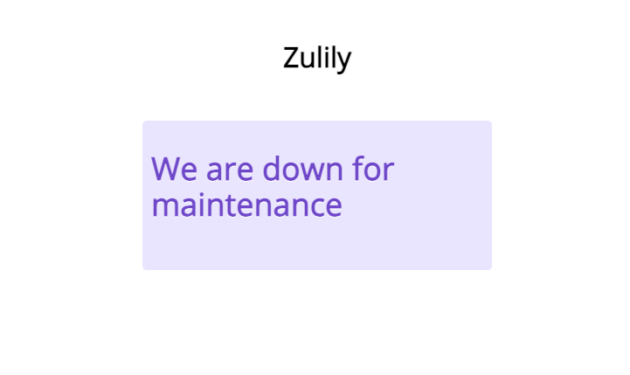
Zulily’s website was “down for maintenance” Monday in the latest sign of the retailer’s collapse.
Zulily.com redirects to Zuliy.com/password and features a bare webpage with just “Zulily” and the phrase “We are down for maintenance.”
It’s unclear if the website is temporarily down or if it’s down for good.
The online retailer earlier this month planned to shut down three offices, including its Seattle headquarters, and lay off more than 800 people in total. The company later announced a “going-out-of-business” sale.
Last week the Seattle-based online retailer surprised some employees, notifying them via email that they were getting laid off effective immediately. Filings with state employment offices previously indicated that the layoffs would begin Feb. 7 of next year.
Also last week, the Zulily credit card was no longer being accepted for purchases as Zulily’s online store, according to Synchrony Bank.
Zulily, a one-time pillar of Seattle’s tech scene that was valued at more than $7 billion in 2014, is in the midst of a stunning downfall following Regent’s acquisition of the company from QVC parent Qurate in May.
The company went through at least two rounds of layoffs since then and moved into a smaller headquarters building in Seattle. Vendors who sell to Zulily started reporting unpaid invoices after the acquisition.
GeekWire reported on two lawsuits filed against Zulily by a logistics company and a software development consultancy in recent months, both alleging unpaid invoices.
Zulily last week filed suit against Amazon, alleging that the e-commerce giant’s tactics made it impossible to compete on price without jeopardizing its relationships with key suppliers. Regent is not mentioned in the lawsuit.
We’ve contacted Regent for comment on the latest notices. The firm has not responded to multiple emails from GeekWire about developments at Zulily over the past several months.
Regent has acquired more than 30 businesses since 2015, including consumer retail and apparel brands.
Seattle artist Andy Arkley’s interactive installation “You Can Do Most Anything” at WNDR Museum in Seattle in March. (GeekWire Photo / Kurt Schlosser)
WNDR Museum, an interactive, tech-infused art experience near the waterfront in downtown Seattle, has ceased operations eight months after opening.
A statement about the abrupt closure is posted on the WNDR website, but it doesn’t provide a reason for the decision. It was also posted as an Instagram story four days ago. A public relations rep for the museum had nothing additional to share when contacted by GeekWire.
“While we’ve enjoyed welcoming Seattle to experience the joy of WNDR Museum this year, we’ve made the difficult decision to close the doors of our Seattle location effective immediately,” the statement reads. “We sincerely apologize for the inconvenience. We’ve loved our time in the Emerald City and hope our paths cross again in the future!”
WNDR opened in March at the corner of Alaskan Way and Marion Street, in a 13,000-square-foot space in the Maritime Building, which previously sat in the shadow of the Alaskan Way Viaduct.
A mural by Seattle artist Stevie Shao between the gift shop and cafe at WNDR in Seattle. (GeekWire Photo / Kurt Schlosser)
The museum, started by a Chicago-based collective of creators working at the intersection of tech and art, featured an array of immersive, multi-sensory experiences showcasing a mix of video, audio, interactive and AI-generated artwork. There was also a cafe and gift shop. It’s unknown how many people the museum employed.
David Allen, a creative director with WNDR, previously told GeekWire that the museum was attracted to what he called a “beautiful” art scene in Seattle. There was some hope that WNDR might help attract more visitors to a downtown rattled by the pandemic. Increased arts and culture options are often listed as potential drivers to get more people to visit Seattle’s urban core.
Earlier this month, WNDR was promoting a Dec. 7 event called “Fresh Fest Seattle,” as a celebration in honor of the 50th anniversary of hip-hop with live DJ sets, live art and lettering stations, break-dancing, beatboxing battles and more.
The museum website now only features links to its locations in Chicago, Boston and San Diego. An email link to share questions or concerns about the Seattle closure featured a misspelling in the address on Monday morning. GeekWire has reached out to [email protected] and will update this story if we hear back.
A Seattle home developed by Green Canopy NODE. (Green Canopy NODE Photo)
Three former executives of the climate friendly housing technology company Green Canopy NODE have left to create Cambia Capital, a sustainability-focused real estate investment firm.
Aaron Fairchild, Andy Wolverton and Susan Fairchild are now managing members of the firm, which will invest in residential developments in the Pacific Northwest and nationally, with a focus on mass timber projects. The Cambia Capital is launching with a $20 million investment dubbed the Douglas Fir Fund that it plans to grow significantly.
As part of Green Canopy NODE, the trio previously raised four funds totaling more than $100 million in corporate and project-related debt and equity that they invested in sustainable housing developments.
One of the biggest constraints to constructing climate friendly housing has been a lack of capital, said Susan Fairchild. Few real estate firms are specifically targeting these projects, she said, which could make Cambia Capital an attractive option for investors who are concerned about the planet.
“People don’t just want a return,” she said, “they want to make sure what they’re doing is adding to some positivity.”
The managing members of Cambia Capital from left: Aaron Fairchild, Andy Wolverton and Susan Fairchild. (Photos via LinkedIn)
Washington is a leader in its sustainable building requirements. The state’s Building Code Council last month approved rules mandating strict energy performance standards for new residential and commercial construction. The regulations don’t include the controversial requirement of installing highly efficient heat pumps — but developers and builders still need to reach that level of performance even if they’re using gas or oil powered devices. The city of Seattle this month signed into law energy rules for existing buildings over 20,000 square feet.
The Cambia Capital team, which is based in Seattle and Portland, expects to work with Green Canopy NODE for future projects, but also wants to partner with other housing companies.
In 2021, Green Canopy CEO Aaron Fairchild and NODE CEO Bec Wilder merged their businesses. The new partnership raised $10 million in seed funding to kick off the merger. Up until now, Fairchild and Wilder served as joint CEOs.
Wilder will continue leading Green Canopy NODE as sole CEO and board director, and Aaron Fairchild will keep his seat on the company’s board. Fellow executive Chief Development Officer Sam Lai will stay in his role with the company as well.
Related: Fire resistant, quake safe, climate friendly: Mass timber is on the rise as a construction alternative
Strike Graph, a Seattle startup and Madrona Venture Labs spinout that helps companies with their security-related compliance and certification, raised $1.5 million in additional funding.
The new cash adds to the $7 million it raised in May, in a Series A round led by Bamcap. Total funding to date is $20.4 million.
The company’s software helps streamline compliance processes for HIPAA, SOC 2, and other security programs. Revenue has grown by 4X over the past two years.
Strike Graph, founded in 2020, is led by CEO Justin Beals, a veteran of NextStep, Koru, Roundbox Global, and other startups. He co-founded Strike Graph with Brian Bero, who co-founded Seattle tech stalwart Apptio and sold security startup Greytwist to SmartRIA. Bero left Strike Graph last month.
Other backers in the latest round include Madrona Venture Group; Information Venture Partners; and Rise of the Rest. The 45-person company added BAMCAP partner Jim Sheward to its board.
Get caught up on the latest technology and startup news from the past week. Here are the most popular stories on GeekWire for the week of Dec. 10, 2023.
Sign up to receive these updates every Sunday in your inbox by subscribing to our GeekWire Weekly email newsletter.
Most popular stories on GeekWire
Employees at Renton, Wash.-based gaming giant Wizards of the Coast were affected by a new round of layoffs at its parent company, Hasbro. … Read More
Zulily employees received notice last week that they’d lose their jobs in February. … Read More
A new round of layoffs at Hasbro has impacted its subsidiary Wizards of the Coast, despite Wizards’ strong recent performance and its status as a linchpin for Hasbro’s overall revenue stream. … Read More
Glowforge, the Seattle-based maker of 3D laser engravers, has laid off 30 employees, co-founder and CEO Dan Shapiro confirmed to GeekWire on Friday. … Read More
When Kelly Campbell bought a metallic gray Tesla last year, the Seattle resident was delighted. … Read More
Editor’s note: William Canestaro is managing director at Seattle venture capital firm WRF Capital and leads the biotechnology investment team. Seagen’s sale to Pfizer would have seemed unthinkable a few years ago. … Read More
Neuroscientists have unveiled their most comprehensive and detailed map of cell types across the entire mouse brain, delivering the latest results of a six-year-long scientific effort in which Seattle’s Allen Institute has played a leading role. … Read More
Updated with Amazon statement. Less than a week after cutting hundreds of jobs and signaling its intent to go out of business, online retailer Zulily filed suit against Amazon on Monday — alleging that the e-commerce giant’s tactics made it impossible to compete on price without jeopardizing its relationships with key suppliers. … Read More
[Editor’s Note: We’re excited this week to welcome a guest host to the GeekWire Podcast, Ross Reynolds, whose voice is well-known in the Seattle region from his 34 years at KUOW, the public radio station from which he retired in 2021. … Read More
Jeff Bezos sat down for an extensive and wide-ranging discussion with Lex Fridman about his life, work, the future of humanity and what’s next for technology on an episode of the computer scientist’s popular podcast, published today. … Read More
Kristi Coulter spent 12 years at Amazon and writes about the experience in her latest book, Exit Interview.
[Editor’s Note: We’re excited this week to welcome a guest host to the GeekWire Podcast, Ross Reynolds, whose voice is well-known in the Seattle region from his 34 years at KUOW, the public radio station from which he retired in 2021. He’s joined by a special guest for a look behind the scenes at work and life inside Amazon.]
Kristi Coulter’s latest book is Exit Interview: The Life and Death of My Ambitious Career. It’s a memoir about what she learned in her 12 years at Amazon about work, gender bias, and herself. Exit Interview is Coulter’s second book. Her first, Nothing Good Can Come From This, is a collection of essays about quitting drinking. As you’ll learn from this podcast conversation, it intersects with her Amazon career.
Listen below, or subscribe to GeekWire in Apple Podcasts, Google Podcasts, Spotify or wherever you listen.Continue reading for excerpts from the conversation, edited for length and clarity.
Ross Reynolds: I really enjoyed the book tremendously. I realized I didn’t know anyone from Amazon at the high level that you were, so I’ve never been able to have this conversation even though I’ve lived in Seattle for 30 years.
Kristi Coulter: Right. People don’t talk, either.
Ross Reynolds: OK. It’s not my fault.
Kristi Coulter: No, it’s certainly not entirely your fault, but people from Amazon have been very closed-mouthed about the place.
Ross Reynolds: Why?
Kristi Coulter: I think part of it is just general discretion. You don’t want to spill, tell how the algorithms work or something, but also I think there’s a certain amount of fear. It’s actually been interesting to me in the past three or four years to see things start to leak out of Amazon pretty routinely. I don’t remember ever hearing about a document leaking to the press in my 12 years there. It probably happened at some point, but now it seems to happen routinely, video footage, documents, all kinds of stuff. ….
Ross Reynolds: The impact of Amazon is what drew you to want to work there, but you had a career before that. What got you to Amazon?
Kristi Coulter: I had a really nifty job at an early internet company called the All Music Guide, which was basically a database of every record on Earth. … I was living in Ann Arbor, Michigan. I had run out of runway in my career. It was just too small a place for me to go any further. And I was really tired of the winters. Weather has often been a motivating force for me. And I thought, “I’m going to have to leave here to go further in my career” because Ann Arbor, it’s a university town. There’s just not the kind of stuff I was looking for.
And so I applied to Amazon on a whim because my husband has family out here, and I thought, “Well, I’ll get my resume polished. This won’t go anywhere.” They called me within two hours. I was here interviewing a few days later, less than a week later, and I recognized it as my chance to make a big change in my life. I was 35 or about to turn 36. Felt like I was stuck and life might be over, which seems hilarious now to think that at 35, but I was like, “This is my chance. Let’s do it.” …
Ross Reynolds: What were you hired to do at Amazon, and what were your first impressions when you came here [in 2006] and walked in the door for those first days?
Kristi Coulter: I was hired to run merchandising, so basically onsite marketing for the books and media stores, so for five different storefronts, and especially hired to make it a better job. They had an incredibly outdated tool set. I mean, the tools were almost non-functional. They broke all the time. People were really miserable. They had been hired as editors, and the job had then shifted to something where their opinions and their knowledge didn’t matter. It was more about just scheduling content. So that was my job. And when I walked in, my first impression was just the chaos. I expected Amazon to be a well-oiled machine, and it was just so chaotic.
Ross Reynolds: What were the signatures of the chaos?
Kristi Coulter: Just people barely able to take five seconds to say hello to me. Really, no ramp up. I interviewed someone the day I arrived. They put me on an interview loop.
Ross Reynolds: To hire someone else?
Kristi Coulter: To hire someone else. I was like, “Don’t do that.” And I was like, “Okay, I’ll go along with it.” My first boss, who was a very nice guy, had basically no time for me. I mean, I probably had, I don’t know, five or six one-on-ones with him and my first six months. So it was just like, “Just figure it out.” And just basically, they give you a list of names of people to talk to and you just do it. So I was on shuttle buses, shuttling all over downtown Seattle, trying to basically put together a jigsaw puzzle.
Ross Reynolds: But you were successful. I mean, you were there for a dozen years. You moved up the ranks.
Kristi Coulter: Well, technically I never moved up. I was never promoted, which became a big sticking point for me. I came in as a level seven. Amazon has twelve levels or something, and I stayed a level seven, but I did get bigger and bigger jobs. And I think it happened first because it was a small enough company that people could see, including people very high up, that I came in and just started to get it together. They could dump me in there, and I was like, “Well, I’ll figure out how to survive here,” because failing was not something I considered an option. And I think I just developed that reputation as someone who could just figure stuff out and delivered some results and people would kind of tap me on the shoulder for various jobs. It also really helped that I came from a liberal arts background.
Ross Reynolds: Really? Why is that?
Kristi Coulter: Because Amazon needed someone who understood language and writing and voice. And they were never really going to hire for that because they, certainly at the time, didn’t want to believe they needed it, but they did. And once I was there, it became apparent that I could help. I could help the site to have a voice again. I could help the merchandisers to actually write better. And so there were a few very smart executives there who were like, “Well, while she’s here, let’s use this.”
Ross Reynolds: So what was the most difficult thing about working at Amazon? What was the biggest challenge for you? And was it the same challenge for everyone there, do you think, or was it particular to you?
Kristi Coulter: Yeah, it’s just a really punitive environment. It’s a culture where there’s not really much of a thank you. You are basically always focused on what you could have done better to the exclusion of what went well. The culture kind of runs on fear. Everyone I knew at Amazon was some level of afraid, from paralyzingly afraid to just a little bit low-level, I’ve learned to live with this afraid, but it’s brutal in that way.
Ross Reynolds: Is that a good thing in some ways, to be a little bit on edge?
Kristi Coulter: I think to be a little bit on edge is fine. And feel like you’re taking risks and things. … In one of the articles on Amazon, someone said, “It’s where overachievers go to feel bad about themselves,” which I was like, yes, indeed. And I think that it gets to a point where you’re just grinding people down. And I don’t actually know that people do their best work when they’re feeling really afraid. You know what I mean? You’re just thinking about survival then.
Ross Reynolds: Well, you write about stacked ranking, and that’s something that would make you really afraid. For people not familiar with it, they basically rank everybody in the department, and the bottom 10% get fired. That’s end of story. I understand Amazon has denied doing this. But in your book, you say they totally did this, right?
Kristi Coulter: Oh, yeah. A couple of years ago, I was reading an article and they denied ever having done stack ranking, and I was just stunned because I participated in that exercise three or four times in my career there. And yeah, you get in and you rank everyone, and that bottom 10%, they’re not fired right then, but they get a very strong message, as we would put it back then, that they needed to improve. And some of those people really did. There were people where you were like, oh yeah, this person’s probably got to go, but there were also people who ended up in that 10% just because they were solid, but more limited in what they could go on to do. And at some point, throwing those people out is just really self-defeating because not everybody needs to be the quarterback. Not everybody needs to be a rock star. You also need people who are not trying to take over the world, but who are really good at their jobs.
Ross Reynolds: You talk about lack of appreciation, but you also talk about some incidents where people said things to you in meetings that were devastating to you. Could you talk a little bit about those experiences?
Kristi Coulter: I think the worst experience I had in a meeting was, I had sold a pretty ambitious plan to transform the merchandising role to the VPs and Senior VP Jeff Wilke in North America. They were very enthusiastic about it. And I went to the International VP [a different executive] to get his buy-in. And he read the doc — the famous thing where people sit in a room and read the doc — really fast. He read it too fast. And I thought, ‘Ooh, this is either really good or really bad.’ And I said, “So, any feedback?” And he said, “Yes, it’s stupid.” Just full stop. And I was like, “OK … can you tell me something more specific about that?” And [he said], “It’s just stupid.”
Ross Reynolds: Where do you go with that?
Kristi Coulter: Yeah. What do you do with that? One of an executive’s biggest roles is to teach. … That’s not how you teach someone. And eventually, he actually denied that the other VPs could have possibly read it. He basically said, Jeff Wilke, junior only to Jeff Bezos, “Oh, he didn’t read it. He just said he did. Because if he’d read it, he would think it was stupid, too.” …
He said this whole room full of alpha males, who are not exactly used to coddling anyone, they all must have been lying. And then he said I was stupid. … I was like, do I throw down, or do I cry? What do I do? And I just tried to just get out of the room without crying, basically. Just very difficult. But yeah, that was probably the worst. It was a direct attack on me. And even worse, it was this grown man with immense power and knowledge just throwing a tantrum.
Ross Reynolds: I’m a big fan of this podcast called Battle Tactics For Your Sexist Workplace. And as I was reading your book, I was thinking about that. Would that executive have said that to a man?
Kristi Coulter: Probably, honestly. Maybe worse. Most people I worked with at Amazon were, at least on the surface, respectful, but there were a few folks … It’s funny, I had a conversation with a friend, an ex-Amazon friend yesterday who said this same guy once yelled at her on a conference call for two hours. I haven’t heard the same stories about him treating men that way, but men got treated pretty badly at Amazon, too.
Ross Reynolds: Was that ever an issue where you thought, I need to raise this gender bias issue?
Kristi Coulter: Who would you have told? … Part of it is that Amazon is so intent, or the system is so intent on having you blame yourself for all of your problems, that I thought, oh, it’s just me. If I were a different kind of woman, I could handle this better. I’d rise above. Also, as a Gen X-er, that’s how I was raised. Nothing can stop you but yourself, which is not really true, it turns out. But also, there was such a denial of any gender bias at Amazon. People were not even willing to entertain the idea. It would’ve been kind of suicidal to make a big deal out of it.
Ross Reynolds: There’s just been a class action suit against Amazon for gender issues. What’s your comment on that, since your book delves into that quite a bit?
Kristi Coulter: Yeah, it’s been interesting. The suit is about huge pay gaps between women in one part of the organization and a man who was at their level, but making [150%] more a year for the same job. Amazon’s comp, like a lot of tech companies’ comp, is really complicated, no pun intended. When you started really affects your base and the stock. I suspect that it could turn out that there’s a non-sexist explanation for the pure comp issues, not that that makes it right, but the women were classified as marketing project managers, and the man was classified as a research scientist, despite the fact that they all were research scientists. And I think that’s really interesting. That drove a lot of the pay difference. And the most interesting thing about the suit is that there was direct retaliation when the women reported it. They went to HR looking for explanations. And one woman who was up for promotion was told that because she had complained, they didn’t feel she was ready for promotion anymore. That’s the big thing for me.
[Editor’s Note: Read the full text of the lawsuit here. Amazon has denied the allegations in the suit, and said it doesn’t tolerate workplace discrimination.]
Ross Reynolds: Did you experience that? Was your job description different than men’s job descriptions who were giving paid more than you?
Kristi Coulter: It’s always hard to know because you’re not supposed to talk about comp, but I did have a time when a man who reported to me was making $60,000 more than I was, despite being a level lower than I was. And I was like, well, this is odd. And I went to HR and just said, “What’s going on?” And nobody was ever able to give me an explanation. And they were like, “Well, it could be a lot of things.” And they also made me feel a little bit gauche for asking. There’s this sense of, “Well, I mean if you want to keep trying to find out, you can, but … “
Ross Reynolds: Can you be a party to the class action suit even though you don’t work there anymore?
Kristi Coulter: No. It’s just three women right now, but they wanted to cover all women from 2016 to ’20 or something in certain jobs. I don’t think I would be a party to it, but I think it could be a nice forcing function to bring some of this stuff out in the light. There was also some data in it about the man who managed all these women taking women’s names off of documents he was presenting, even though they had written the documents or co-written them. Just some really bad stuff.
Ross Reynolds: If approached by an attorney, would you join a lawsuit like this? Do you think you have the goods?
Kristi Coulter: I would certainly talk to the attorney. I’ve never felt like anything that happened to me at Amazon rose to “call a lawyer” level, but if there was a class action and I could benefit from it, I’d have to take that phone call, right?
Ross Reynolds: You were in meetings with Jeff Bezos. What was that like?
Kristi Coulter: Scary. Jeff, in my experience one-on-one, was really cool. I actually really liked him. He’s funny. He’s very engaged. Almost in every meeting he’d say something that would make me go like, “Oh my God,” something revelatory that I would remember. But it’s frightening because he’s so powerful. To be in the room with somebody who’s the wealthiest man in the world. Or he was second or third at the time, was really, really terrifying to me, and I could never quite get past that. It was very hard to just see him as a person, even though he’s actually quite personable.
Ross Reynolds: Notwithstanding Amazon’s manifest success as a business, from the inside, did you ever think, they could be doing some of these personnel things better? Or does its very success say, “No, they’re obviously doing it right”?
Kristi Coulter: In some ways, I thought the success said they were doing it right. Even at its best, it would not be a place for everyone. You need to be super-comfortable with change and things moving fast and ambiguity, and it’s really exhilarating. I got to work on things I never would have at more sane companies or companies with less money, but yeah, I mean, you would have to look around and think, these people are so good, so brilliant. My coworkers were so talented. What if they weren’t also fried and exhausted and desperate? They could probably be even better, and it just didn’t seem sustainable.
Ross Reynolds: But how do you do both, I guess?
Kristi Coulter: Yeah. I don’t know that you do. I think that it’s interesting seeing the struggles Amazon’s having now. Part of me thinks, have they hit some wall? I got to a point where women locally especially would tell me, “Yeah, I just won’t take their phone call. I won’t interview at Amazon.” The reputation was so bad it was pushing talent away. And that’s anecdotal, of course. I’m sure lots of people would be happy to work there, but I remember thinking, that’s not good when your rep is so bad that talented people just are writing you off because there’s a lot of interesting things about working there.
Ross Reynolds: You write that success at Amazon wasn’t necessarily having these core skills. It was figuring out how to work the Amazon system, how to get the programmers to do what you needed them to do.
Kristi Coulter: Yes. One reason I was able to move around a lot and actually have, really, a few different careers at Amazon was because people would openly say, “Well, I’m not so worried that you don’t know how the publishing business works. You know how Amazon works and you could figure out the publishing business.” And it’s true, it was true. And when I talk to young people now, I always say, “Don’t underestimate your transferable skills. Knowing how to meet people and ask questions and think critically, they’re really valuable.” But yeah, it would take someone else six months to figure out how Amazon works. It took me at least six months, and so we always wanted to hire from within. People would get frightened about hiring from outside because the ramp-up time would always be longer than we thought we could afford, because that’s just how humans work.
Ross Reynolds: Amazon is so massive, and that really came through to me in a section in the book where you read news accounts, these famous accounts, of workers at an Amazon Fulfillment Center being taken out in ambulances because the temperatures were over 100 degrees. And part of your reaction was, “Oh yeah, that’s the company I work for.”
Kristi Coulter: Yeah. That was [reporter] Spencer Soper. He’s here in Seattle now, but he wrote that in Pennsylvania. Yeah. I was like, “Oh, right. We have warehouses.” Because I moved away from the retail business fairly early on. … And it was shocking to realize how quickly something like that could just fall out of my view. But it did and then it did again.
Ross Reynolds: You went there because you were ambitious to do something big. By the time you left, did you accomplish what you set out to do?
Kristi Coulter: I worked on things I never would’ve dreamed of. I think in some ways I did accomplish what I set out to do, but I was the kind of person who got promoted like clockwork my entire life. I was just that kind of girl, I’m going to do the extra credit, I’m going to get promoted, and I never got the big promotion that was dangled in front of me for 12 years. I think I had seven or eight conversations with different bosses that were like, “You’re a year away.” And so by that one external metric of success, I left feeling like a failure. I was like, “Twelve years. These people, no one could manage to get me promoted.” And it honestly still kind of bugs me.
Ross Reynolds: So you internalized that. You thought to yourself, “That must be my fault that I didn’t get the promotion.”
Kristi Coulter: I definitely thought so for a while, and then at some point I was like, “These people don’t have their act together.” Nobody could give me the same story. I had one VP tell me — I had a whole document with what I thought I needed to do to get promoted, and I wanted his feedback and he said, “Just change the world. Just change the world and you’ll get promoted.”
Ross Reynolds: Just change the world.
Kristi Coulter: Yeah. I was like, “Oh, thanks, dude. That’s great.” And it was like he wasn’t even trying to have a serious conversation with me. And so I got to a point where I was like, “These people don’t understand what they’re doing, what they’re talking about.” I stopped blaming myself a bit then.
Ross Reynolds: I’m sure people ask you, “Should I go to work at Amazon?” What do you tell them?
Kristi Coulter: I usually tell them, “It depends.” I don’t tell people, “No. Just run screaming.” But I think you want to be very specific and clear about what you want out of the experience. You want to probably go in with an exit strategy. Maybe if you’re young in your career, you go in and you say, “I’m going to stay for three years and I’m going to do X, Y, and Z, and then I’m going to go.” And you have to remember that it’s going to be rough and that no one is really going to care about you. Your coworkers and your boss, lots of wonderful people work there, but the system of Amazon really doesn’t care if you are a well person or not, and it will absolutely spit you out.
Ross Reynolds: Since you started, Amazon has all these brand new buildings in downtown Seattle. So has the catering improved? Have those elements that were so starkly not there when you arrived, did they change over the years?
Kristi Coulter: A little bit. There are cafeterias now. I was in Columbia Tower with that weird food court, but there’s no gym, the basic corporate amenities. We had bike cages and eventually we had some locker rooms. There weren’t rooms for nursing mothers when I got there. There was a bathroom.
Ross Reynolds: Were there by the time you left?
Kristi Coulter: Yeah, yeah. … But I was at a coffee shop somewhere and I heard a guy running a startup talking to an employee, and he was trying to give her a pep talk, and he was like, “This isn’t Amazon. I’m not going to be able to give you the free meals and the free haircuts and the massages and … but it’s going to be fine.” And I was thinking, wait, he’s got the wrong idea about Amazon. It’s not Google. So the main perk for employees was you could get $100 off the website per year if you went into the HR tool and found this code in January. Nobody would email you to remind you. They wouldn’t send it to you. It was basically, if you remembered you could get that $100 off.
Ross Reynolds: Was that a conversation among employees there? “Boy, they’re kind of cheap!”
Kristi Coulter: Yeah. We had a leadership principle of frugality, which is that you want to be frugal with money, which makes sense. But at some point, someone made a Wikipedia page called “frupidity,” for the merger of “frugal” and “stupid.” There were things like people being expected to fly to India multiple times a year in coach and go straight to the office when they got off the plane. I had a computer that was taking seven minutes to boot up and they didn’t want to give me a new one because it wasn’t quite at the end of its four-year life cycle. Things got really stupid.
Ross Reynolds: Your first book: Nothing Good Can Come From This: Essays About Quitting Drinking. Your second book, Exit Interview, The Life and Death of my Ambitious Career. Are those two things related, the drinking issues and working at Amazon?
Kristi Coulter: Yeah, absolutely. I mean, Amazon did not make me an alcoholic. I was probably destined to be an alcoholic from a very early age, but I certainly was drinking more and more to just cope with the stress of the day. It was the only way I could forget every mistake I had made that day or every perceived mistake, and it really, really ramped up. And I actually ended up doing an A/B test because I quit drinking halfway through my Amazon career, and I wasn’t sure I’d be able to stay, and stay sober, but I did. I stayed another five or six years. It’s doable, but I really had to put up boundaries and develop a spine in a way that I had not had to as a drinker, when I could just go home and drink it away. So I had to change as a person, and not everybody liked Kristi with a backbone.
Ross Reynolds: That shows enormous strength, not only to be able to overcome this difficult workplace, but to overcome alcoholism, which is a disease.
Kristi Coulter: I didn’t want to die. I was either going to die young or I was just going to not — My life was getting smaller and smaller. It was just Amazon and then drinking to get over Amazon, and I had enough, I don’t know, vision to see that there had to be a better way.
Ross Reynolds: So have you gotten any comments from former colleagues at Amazon about Exit Interview?
Kristi Coulter: A flood. A flood of them. I have heard from so many people in Amazon offices around the world, women especially, saying, “Thank you for telling my story.” But a lot of men too, which surprised me, because the book has such a gender inflection. Men saying either, except for the gender part, you were telling my story. … Or, there’s a lot in the book about the sexism as a lot of unconscious bias. It’s not a place where men are just like, “Well, women are dumb.” They don’t know that they’re sexist.
Ross Reynolds: Could you give an example of that? What is something that was, obviously, they’re just clueless?
Kristi Coulter: The leadership at that level. So at my level, it was 20% women and 80% men. Amazon at entry level is about 50/50 split, and then women just vanish. And you get into management, women are gone. For most of the time I was there, there was no woman reporting directly to Jeff on the S Team.
Ross Reynolds: The S team is? For those who don’t know.
Kristi Coulter: Oh, yes. The S team is basically Jeff’s direct reports. It’s the very top level of leadership. But whenever this would come up, men would just be like, “Well, I guess women, they just don’t want these jobs really.” Or, “Women have different priorities.” … I was like, really? It’s 80% male as you go up the ranks? And a lot of it would come around to, well, women have children. But I was like, but I don’t have… In fact, a lot of women I knew at Amazon did not have children because if you wanted to rise, it was much easier not to have children.
But I think that men were falling victim to this thing that men do sometimes and that I see white people fall victim to also, which is thinking it was their personal fault if an environment had structural sexism.
So they weren’t able to step back and be like, “This is weird.” Amazon had no company daycare, and that was something women talked about a lot, and I rarely heard men talk about it, and if men had talked about it, maybe something would’ve changed because they had the power. But it was just like, well, women don’t want these jobs. I heard many times, “Oh, women are too smart to want these jobs.” Like, oh yeah, we’re just passing on the power and the money and the leverage. Sure. We’re just too smart for that.
And so it’s frustrating because when you can’t name a problem, you can’t talk about it at all. So a lot of men wrote to me saying, “Thank you for showing me what I just… absolutely, it was not seeing. I was just convinced that this is just the way that nature made it. Clearly, it’s supposed to be mostly men for a reason,” and that was great to see men be like, “Oh, right, this is not normal.”
I’ve also had women tell me that physical copies of the book are being passed around Amazon from woman to woman, and they’re writing notes and inscriptions to each other, and that sent chills down my spine. It’s like a new little whisper network for women, like a yearbook or something.
Ross Reynolds: Have you got to do any readings here in Seattle and have those people show you those books with the annotations?
Kristi Coulter: I’ve seen a couple photos of one of those. But yeah, I have women come up to me at events in Seattle and within a minute they’re crying. They just walk up and just start sobbing. And it’s heartbreaking. I mean, it’s wonderful because they’re crying because they feel like the book showed them themselves, but I feel like there’s a lot of people in pain out there in tech.
Ross Reynolds: Your book is called Exit Interview. Is this instead of a real exit interview? Did you get a real exit interview at Amazon? Did you get to say any of this?
Kristi Coulter: No, I did not. Amazon, it’s a huge company. A lot of people just get this form to fill out, but some people do get in-person exit interviews. And as someone who’d been there for 12 years, I was in the 98th percentile for tenure and one of few women at my level. I thought, well, someone’s going to want to talk to me. I was leaving on good terms. I got the form instead, and I was kind of stunned, but I thought, okay, I’ll do this. And we had a tech glitch when I was submitting the form, which I had taken two hours to fill out, and it was lost to the ether, and I laughed because it was perfect. I was like, of course, now I’m going to leave, and still, my voice will not be heard. I could be glib and say, I wrote this book because I did not get an exit interview. But there was something to that. I was like, I have things to say about my experience here, and I am going to say them somehow.
Ross Reynolds: Just a personal question, because you worked at Amazon for 12 years, do you never have to work again?
Kristi Coulter: Oh my God, I wish. No.
Ross Reynolds: Not that good?
Kristi Coulter: Yeah. I was very well paid at Amazon. The pay was great, and I was there at a time when the stock was going insane. No. It bought me some ramp. Amazon paid for me to write this book, essentially. But no, I do need to work, sadly. But I like to work, also.
Exit Interview: The Life and Death of My Ambitious Career, by Kristi Coulter, is published by MCD, an imprint of Farrar, Straus & Giroux. It’s available wherever books are sold (yes, including Amazon).
Production assistance on this episode from Curt Milton.
Listen above, or subscribe to GeekWire in Apple Podcasts, Google Podcasts, Spotify or wherever you listen.
Ted and Chris Ackerley at Climate Pledge Arena. The Seattle-based brothers are part-owners of the Seattle Kraken and recently launched a new sports and media investment arm. (Photo courtesy of Ted and Chris Ackerley)
Ted and Chris Ackerley are on the hunt for companies at the forefront of sports and media innovation.
The Seattle business leaders recently announced the Ackerley Sports Group (ASG), a new arm of their longtime investment firm Ackerley Partners.
ASG plans to invest in teams, leagues, and growth stage companies.
The Ackerley brothers are part-owners of Seattle’s NHL franchise, the Seattle Kraken, which debuted two years ago. And this year they became owners and partners of Leeds United Football Club, a top English soccer franchise that recently shifted majority ownership to 49ers Enterprises, which owns the NFL’s San Francisco 49ers.
The Leeds investment is the first out of ASG, the firm told GeekWire.
We’ve documented the crossover between technology and sports over the years here at GeekWire, and the intersection continues to evolve with the proliferation of AI, more tech giants getting into live streaming, advancement of analytics, and much more.
Sports runs deep in the Ackerley family. Ted and Chris are the sons of the late Barry Ackerley, a Seattle businessman and founder of The Ackerley Group media company, which owned the NBA’s Seattle Supersonics for 18 years. Barry and Ginger Ackerley, his wife, founded the WNBA’s Seattle Storm in 2000.
The Ackerley brothers are also involved in a special purpose acquisition company, or SPAC, called ESH Acquisition Corp. that is targeting an enterprise in the entertainment, sports, and hospitality sectors. It closed an IPO in June, raising $115 million.
Ackerley Partners formed after The Ackerley Group sold to Clear Channel Communications in 2002 for more than $800 million. The firm, now led by Ted and Chris, has backed various Seattle tech startups in addition to other investments.
Glowforge co-founder and CEO Dan Shapiro with the company’s latest laser engraver at the startup’s offices in Seattle’s SoDo neighborhood last summer. (GeekWire File Photo / Kurt Schlosser)
Glowforge, the Seattle-based maker of 3D laser engravers, has laid off 30 employees, co-founder and CEO Dan Shapiro confirmed to GeekWire on Friday.
“We’ve had to make some tough calls about parting ways with amazing people,” Shapiro said in an emailed statement. “They’ve helped us accomplish incredible things. And as we prepare for the opportunities ahead, we realized we had to make these changes to get ready for what’s next.”
Shapiro declined to get into specific reasons for the cuts or provide an updated headcount number. The startup employed 145 people as of July, when GeekWire got a preview of its latest product, a lower-priced machine called Aura, designed to bring home crafting to a wider audience of consumers.
Shapiro said he’s “grateful and indebted” to the people who got Glowforge to where it is, as the company looks toward “big plans” in 2024.
“As the CEO, I’m responsible for the impacts this has on our departing colleagues, and we are doing everything we can to help,” he said. “We’ve made sure the people affected have outplacement support, severance, visa assistance, and 12 months of paid medical coverage to support them.”
Glowforge is also compiling an opt-in list of people affected and encouraging other employers to email [email protected] for an introduction.
Shapiro founded Glowforge in 2015 with fellow startup veterans Mark Gosselin, the current CTO, and Tony Wright, who left the company in 2017. Shapiro previously sold the startup Sparkbuy to Google, and he created Robot Turtles, a coding board game for kids that was one of the most successful campaigns ever on Kickstarter.
The company raised $20 million as part of an extended Series E funding round in May, and has raised $135 million to date.