Kim Cattrall advocated for her right to appear how she wanted on screen, but she also appreciated that Valeris wasn’t a carbon copy of how Star Trek portrayed women in the past. The Vulcan helm officer is integral to the plot of «Star Trek VI: The Underdiscovered Country.»
«I don’t think she’s like the other women in Star Trek,» Cattrall commented. «In the 60s, they were mostly beautiful women in great-looking, tight outfits with fabulous makeup and hairdos, more set decoration than real motivators in the mechanics of the plot.» Her character is quite the opposite. «The Undiscovered Country» is the sci-fi version of the Cold War, as reflected by relations between the Klingons and the Federation.
During peace talks, Valeris reveals ulterior motives, which include sabotaging the already fraught relationship. As part of the Khitomer conspiracy, she and a group of similarly disaffected Federation, Klingon, and Romulan conspirators do what they can to stop cooperation. As a Vulcan, Valeris sees no logic in continuing peace talks since it would be impossible to trust the warring culture. Valeris’ subterfuge is a betrayal, particularly for Spock when considering Spock’s entire backstory. Because she was a Vulcan at the top of her class, the science officer had a vested interest in Valeris. This makes her final turn shocking, the kind of plot twist that women weren’t always afforded in the original run of «Star Trek.»
In case you weren’t aware, Margot Robbie usually has a surefire way to connect with her characters, but it didn’t work this time. According to a feature in Entertainment Weekly from earlier this year, Robbie uses animals as inspiration. For her role as Tonya Harding in «I, Tonya,» she brought the physicality of a pitbull to the character … but whenever Tonya got onto the ice and started skating, she channeled a graceful mustang. As Nellie in «Babylon,» Robbie’s character had to fight a snake, and she watched videos of honey badgers fighting the reptiles to get a feel for the character. However, as she told Murphy, that didn’t click for her when it came to her role as Barbie.
«It was so weird prepping Barbie as a character,» Robbie said. «All my usual tools didn’t apply for this character. I work with an acting coach, and I work with a dialect coach, and I work with a movement coach, and I read everything, and I watch all the things. I rely on animal work a lot. I was maybe 45 minutes into pretending to be a flamingo or whatever, and I was suddenly like, ‘It’s not working.’»
While the Scourge may be one of the greatest threats to ever rival the Force itself, there have been other terrifying creatures in the «Star Wars» universe that have shown themselves to be more powerful than the Force. The Nameless may be the most threatening of the bunch, as these monstrous beings have the power to track down Force-sensitive individuals, disrupt their connection to the Force, and feast on their life energy.
Other entities have historically demonstrated some level of immunity to the Force as well. The extra-galactic antagonists known as the Yuuzhan Vong seemingly exist outside of the Force, with most Jedi tactics proving ineffective against them. For some reason, Hutts like Jabba the Hutt also exhibit some resistance to the Force. It’s unclear why certain «Star Wars» entities can reject the Force as opposed to others, but it’s certainly a possibile in-universe.
All in all, the Force is an extremely strong power in the «Star Wars» universe — but it’s not all powerful. Even the strongest of Force users like Luke Skywalker will have a difficult time facing off against foes like the Scourge or the Nameless if they’re not incredibly careful.
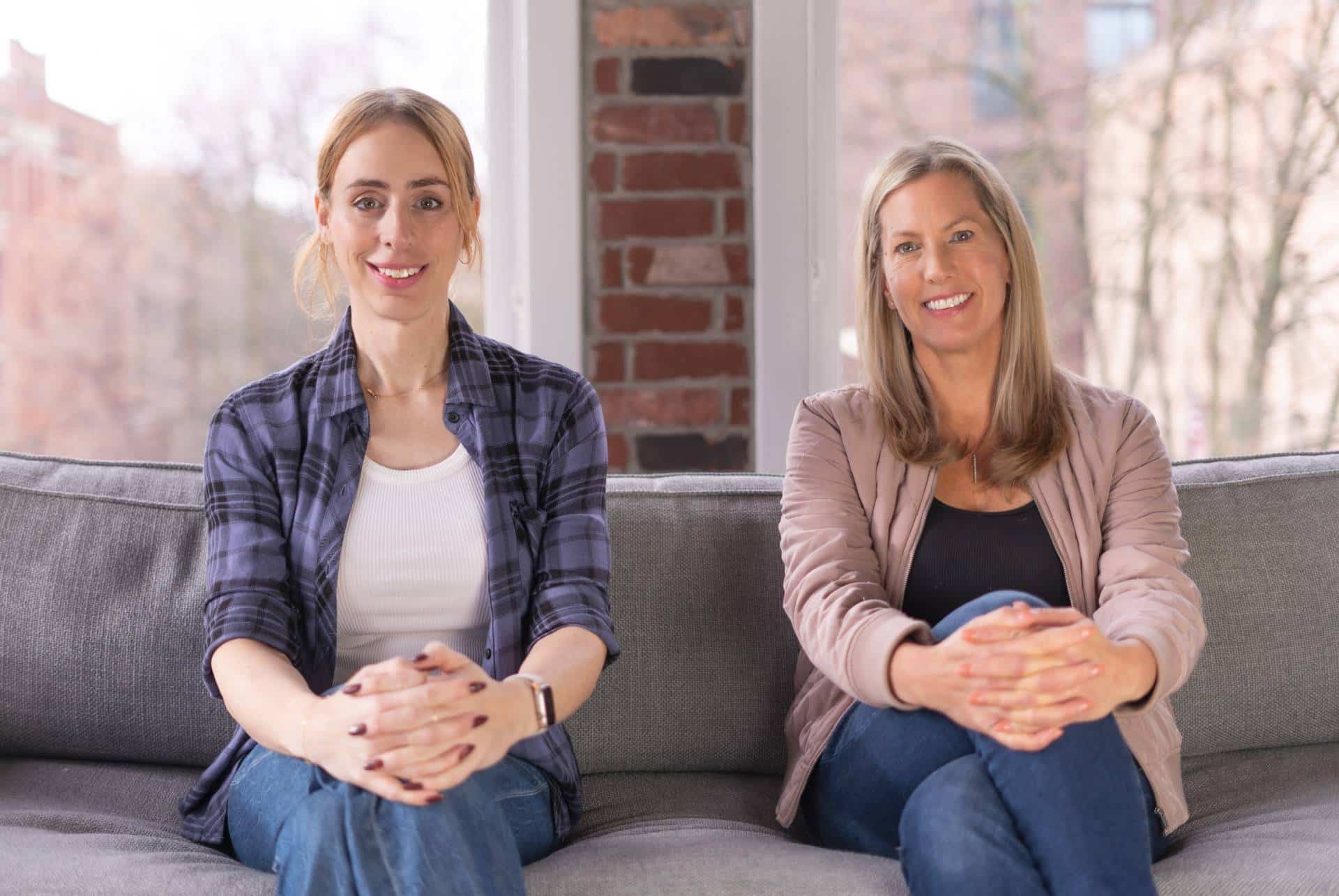
Joon Care CEO Emily Pesce (left) and cofounder and Chief Psychologist Amy Mezulis. (Joon Photo)
Teletherapy startup Joon Care raised $6 million from investors to extend the company’s runway as it grows its mental health software platform.
The Seattle startup serves patients 13- to 24-years old who need help with anxiety, depression, disordered eating, sexual and gender identity, academic problems, and other challenges.
Joon delivers therapy sessions online and provides digital mental health tools and resources to teens and young adults. It supports therapists with evidence-based care strategies and patient assessments to track progress.
“What’s great about our product is once kids get into it and they start to feel agency in a life where they’re getting whiplashed around, it feels great,” said CEO Emily Pesce. “They want to come back.”
Joon launched in 2019, spinning out of Seattle’s Pioneer Square Labs (PSL). A year later it raised $3.5 million. The latest round includes funding from past investors PSL Ventures and Route 66 Ventures, as well as Pesce herself and other unnamed sources.
The fresh cash should provide enough funding for two to three years of operations, Pesce said. The company is not profitable.
Example of an online therapy session via Joon Care. (Joon Photo)
Over the past year, Joon has added insurance plans for which it’s an in-network provider, bringing the total to eight insurers. It also launched a partnership with the City of Seattle to provide free care to clients who are referred to the startup through the city’s human services programs. And Joon became a care provider on the Valorant Health platform, a portal to digital healthcare for underserved communities.
Joon has created an approach to care that shows measurable success, according to internal research. While the company will keep working to improve its services, its focus now is on reaching the parents and guardians of the 1.6 million teens and young people that it estimates need mental health care. It’s boosting its marketing and pursuing additional partnerships to connect with clients.
Joon currently treats patients in Washington, Oregon, California, Texas, New York, Pennsylvania and Delaware. It has more than 20 employees and nearly 100 therapists.
Despite the startup’s growth, raising venture capital was difficult amid a tightened investment market, said Pesce, a finalist for Startup CEO of the Year at the 2023 GeekWire Awards. The healthcare sector is particularly tough, she added, given general struggles right now for direct-to-consumer businesses, regulatory issues in medicine, and the lack of a model for acquisitions in teletherapy.
The team is thrilled with the cash infusion, Pesce said, but added that “this is not a victory lap.”
“We’ve got a lot of work to do as a company and we’re nowhere near accomplishing what we desire to accomplish, which is to make this care far more accessible,” she said.
Hugh Grant has been very upfront about how much he hated playing an Oompa-Loompa in «Wonka,» which required him to wear an uncomfortable motion capture suit and try to envision how his performance would ultimately be rendered. At the same time, it’s also clear that he’s maintained a very positive relationship with director Paul King. The actor revealed as much in his interview with People, observing, «We seem to be on a wavelength.» King, for his part, told the outlet that he didn’t have to try very hard to get Grant to join «Wonka» as an Oompa-Loompa.
«I think he has a very pleasing lack of vanity. He’s very happy to look as ridiculous as I ask him to — I got him in a dog suit eating dog food in ‘Paddington 2.’ I think once he’d done that, he’d already hit bottom,» the director joked. «This was coming back up in the dignity state.»
Fortunately, it seems like King and Grant’s ongoing collaboration has produced another effectively sweet, memorable movie. Indeed, the early reviews for «Wonka» have been overwhelmingly positive. Contrary to what some people may have initially predicted, many have asserted that King actually does stick the landing with «Wonka.» Whether or not its critical reception will boost its box office earnings remains to be seen. Either way, it doesn’t seem that King and Grant are sick of each other yet, which means they may work together again in the future.
For what it’s worth, it won’t be the least bit surprising if they do. The two, after all, seem to share a similarly dry yet absurd sense of humor.
Influencer Alexa Losey says she mysteriously received designer shoe deliveries every month from a man she’s only ever met.
Losey said she met the men at a dinner party in New York and for the past year and a half has received shoes from Louboutin, Chanel, and Louis Vuitton right to her door.
She shared her mysterious story in a video on her popular TikTok account, in which she explained that most of the time she ends up trading the shoes for store credit as she doesn’t like them.
They met at a party in New York
In her video uploaded on November 5, Losey explained that she met the man at a party in New York a couple of years ago and briefly chatted to a group of guys – one of whom became her mystery shoe donor. During the same trip to New York, she met the man at a friend’s dinner party and said they had “light banter” with one another, making loose plans to get dinner together at some point.
Losey said she was forced to leave the city early due to work commitments and so was unable to hang out with the man again. “We didn’t really keep talking, didn’t keep in contact,” she said. “Until one say a pair of Louis Vuitton shoes just arrives at my door.”
“I did not order these shoes,” she said, adding that in the influencer industry, they know if they are about to receive a press package from the designer.
“I find a card in the box,” she described. “It’s from the guy, it says ‘wish we got to hang out’.”
Losey contacted their mutual friend who confirmed she gave her shoe size and address to the man. Losey however was less than impressed with the elaborate gesture. “It honestly kind of gave me the ick,” she said, but made sure to send him a text thanking him and adding that she was “bummed” they didn’t hang out. The influencer however only received a simple smiley face back in response.
The next month, Losey said she received Proenzer boots at her door. A month later she received Louboutins. “Eventually he didn’t even put a card in there, the shoes would just show up at my front door,” she said.
In fact, the shoes were never Losey’s style so she would end up trading them in for store credit. After a year and a year and a half, they suddenly stopped, until last month, when another pair randomly showed up with “I miss you” on the card.
Alexa Losey’s shoe admirer saw her TikTok video
After posting her original TikTok, Losey said the man saw it but found humor in her reaction. He told their mutual friend: “I wish she would have just told me what shoes she wanted because I was just picking what I thought she would like.”
This time, Alexa Losey said she got a dream pair of Chanel ballet shoes after the man asked her friend for suggestions.
“I feel a little weird, but I really like them,” she said.
TikTok users wish it was them
Losey’s video grabbed the attention of her followers, with many of them wishing they would also be sent designer shoes every month.
“Lord I see what you’ve done for others,” wrote one follower in a comment.
Considering the broad similarities between Tony Perkis and White Goodman — the fact that they’re two egotistical fitness fanatics with an unending love for the spotlight — the theory that they’re the same person has made the rounds online in the past. In fact, long before @confusedbreakfast shared it on TikTok, u/NameIdeas brought the concept to Reddit. Their lengthy write-up covers similar ground, but they take the «Heavyweights» and «Dodgeball» theory a few steps further, thoroughly breaking down the similarities between the two characters that make them appear to be the same person.
For instance, they point out that Perkis and Goodman are both depicted as woefully out of touch. It’s revealed in «Heavyweights» that Perkis grew up secluded, getting a private education, and rarely interacting with his fellow kids. In «Dodgeball,» Goodman shows his own lack of social awareness by sprinkling outdated references into his everyday speech. Both also display a deep-rooted hatred toward those perceived as ugly or overweight, and they fail to understand mythological stories. Perkis combines the stories of Icarus and Sisyphus, while Goodman believes Midas has a silver touch rather than a gold one.
«White/Tony must further his goals of «defeating» fatness, ugliness, and normalcy that is all he hates about himself so his tagline for Globo Gym is, ‘We’re better than you, and we know it.’ He has no self-esteem and must obtain it from others,» they write. With this mountain of evidence, there’s a solid case to be made that Tony Perkis and White Goodman are the same person so feel free to make «Dodgeball» a «Heavyweights» sequel in your own personal headcanon.
The Hollywood news story of the year was easily the Writers Guild of America and Screen Actors Guild strikes. Writers went on strike in May after contract negotiations with the Alliance of Motion Picture and Television Producers (AMPTP) failed. Issues the WGA was striking over included the lack of minimum staffing requirements in writers’ rooms, the lack of residuals from streaming, and the threat of being forced to work with AI-generated material. The AMPTP went months without negotiating, but eventually, a satisfactory deal was reached in September and ratified in October.
The SAG strike, which began in July, was dealing with similar problems to the WGA regarding streaming residuals and AI, along with concerns about background actors losing work to digital scans. The strike concluded with a tentative agreement in November, though concerns about loopholes regarding the usage of digital doubles and AI stirred additional controversy before its ultimate ratification in December.
Effects of the dual strikes — the first simultaneous actors’ and writers’ strike since 1960 — were felt most immediately on television. Late-night talk shows were gone from the air as soon as the WGA strike began, and fall network lineups were unusually empty. As the months dragged on, theaters were impacted as well, with major films like «Aquaman and the Lost Kingdom,» «Dune: Part Two,» and «Kraven the Hunter» delayed until the actors could finally promote them. The full impacts of the strike will still be felt in 2024, with even more delays due to the AMPTP’s reluctance to negotiate fair deals.
For every fan of the «Twilight» franchise, there appeared to be an equal and opposite force of detractors. Of course, this phenomenon of criticism and backlash isn’t exclusive to «The Twilight Saga,» as anything considered mainstream or popular is bound to become a target for ridicule. Despite box office success and an adoring fanbase, the «Twilight» movies were met with unfavorable reviews upon their release. While some criticisms, such as poor dialogue, questionable romance, and inadequate Indigenous representation, were undoubtedly valid, it is now evident in hindsight that the lead actors, Robert Pattinson and Kristen Stewart, unfairly carried the bulk of the burden as the faces of the franchise.
Unfortunately, this level of disapproval from the public contributed to Pattinson’s perception of himself as an actor. «In a lot of ways, people have decided what ‘Twilight’ is about before they’ve even thought about it, and then they’ve labeled us, the actors, as part of whatever that may be,» Pattinson told The Daily Beast. Despite acknowledging that the experience improved his acting skills, Pattinson revealed that the reviews only intensified as the franchise advanced. «I don’t know who I am as an actor,» he said. «I’ve found that the ‘Twilight’ movies were probably the hardest jobs I’ve done.» Over the years, however, the perception of «The Twilight Saga» has undergone a significant transformation, recently earning it the status of a cult classic.
Tal y como avanzan desde Bloomberg, el presidente de Serbia, Aleksandar Vučić, le acaba de entregar la nacionalidad balcánica a Stephan Gary Wozniak, Woz para los amigos, confundador de Apple. «Ahora podemos decir con orgullo que un genio de la informática es un serbio», ha comentado el presidente a los medios en un momento de extrema tensión social, ya que Serbia adelantará sus elecciones parlamentarias tras meses de protestas. De hecho, la primera ministra Ana Brnabic puntualizó que esta acción es una de tantas que el Estado está promoviendo en materia de educación tecnológica.
Steve Wozniak, de ascendencia ucraniana y polaca, confirma así que su estado de salud es mucho mejor y ya se ha recuperado del ictus que sufrió mientras asistía al Foro Mundial de Negocios en Santa Fe, México. En aquel momento, al parecer, su esposa dijo que no se encontraba bien, que estaba «de forma extraña», aunque Wozniak renegó de recibir atención médica. Poco después, fue ella misma, Janet Hill, quién acabó llamando a una ambulancia, tras el desmayo de su esposo. Tras el traslado al hospital Centro Médico ABC Santa Fe se confirmó que había sufrido «un evento vascular cerebral isquémico». Ya está, en cualquier caso, fuera de todo peligro.
Quién es el Steve Wozniak tras el relato que todos conocemos
Wozniak siempre se ha mostrado entre distante y descreído. Pero su aparente cinismo reside en una visión muy noble pero crítica con la industria informática. Es de sobra conocida su perspectiva crítica y analítica sobre las inteligencias artificiales y empresas como Meta, desmitificando el nacimiento de Apple o los logros maravillosos de Steve Jobs, quien se atribuyó más méritos de los que le correspondía.
Para muestra, tres botones: Wozniak, por ejemplo, se encargó del prototipo de Breakout que Atari le encargó a Jobs, tras varias noches sin dormir y sin llevarse ni un dólar de la prima de 5.000 dólares que el fundador de Atari, Nolan Bushnell, le prometió a Jobs en privado. También fue el responsable de hacer realidad la imposibilidad del Apple I y le consiguió trabajo a Jobs en Hewlett-Packard, un enlace fundamental para sus futuros contactos.
Sin embargo, Steve Wozniak ni siquiera quería ser informático. De hecho, lo fue por imposición tácita, porque era lo lógico. Un niño criado en Cupertino, hijo de un prestigioso ingeniero de Lockheed Corporation, no podía ser otra cosa. Una vez se graduó en la Homestead High School en 1968, en la primavera del 70 ya había diseñado la famosa caja azul que le valió el apodo de ‘Berkeley Blue’. Una especie de caja azul que aparece hasta en Los Simpsons y no es otra cosa que una herramienta de pirateo telefónico que hackeaba la línea para llamar gratis.
El amor secreto de Steve Wozniak
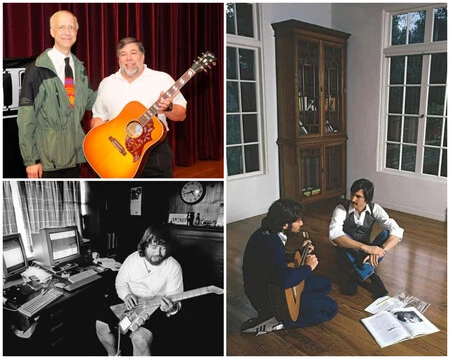
Steve Wozniak ama la música por parte de su madre. Él nunca lo quiso reconocer, pero es un guitarrista consumado, solo que nunca se ha prodigado o se ha atrevido a decirlo a las claras. «En la universidad tomé un par de libros de canciones y comencé a aprender guitarra de oído», relató en una entrevista. «Me convertí en un fan de ciertas guitarras sobre otras, pero no estoy tocando bien en este momento. Voy a muchos conciertos, pero no a los grandes espectáculos sobre-producidos. Voy a lugares más pequeños en San Francisco. Mi esposa y yo asistimos a unos 50 conciertos al año y, por lo general, observo cómo están escogiendo la guitarra, cómo obtienen el sonido».
Un freak, también. Uno que diría hace apenas un par de años «La música es una parte enorme de mi vida. Desempeña un papel integral en la creación de la persona completa». De hecho, en su pasión por la guitarra se hizo buen amigo de Steve Capps, el co-diseñador de Macintosh Finder, creador de la Jaminator, una guitarra digital que inventó él mismo y que le permitía tocar mientras trabajaba con el software Newton. Puedes verlo en la siguiente foto:
Así bien, ya solo falta ver a este nuevo Woz serbio como a su nuevo compañero de patria, el guitarrista Goran Bregovic. ¿Quizá colaboren en algún evento cultural? Como fuera, Wozniak ha pasado a formar parte de esa gran plantilla de ilustres del país como pueden ser Novak Djokovic o Nikola Tesla. Y que sea así por muchos años más.
By tackling an argument as controversial as the cultural contribution of superhero movies, Jodie Foster is showing that she’s not afraid to speak her mind. After all, Foster’s career has spanned more than 50 years dating back to her screen debut in 1969, so there’s no question her knowledge of an actor and business acumen she acquired along the way informs any debate she enters.
While Foster feels it’s not her place to talk with young female actors about the career choices they make since those are personal decisions, she told Elle she’s concerned with how they conduct themselves away from the set. «I find myself reaching out to girls who could be my daughters and saying, ‘Wait a minute, you keep doing dumb things on publicity tours. What’s going on with you? This is a little self-sabotage. You know better than that. Who’s letting you do that? And where’s your mom?’»
As such, Foster is happy to be in a position to influence female performers in a positive way.
«I do have this really big soft spot for the young actresses who came up as young people, because I just don’t know how they survive without some mother around the way I had a mom around. To be able to say, ‘You’re overexposed,’ or ‘You’re torturing yourself,’ or ‘You have to have faith in your talent,» Foster explained to Elle. «You can go away for two years and have a life and come back and there will be work for you. Yeah, maybe it won’t be in some franchise, but what do you care? This is your life.»
TikTok users have been left baffled over whether or not a viral doll is really a doll at all.
Videos of an apparent life-size doll have gone viral on TikTok, gaining millions of views, but it’s not all it seems, with viewers stumped over whether it’s human or a doll.
Although it’s difficult to tell at first, a little digging reveals all.
Still from @piranka_tik on TikTok.
The accurate doll has confused people online
You might be forgiven for immediately assuming the video does in fact show a life-size doll, but a simple search on the account behind the video shows it’s actually a very real human.
@piranka_tik regularly shares videos to TikTok pretending to be a doll, but her other videos show her real life, away from being a doll.
On November 30, Piranka went viral on TikTok for her version of a “basketball doll” in which she dressed up as an eerily accurate Lakers player doll. Beginning covered in a sheet of plastic, the man behind the camera ripped it off her, revealing the doll-human. The video can be seen through this link here.
Piranka stood perfectly frozen in place with a cartoon expression on her face. The human-doll was holding a basketball toy, which when pushed by the camera man simply dropped with no motion from the hand.
In the other hand, she held a plastic sports bottle, which was attempted to be fed to her by the cameraman, but simply trickled down her face instead.
When the cameraman placed a coin on the doll, her basketball-shaped speaker began to play music and move her around in a circle, looking exactly like a wind-up doll.
Still from @piranka_tik on TikTok.
Viewers were confused by the TikTok viral doll video
“This is uncanny valley,” commented one TikTok user.
“Is it from a 3D printer?” asked another user.
“She should play Squid Game,” joked one comment, citing her strong ability to stay still.
Still from @piranka_tik on TikTok.
Piranka’s creation of a realistic Russian doll
More recently, Piranka went viral for another version of a doll, using her skills to create a “Russian doll.” She shared the video just last week,.
Like with the NBA doll, she was ripped out of plastic by the cameraman, revealing her frozen in place. This time, she was dressed as a Russian doll, fit with a long fur coat and hat, with a scarf around her head.
Piranka was holding a shot glass of vodka in one hand and caviar in the other, while her face stared spookily into the sky. The doll-human was wearing a mini vintage stereo, which when turned on played the viral “Moi Marmeladnyi” song that’s taken over on TikTok recently.
Viewers were similarly left stumped by this doll video too, debating in the comments whether she’s real or not.
After all this time, Richard Curtis is big enough to admit that this scene feels completely weird and even acknowledges that people now feel like Mark is basically stalking Juliet. What he does want to say, though, is that it was never intended to be as creepy as it later felt, and it didn’t seem that strange at the time.
«All I can say is that a lot of intelligent people were involved in the film at the time, and we didn’t think it was a stalker scene,» Curtis said. «But if it’s interesting or funny for different reasons [now] then, you know, God bless our progressive world.»
This isn’t the first scene from «Love Actually» that Curtis has re-evaluated as of late. While speaking to his daughter Scarlett Harris — a writer and activist — during a literature festival in England, Curtis admitted that some of the film’s body-shaming is completely regrettable. Specifically, the character Natalie (Martine McCutcheon) is frequently referred to as fat. Not only is Natalie a beautiful and normal-sized human woman, but this kind of language is never appropriate, particularly from in-universe staffers who work alongside her for the Prime Minister of England, David (Hugh Grant). «I think I was behind, you know, behind the curve, and those jokes aren’t any longer funny, so I don’t feel I was malicious at the time, but I think I was unobservant and not as, you know, as clever as I should have been,» Curtis told his daughter and the audience.
Given their unethical — to put it lightly — creation and inability to do anything other than serve others, it’s no surprise that the Decraniated became laborers for crime lords like Dryden Vos. At the same time, by pure happenstance, there are a few out there who had the chance to leave a more positive impact on the galaxy instead of serving drinks to criminals. As seen in «Rogue One: A Star Wars Story,» Dr. Evazan and his Aqualish associate, Ponda Baba, are in the Imperial-controlled world of Jedha. Their goal? As stated in «Star Wars: Rogue One: The Ultimate Visual Guide,» it’s to turn those injured during the insurgency attacks into Decraniated drones.
The two criminals are successful to some extent, though their operation is cut short when the Empire turns the Death Star superweapon on Jedha City. In the aftermath of the attack, Evazan and Baba leave Jedha behind, likely to cause more pain and misery elsewhere in the galaxy. They leave their Decraniated subjects behind and a few go on to fight a noble cause. They join the remaining members of the Partisans resistance group and do what they can to interfere in the Empire’s ongoing kyber mining operation that has greatly harmed the planet.
Still, even though some of them fought the good fight against the Empire, there’s no denying that the Decraniated should’ve never come to exist. The heinous acts committed by Dr. Evazan to create them make it clear exactly why he had the death sentence in 12 systems.
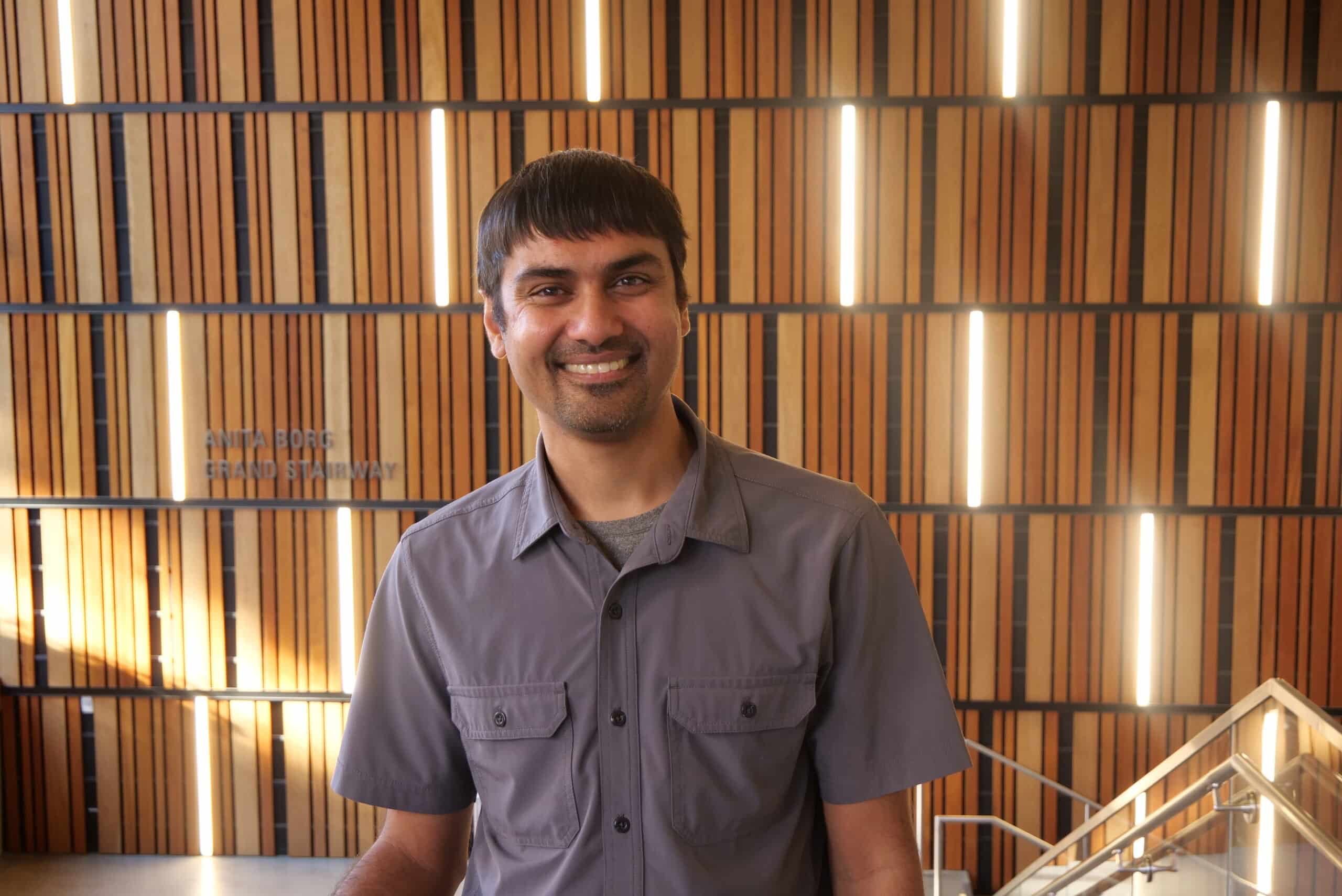
Shwetak Patel landed in Seattle in 2008. Since then, he’s co-founded three startups built on technology he helped invent. Patel currently leads a health tech group at Google and is a professor at the University of Washington. (GeekWire Photo / Todd Bishop)
Editor’s Note: This is part of a series profiling “Uncommon Thinkers”: inventors, scientists, technologists and entrepreneurs transforming industries and driving positive change. All six will be recognized this week at the GeekWire Gala on Dec. 6. Uncommon Thinkers is presented in partnership with Greater Seattle Partners. Read other profiles here.
Shwetak Patel isn’t a medical professional. He isn’t a licensed electrician.
But he is a self-described “naive innovator” — a quality that helps him develop out-of-the-box ideas that turn into successful startups.
“When you think about a problem on its head, you can come up with some really cool ideas,” said Patel, a renowned University of Washington computer science professor and serial tech entrepreneur.
Patel embodies what it means to be an Uncommon Thinker.
“He’s not afraid to pursue things with a weird or different approach,” said Vikram Iyer, a UW computer science professor who collaborates with Patel. “He finds questions that people aren’t asking.”
Those questions have sparked the formation of several entrepreneurial ventures built on Patel’s inventions.
Patel co-founded Zensi, which detected noise on electrical systems to monitor the energy usage of home appliances. The Seattle startup was acquired by Belkin in 2010.
He later co-founded SNUPI, which used existing power sources in homes to notify homeowners of potential hazards such as water leaks. Sears acquired the company’s technology in 2015.
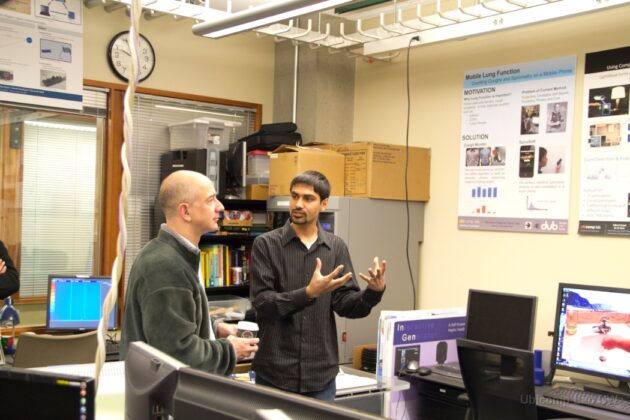
Shwetak Patel shows Amazon founder and former CEO Jeff Bezos his lab at the University of Washington. (Photo courtesy of Patel)
More recently Patel has been immersed in medical technologies, co-founding a health monitoring company called Senosis Health that was acquired by Google in 2017. He currently leads the Health Technologies group at Google as a distinguished scientist, in addition to his work as an endowed professor at the UW and director of the Ubicomp Lab.
“He has a creative brilliance you don’t find often,” said Gregory Abowd, dean of the college of engineering at Northeastern University and Patel’s Ph.D advisor at Georgia Tech.
When Patel arrived in Seattle in 2008, his entrepreneurial ambitions were met with raised eyebrows within the academic community. He didn’t just want to publish research papers. He wanted to get innovations out in the world.
“I knew I had to shepherd this stuff through, or it was going to get stuck on the shelf,” Patel said.
In many ways, Patel was a trendsetter. Now about half the students he works with at the UW express interest in commercializing their research, and many of his fellow professors also spend time inside tech companies.
“That was never a thing that used to come up,” he said. “Students are more excited about the impact their stuff can have broadly, beyond just a paper.”
Patel’s colleagues praise his ability to bridge academia and industry, as well as his skills as a collaborator and leader.
“He’s very supportive of the people he works with,” said Iyer, whose latest project with Patel involves tiny battery-free autonomous robots.
Added Abowd: “He’s not just a geek. He’s a very nice individual.”
Patel (top left) grew up in Alabama, where his parents ran a hotel and the family lived in an adjacent apartment. “My neighbors were Walmart and Taco Bell.” he said. (Photo courtesy of Patel)
Patel, 41, was born in Selma, Ala., where his parents landed after immigrating from India in the 1970s. They were engineers, but ended up managing a hotel. That’s where Patel’s father taught him how to fix broken air conditioning units and jammed vending machines — providing an early foundation for Patel’s electrical and water-sensing inventions.
“I can fix anything because of all the random stuff I did in the motels with my dad,” he said.
His parents didn’t know much about new technology, but they bought Patel a computer. “And then I just figured stuff out,” he said.
Patel graduated high school in Birmingham and headed to Georgia Tech, where he earned bachelor and Ph.D. degrees in engineering.
Abowd, his advisor, had trouble finding projects that were challenging enough for Patel. But he did come up with a way to motivate his student: telling him something couldn’t be done.
“He just loves to defy the odds, and he has the tools to back it up,” Abowd said. “He can also inspire other people to do the same. It’s a rare gift.”
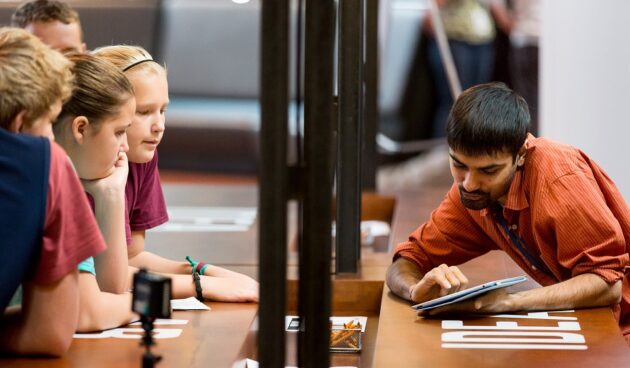
Patel working with K-12 students as part of an outreach program organized by the UW computer science school. (University of Washington Photo)
Between his current jobs at Google and the UW, Patel’s work schedule is packed. But he does find time for hobbies — tinkering with cars and watching sports (Patel is a huge Alabama football fan) — and family. His wife, Julie Kientz, is a professor and chair in the Department of Human Centered Design and Engineering at the UW.
Kientz has had a front-row seat to Patel’s nonstop motor that drives him to keep tinkering and inventing.
“His idea of vacation reading is downloading the car manual for one of his cars,” said Kientz, who met Patel at Georgia Tech.
Part of what makes Patel unique is a constant desire to learn and develop expertise — and then connect the dots.
“He’s able to pick up on all these skills and apply them across to different fields,” Kientz said.
Patel is drawn to topics that could benefit from an unconventional approach. For example, when he helped develop a mobile-based spirometer that measured lung function with a smartphone, some medical experts scoffed at the idea. Now there are several spirometer apps in the market.
“Sometimes when you approach a problem by being a non-expert, you just think about it so differently,” Patel said. He added: “I tell my students that just because an expert says it is not possible, doesn’t mean it’s not possible.”
From left: Patel with his family, wife Julie Kientz and kids Rohan, 8, and Maya, 11. (Photo courtesy of Patel)
Patel, a past winner of the prestigious MacArthur Genius grant and ACM Prize in Computing, said the tech industry is at an inflection point with the rise of AI that he believes is on par with the invention of the smartphone.
Patel is excited about how generative AI and large language models can accelerate the way researchers synthesize literature or develop algorithms.
“The pace of prototyping is much faster,” Patel said. “Engineering has gotten much faster now, too.”
Even AI hallucinations, when AI models produce false or misleading information, can be useful because it presents a new way of thinking, he said.
“It might not be perfectly framed, but it takes you down a path you wouldn’t have gone down,” Patel said, adding that it’s important for researchers to have guardrails and understand limitations of an AI program.
Patel predicts that AI will help software become more personalized and more equitable. And he thinks it will help sensors — cameras, speakers, touchscreens — become more powerful.
Patel said it’s important to identify what types of problems new AI-powered software tools can help solve. And he wants more collaboration between academia and industry, particularly with making sure universities and researchers get access to the computing capacity needed to train AI models.
As for students, Patel advises to stay flexible and not take a normal path. “Thinking differently and not going with the status quo,” he said.
And it’s perfectly fine to try many things out and not specialize too early, he said. “Don’t force yourself to be pigeonholed,” he said. “It’s OK to dabble.”
During the Parade magazine interview, Tom Cruise stated he agreed to have a face-to-face conversation with Thomas Cruise Mapother III in his early 20s after he discovered he had been hospitalized for terminal cancer. The «Top Gun» star shared he found the situation upsetting despite his decade-long estrangement from his father. «When I saw him in pain, I thought, ‘Wow, what a lonely life.’ He was in his late 40s. It was sad,» shared the actor.
In a 2004 «Inside the Actors Studio» interview, Cruise revealed he gifted his dad a figure in the likeness of Mark Twain’s beloved character Tom Sawyer. «It had the music from ‘The Sting’ on it … because he and I, we loved that movie. We saw that movie together. I gave him that as a gift, and he laughed,» shared Cruise.
While speaking to Barbara Walters in 1992, Cruise stated that his father asserted that he wanted to get to know him better after his hospital visit. «He said, ‘Look, when I get out of here, we’ll go out and we’ll have a beer. And we’ll talk about everything.’ And then he died,» he related.
While the exact reason for the actor’s choice of Hollywood name is unclear, it’s difficult to deny that the name Tom Cruise makes a big impact when the credits are rolling.
The effort to truly give Tony Stark (and, by extension, RDJ) a proper send-off was so intense that the goal was to not even do reshoots if possible. «Endgame» directors Joe and Anthony Russo were also among those who participated in the Vanity Fair cover story on the Iron Man actor’s life, and they rehashed some insights into how those final moments played out.
In the original version of the script, Tony Stark doesn’t say a word in his final showdown. Thanos says, «I am inevitable,» and Stark just snaps his fingers. However, in post-production, the directors felt a response was needed, and when the line «I am Iron Man» was pitched, they knew they needed to reshoot the scene. When they originally approached him, Downey Jr. didn’t want to revisit the emotional weight of the character and the overall MCU experience.
«We’d already said tearful goodbyes on the last day of shooting,» explained Joe Russo. «Everybody had moved on emotionally. We promised him it would be the last time we made him do it — ever.»
Anthony Russo added, «That was a difficult thing for him to do, to come back to pick up that line. When he did come back, we were shooting on a stage directly opposite where he auditioned for Tony Stark. So his last line as Tony Stark was shot literally a couple hundred feet from his original audition that got him the role.» Robert Downey Jr.’s tenure as Tony Stark came full circle. It ended right next to where it began, and the powers that be at Marvel Studios have clearly made a commitment to keep it that way.
A woman has gone viral online after sharing that she used her Tinder matches to fix up her bathroom.
When Madison Weinrich was left needing to put up her shelves but without a drill, she turned to her dating app matches.
After sharing her tip to TikTok, the influencer has gained over 2 million views, with many others sharing their own similar anecdotes.
Stills from @madison.weinrich on TikTok.
Enlisting a Tinder match to put up shelves
On December 7, Weinrich had the smart idea to use her Tinder account in a way that it might not have been intended for. “Do you have a drill?” Weinrich messaged all of her matches on the app.
“POV: You use Tinder to get your skincare shelves put up,” she wrote on-screen in her TikTok video.
Luckily for Weinrich, one of her matches appeared to have a drill and even came around to help her put up the shelves. A clip from the video showed the Tinder date drilling the shelves up on the bathroom walls.
He did a good job too, as a happy Weinrish showed the finished product, holding all her skincare on her bathroom wall.
TikTokers have also done the same
It’s innovative, but Weinrich isn’t the only one to have used a dating app in this way. Viewers flooded the comments of the viral video with their own stories of using Tinder to find their own personal handymen.
“I once did this because I wanted a guy to come help me wash and shear my show lamb,” wrote one TikTok user.
“Me getting a man from Tinder to come and jump-start my car. Work smarter not harder” added another.
One comment reads: “Mine came over with a drill and made my bed frame. Two years later and we’re buying a house.”
“Had a guy build shelves for me from Tinder. Still one of the most romantic things a man has done,” recounted a viewer in the comments.
Image by Getty Images/ Tim Robberts.
The ethics of dating app matches doing your housework
In 2016, the New York Post explored this phenomenon of daters using their apps to get housework done—and opinions were split.
While some were all for the technique, others felt it was unfair on the Tinder matches.
“I don’t feel guilty using them for a little help,” reasoned one dater to the outlet, adding that she always makes it clear that the visit isn’t a real date. She used Tinder matches to fix up her AC and also to get a ride from the city to the Hamptons.
Others however felt differently and argued that the method is a “thinly veiled exploitation” of matches. “It just seems so transparently selfish,” a dating coach told the Post, adding that they should use Craigslist instead.
Outside of acting, Chauncey Leopardi has another passion that has consumed much of his life. The former child star began smoking cannabis when he was still a teenager at the recommendation of his doctor. He took a keen interest in cannabis and began to research the history of the drug as well as various different strains. A few years later, he discovered that medical recommendations provided an exemption for him to grow his own cannabis, so he quickly started experimenting. «And then I built a little room and that was kind of the first time I hung lights or started to grow plants, which was a disaster,» Leopardi told LA Weekly.
Since that time, Leopardi has has more than two decades of experience growing his own cannabis. In the same interview, he explained that while the first 10 years were experimental, his skills improved considerably in the second. «I won’t give myself credit for it,» he said. «Obviously, I had plants in the ground back then, but I’ll give myself like a good 10 years of solid actual seeing rooms through and having a decent quality product to put out there for the consumer.»
Leopardi now owns his own recreational cannabis business in Los Angeles. Most of the products feature Squintz branding, a homage to his character from «The Sandlot.»