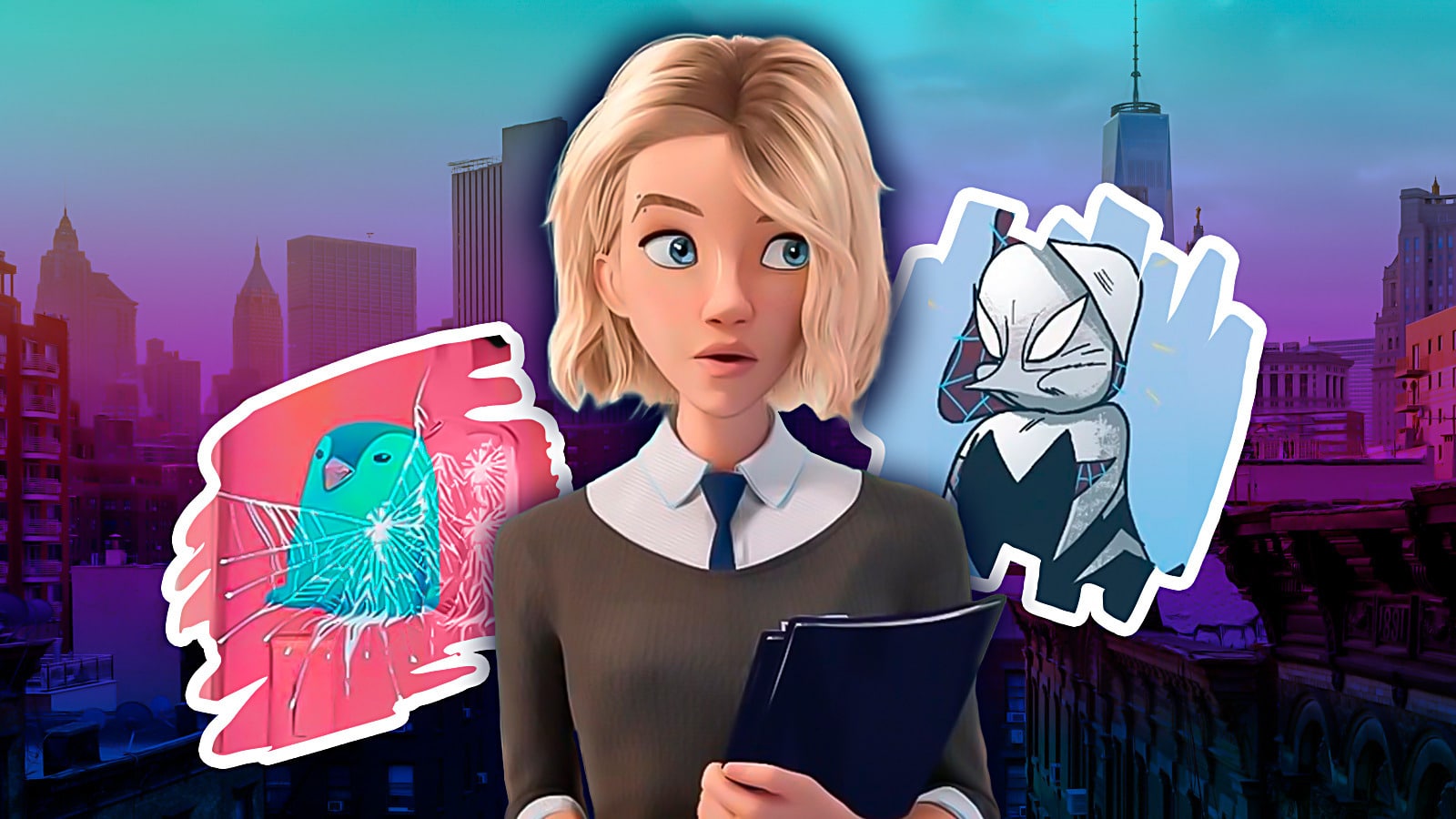
There are hundreds of versions of Spider-Man featured in «Spider-Man: Across the Spider-Verse.» However, one web-slinging variant that isn’t actually included in the film is Spider-Guin. The obscure comic book character is a resident of Earth-8311, the same world as Spider-Ham, who is voiced by John Mulaney in «Spider-Man: Into the Spider-Verse.» An anthropomorphic animal variant of Gwen Stacy, Spider-Guin is a penguin imbued with spider-like abilities.
Penguin Stacy’s existence adds some unexpected layers to Gwen’s emotional reconciliation with her father in «Spider-Man: Across the Spider-Verse.» Referencing George Stacy’s comment about his daughter shooting a web at her stuffed penguin, one TikTok commenter even observed, «‘You wanna go easy on the penguin?’ has layers [because] Gwen is a penguin in [Spider-Ham’s] universe. He’s asking her to go easy on herself.»
As dark as it is that Gwen initially thinks her father is holding a gun at her at the start of the scene in question, the detail itself represents a small, full-circle moment. After all, the prologue of «Spider-Man: Across the Spider-Verse» ends with George holding Spider-Gwen up at gunpoint and trying to arrest her. Additionally, while it’s still unclear whether or not viewers will ever get to see Penguin Stacy brought to life onscreen, it’s worth noting that «Across the Spider-Verse» does end with Gwen recruiting some of her multiversal friends to help her save Miles, including Spider-Man Noir (Nicolas Cage) and, yes, Spider-Ham.
The reintroduction of the latter character could present the door for either a Spider-Guin appearance in «Spider-Man: Beyond the Spider-Verse» or a trip to the character’s universe.
Bringing «The Little Mermaid» to the live-action realm was no easy feat. Along with ensuring that the songs, characters, and story beats lived up to the legacy of the original 1989 animated classic, there was also the practical matter of making live actors look and move like mermaids — including Javier Bardem, whose role as King Triton required plenty of prep.
Already an avid swimmer, Bardem told British GQ that after securing the part, he used his swimming time to get into the proper head space. «I would go under the water to see how my body reacted against the opposition of the water,» he explained. «It’s something that you know about, but you’re not very aware of unless you are a professional.» While shooting the movie, the actors often had rigs moving them through blue screen environments that would later be transformed into Ariel’s (Halle Bailey) underwater home.
Even with his training, Bardem’s skills were put to the test, since he had to pretend to move through water when there was none. «That’s the part that’s really challenging,» he added. «So with every movement, they will be like ‘Okay, now you are going like this,’ so they change the rig, and then ‘Now you’re gonna lay like that,’ and they change the rig again.» Still, whether handling an average day or a brush with mortality while on set, it’s hard to say that Bardem gave it anything less than his very best in bringing Triton to life.
For those who are unfamiliar, the Amy Cooper video (via CNN) follows the titular dog walker as she’s told by a nearby bird watcher, Christian Cooper, that her dog must be leashed in the area. From there, things escalate until Christian begins filming Amy as she calls the cops to say that she is «being threatened by an African-American man.»
Clearly, the video struck a chord in Beth de Araújo, who imagined a meeting between six women who look normal in «Soft & Quiet.» However, there’s nothing normal about them, as they’re working together to form a white nationalist newsletter and accost minorities in between dropping racial epithets and doing the Nazi salute in public.
It’s incredibly jarring, and horrifically, the events unfold in real-time with an intensity that will leave you gasping for breath, grimly entranced by the rising tension. «It immediately clicked that I wanted to write a role where [‘Soft & Quiet’ star] Stefanie [Estes] would play a modern-day female White Supremacist,» Araújo explained. «It just clicked from there. I ran the idea by her. She was quite nervous about it, and then I showed her the script once I had it done. She was incredibly brave to take on such a feat.»
There’s no doubt that with its influences of «Seven» (which fans theorize is a prequel to Batman), «The Conversation,» and «Zodiac,» Matt Reeves’ take on the Dark Knight was just that: dark. Like, really dark. It begs the question, then, of how and where Robin could fit in this world of cold-blooded killers and online cult leaders. Introducing a 13-year-old sidekick into a world where Batman used a severed thumb to crack a case would feel like a wild choice, but perhaps in this dark and deathly serious world, Robin doesn’t have to fly too far from the nest or Batcave.
If Dick Grayson does make an appearance in «The Batman Part II,» it might feel like a safer and more believable move to have Dick stay home and be aware but not involved in his caretaker’s evening activities. Perhaps he could stick around to keep Alfred company and learn more about the man who has taken him in from the other man who has spent his life looking after him. As is often the case, though, these are all hypotheticals for a film that has yet to confirm that anyone but Robert Pattinson as Batman will be part of the cast. We’ll be able to see for ourselves when «The Batman Part II» arrives in theatres on October 3, 2025.
Thanks to Todd Garner’s social media tease, fans can rest assured that Scorpion will return for more brutal battles in «Mortal Kombat 2» — but what about his actor? Some fans’ worries were stoked when Hiroyuki Sanada revealed to IGN as late as March 2023 that he had not been officially contracted to return as Scorpion in the sequel. It certainly wasn’t for a lack of desire on his part either, as the actor had been indicating his desire to return for a follow-up in interviews with outlets like ComicBook.com.
Thankfully, fans were able to breathe a collective sigh of relief when Deadline reported in June 2023 that Sanada would be among the major cast members reprising their respective roles for «Mortal Kombat 2.» In fact, the bulk of the cast of «Mortal Kombat» is set to return, including Joe Taslim as Scorpion’s nemesis Sub-Zero, Max Huang as Kung Lao, Chin Han as Shang Tsung, Ludi Lin as Liu Kang, Mehcad Brooks as Jax, Tadanobu Asano as Lord Raiden, Josh Lawson as Kano, and Jessica McNamee as Sonya Blade. There are also a few new faces, such as Karl Urban as Johnny Cage.
As for what exactly Scorpion’s role in «Mortal Kombat 2» will entail, the details are still unclear.
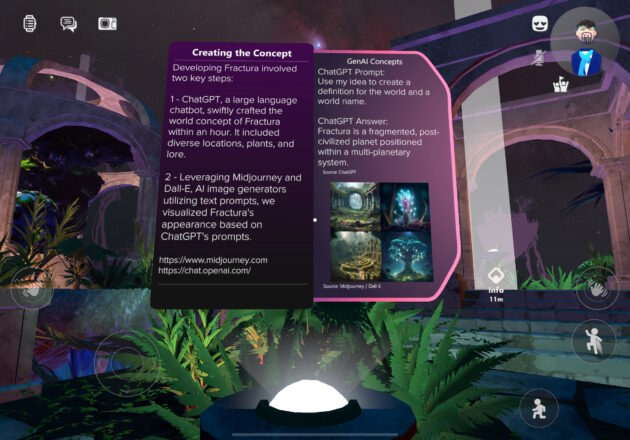
The view from inside Fractura, an alien world in Rec Room that was made from scratch using various AI tools. (Rec Room screenshot)
Video game companies are dipping their toes into the rapidly-evolving world of generative AI with behind-the-scenes development. It may soon be applied to actual gameplay.
A recent example came earlier this month from the Seattle-based creators of the popular social app Rec Room, which debuted Fractura, an in-game room created as a “research project” to demonstrate how players can use generative AI to create their own content for Rec Room.
The Seattle startup evaluated more than 20 different tools in the process of designing Fractura, such as ChatGPT to develop and iterate on their ideas, including the creation of a “bible” for Fractura’s backstory. It visualized ideas via Midjourney and DALL-E, and turned the resulting images into 3D assets with CSM and Shap-E. Finally, Fractura’s alien skies were built out with Skybox, an AI tool from Blockade Labs.
“Despite some challenges,” Rec Room wrote in a blog post, “the future for 3D GenAI looks bright, and the team looks forward to further explorations!”
Like anywhere else in tech, the debate over AI has been one of the running themes of 2023 in the games industry. Much of that debate, however, has been crowded out of the limelight by other concerns, such as a year-long wave of layoffs that has cost roughly 10,000 developers their jobs since January.
When work in the field is already unstable, no developer that I’ve spoken to has been enthusiastic about the advent of technology that could be (read: inevitably will be) used to automate and eliminate somebody’s position.
However, generative AI is already helping some studios behind the scenes.
(RoboSquad Image)
By giving ChatGPT access to the code base for its free-to-play arena shooter RoboSquad, New York-based Zorans Resistance has turned it into a useful assistant for playtesting, training, code analysis, and integrating new programs.
Zorans also trained AI to go through its recorded gameplay footage and pick out particular clips based upon recognizable keywords, such as “bug” or “Steam Play.” The AI can then organize a list and assign the potential issue to the most relevant members of the team.
“It’s definitely helped with our productivity in general, so we don’t have to watch and rewatch our gameplay videos,” said Joey Thigpen, co-lead developer.
There is an important distinction to be made between using generative AI to accelerate development processes, and using the technology to make a game with content generated by AI, said David Ryan Hunt, CEO of Noodle Cat Games in Salt Lake City.
“We’ve put a lot of attention on, ‘Oh, I made a cool picture by typing a few words!’” said Hunt. “But the reality of game development is that the majority of the work that goes into making a product is unseen.”
As Hunt notes, AI art and prose are what get all the attention in this conversation, and they also carry legal and ethical challenges.
Plagiarism stew
Generative AI tools are trained on data, much of which is scraped from publicly available online sources, which can include identifiable snippets from copyrighted work. Despite how it looks, and how it’s sold, publicly available AI isn’t creating anything; it’s grabbing everything it can find and boiling it for soup.
Professional artists such as Greg Rutkowski have discovered their online portfolios have been “harvested” by AI tools, which has flooded the internet with artwork that vaguely resembles their own styles. Some have gone so far as to fight back with tools like Nightshade, which “poisons” online artwork in ways that disrupt AI models using it as training data.
Several companies have preemptively banned AI tools for use in related projects. Valve Software made a few headlines in June when it rejected a game that was submitted for publication via its online storefront Steam, on the basis that it had been made using AI.
The game developer took to Reddit to complain on the subject, which spurred a public statement from Valve in response. According to Valve, it wasn’t the AI tools themselves, but rather, the significant risk that material produced with those tools has likely violated someone’s copyright.
“The introduction of AI can sometimes make it harder to show a developer has sufficient rights in using AI to create assets, including images, text, and music,” a Valve representative told GeekWire in July.
Valve continued: “In particular, there is some legal uncertainty relating to data used to train AI models. It is the developer’s responsibility to make sure they have the appropriate rights to ship their game. …While developers can use these AI technologies in their work with appropriate commercial licenses, they can not infringe on existing copyrights.”
Bellevue, Wash.-based Valve has consistently taken a zero-tolerance stance on any new technologies that could cause legal issues. It previously banned “play-to-earn” games on Steam in 2021, in which users could generate small amounts of cryptocurrency or collect special NFT drops by playing games.
Meanwhile, one of Steam’s competitors, the Epic Games Store, has stepped in as a storefront that will take Web3 projects, and as of September, may also be open to hosting AI-developed games.
AI content generation
An image from the pre-alpha version of Adventure Forge‘s built-in game setting, Tales of Fortunata. (Endless Adventures Image)
It’s worth restating: the problem with generative AI in video games, at least for the time being, isn’t inherent to the tools. It’s typically with the data that’s been used to train those tools, and how the tools regurgitate that data. An AI that’s simply trained using whatever data it can find can pose some serious risks, up to and including the possibility of having illegal material in its dataset.
If best practices are pursued, though, generative AI has a number of potential applications in game design, particularly in the field of content created by users.
Microsoft made headlines earlier this fall through its partnership with Inworld.AI, which promises to bring unspecified “AI-powered” upgrades to future Xbox games. In theory, AI could remove certain current limitations in game narrative, such as removing the need for generic NPC dialogue. Instead of having a few scripted lines and coded behaviors, AI-driven characters could react realistically to whatever happens to or around them.
For a more specific example, there’s Adventure Forge, scheduled for release on Steam Early Access in early 2024. It’s a no-code toolset by Seattle-area company Endless Adventures, which players can use to create their own original games, ranging from dungeon crawlers to visual novels.
This includes a built-in Stable Diffusion system by Scenario.GG that has only been trained on art assets that were created for the project by Endless Adventures. Everything that could be created for Adventure Forge with its built-in generative AI, such as new maps or in-game props, would thus fall under Endless Adventures’ copyright.
Adventure Forge will ship with over 1,500 environmental assets for players to use in their games, such as floors, walls, and furniture. In previous generations of homebrew software, those assets would be all users had to work with for the duration. With Scenario.GG’s system, though, players can simply create new Adventure Forge assets on the spot.
“This is not technology for technology’s sake,” Endless Adventures CEO Jordan Weisman told GeekWire. “This is from people whose whole lives have been about storytelling, and we want to empower storytelling, but we want to do it in a responsible way.”
Reality check
In Rec Room, visitors to Fractura can take an in-app tour that details the process by which Rec Room designed the experience, including a list of tools. (Rec Room screenshot)
The advancements from generative AI for game studios, for now, may not be massive.
“A lot of the capabilities that we have now are not very far removed from procedural generation and various types of algorithms that we’ve been using in games for decades,” said Hunt.
You’ve likely played a video game that uses procedural generation. These are created with a number of handcrafted assets, which are assembled algorithmically into a randomized order. The most famous example may be the dungeons in Blizzard’s action-RPG series Diablo, which are different every time you play the game.
The distinction between procedural generation and generative AI may seem academic from a player’s perspective, but under the hood, they’re doing two very different things. If you picture game design as a set of building blocks, then procedural generation rearranges building blocks according to a pre-programmed algorithm. Generative AI tries to create new blocks there on the spot, based on the data it’s accumulated on how blocks are supposed to work.
“We automate all sorts of different pieces of development,” said Hunt, who previously worked on Fortnite at Epic Games. “It’s not specific to AI. It’s just how the industry works.”
Current generative AI, from Hunt’s perspective, is a more advanced version of automated technologies that have already been in use in game development. Under the hood, many of the use cases for AI in game development are a simple step up from understood best practices, he said.
“There’s a big gap to me,” Hunt said, “between the discourse around AI and the practical reality of what it’s likely to look like over time.”
Over the course of the last year, bad actors have used various AI/LLM tools to create everything from quick cash-grabs, such as churning out nonsensical children’s books or flooding a sci-fi magazine with submissions, to scams that involve cloning someone’s voice in order to extort money out of their relatives.
In the games industry, there are already stories of people using the same tools to turn out simple games in a week or less. The concern is that we’re on the verge of a dark age of auto-generated machine garbage, in a business where many open storefronts already have real issues with “troll games.”
It’s likely that as its usage increases, many of the problems with AI will get worse before they get better. In the meantime, that only makes it more important to find ways to filter the signal from the noise.
After a successful 2008-2009, where «The Curious Case of Benjamin Button» earned Taraji P. Henson additional accolades from the likes of the BET Awards, NAACP Image Awards, Critics Choice Awards, and SAG Awards, the actor’s star status shot into the stratosphere. In the years since, Henson has starred in the hit series «Person of Interest» and «Empire.» As for movies, she headlined the best picture Oscar nominee «Hidden Figures» and the movie musical version of «The Color Purple.»
Speaking with Gayle King in support of «The Color Purple,» Henson explained how the numbers are deceiving when hearing about how much actors get paid. «When you hear someone go, ‘Such and such made $10 million,’ that didn’t make it to their account,» she said. «Off the top, Uncle Sam is getting 50%. Now have $5 million. Your team is getting 30% of what you gross, not after what Uncle Sam took. Now, do the math.»
Elaborating, Henson said the process of trying to reach for the top only to find herself starting anew at the bottom has left her exhausted. «I’m only human. Every time I do something and break another glass ceiling, when it’s time to renegotiate, I’m at the bottom again, like I never did what I just did, and I’m tired. I’m tired. It wears on you. What does that mean? What is that telling me? If I can’t fight for them coming up behind me then what the f*** am I doing?»
Stars Rob Delaney and Sharon Horgan had an immediate hit on their hands when they created the comedy series «Catastrophe,» a story of two people who form an unlikely connection after Sharon (Horgan) gets pregnant after a one-night stand. Though the show is already great, it’s improved by Carrie Fisher’s mere presence. Fisher plays Mia Norris, mother to Delaney’s Rob, who lives in America and is initially befuddled as to why her son is moving to London to start a family with a woman he barely knows. But as Rob and Sharon’s relationship becomes real, Mia is a source of wisdom, particularly regarding Rob’s alcoholism.
Mia knows that Rob is an alcoholic, and when he starts drinking again during Season 3, she’s stern but loving. «You never could drink,» she tells her son. «Why is it going to be any different now?» She also tells Rob that she’ll defend Sharon against him — «If you ever hit Sharon, I’ll f**king kill you» — and opens up about Rob’s father, who was also an alcoholic and physically abused her on multiple occasions. When Rob gets into a car crash at the end of the season, he hits rock bottom and takes his mother’s advice to get sober again … but because Fisher passed away while the show was still filming, its fourth and final season includes a devastating and touching funeral for Mia, serving as a send-off for Fisher as well.
If you or anyone you know needs help with addiction issues, help is available. Visit theSubstance Abuse and Mental Health Services Administration websiteor contact SAMHSA’s National Helpline at 1-800-662-HELP (4357).
If you or someone you know is dealing with domestic abuse, you can call the National Domestic Violence Hotline at 1−800−799−7233. You can also find more information, resources, and support attheir website.
Joseph Williams is returning to his post as tech policy advisor to Gov. Jay Inslee, after a stint with the Pacific Northwest Laboratory. (Jamison A. Johnson Photo)
In the five years since Joseph Williams advised Gov. Jay Inslee on tech policy as the state’s Information and Communications Technology (ICT) Sector Lead, a global pandemic upended work and home lives, artificial intelligence smartened up, and tech sector jobs in Washington — which account for 9% of the state’s workforce and nearly 22% of the state’s economy — grew by 33%.
Now, after a stint leading the Pacific Northwest National Laboratory’s Seattle office and a turn at starting a cybersecurity consulting firm, Williams is making the return to public service. For Inslee’s last year in office — and maybe beyond, depending on who becomes the next governor — Williams will fill his own shoes as the ICT lead once again.
But, the landscape is different from when he held the job from 2016 to 2019. The governors’ priorities and the ever-evolving innovative tech space has changed.
What will Williams focus on? He has five big ideas: tapping into semiconductor federal funding, building up the blockchain economy, and establishing Seattle as a tech hub for AI, quantum computing, and cybersecurity.
As ICT lead, Williams’ job has two main roles. First, he must advise the governor on policy issues of the day amid a sea of tech and political lobbyist voices.
“The idea is to keep balance,” Williams said. “The governor is really focused on how we balance the needs for affordable housing, for equity, but the fact that we also need to drive industry growth.”
That’s the other part of Williams’ job: economic development. He has five different economic development focus areas which he’ll pursue in Inslee’s last term, and potentially, beyond.
CHIPS Act money
According to Williams, he was mainly hired to pursue the $52 billion in funding available from the CHIPS and Science Act for the domestic production of semiconductors, or chips, passed in 2022. Williams described this funding as a “big pool of money we’re not taking advantage of.”
One of his ideas is to work with Washington tribes who he said have been “very poorly represented” in the CHIPS Act conversation.
“It would be good to engage with the tribes here to see if they want to get involved, how they want to get involved, that sort of thing,” Williams said.
How could tribes benefit from semiconductor technology? Williams thinks there’s a way to draw up a deal that could establish a fabrication facility using tribal land, water, and power while economically benefiting the tribes.
He still needs to work things out with the tribes, however, having only spoken to them once.
Tapping into this available money and growing the semiconductor space in Washington was the main lure for Williams when it came to signing on to the ICT lead job.
“[This work] is hard and it has a purpose,” Williams said. “If we win at this, it will improve a sector of the economy that doesn’t exist, really, or isn’t very mature, and it will potentially benefit whatever local community these things end up in.”
What’s the deal with blockchain?
Williams needs to explore blockchain in Washington. Last legislative session, lawmakers asked for a report on “potential uses and impacts of blockchain technology” in the state. According to Williams, that report isn’t done. Not only that, but he’s not even clear what they meant by “blockchain.”
“When a lot of people say blockchain, what they really mean is cryptocurrency,” Williams said. “And, I haven’t had time yet to find out what the legislature meant. Did they want a report on blockchain as in the distributed ledger technology, or did they want to really know what the cryptocurrency environment for the state of Washington is?”
He’ll puzzle that out soon.
An AI tech hub
Many investment dollars that once went to blockchain are now flowing to AI, an aside which brings Williams to his third priority: making Seattle an AI hub.
The landscape in and around Seattle with the University of Washington, Amazon, Microsoft, Facebook, Google, and Apple, all with their AI and machine-learning labs, is booming with AI innovation — but region has been left out of the national narrative on AI epicenters.
“We could do a lot more in this space,” Williams said. “We could be attracting investment capital from all over the world.”
Why not brand Seattle as “AI Central,” and attract more talent from out of state while growing more in-state talent? Williams would like to, but it’s easier said than done. Housing pressure would increase. Cost of living, with more high-paid tech jobs, would certainly go up.
“It’s not an ‘everyone wins’ proposition,” Williams said, “so, you have to weigh what everyone wants.”
Getting ahead on quantum
While on the subject of tech hubs, Williams proposed Seattle could also be the home for quantum computing, a new technology which could take two decades to develop.
Countries all over the world are investing in quantum research and the Seattle area is home to a large R&D center for one of the buzzy new startups. Williams wants to expand on that.
Quantum computing will also revolutionize the chemicals industry, Williams said. He believes that’s where Washington could excel. There are investment dollars Washington could tap into.
“It’s a quantum race,” he said. “The question becomes, ‘How are we as the state of Washington taking advantage of this?’”
Cybersecurity
All of these new technologies breed cybersecurity issues.
Recently, across the state, cyberattacks plagued hospitals and hackers stole hundreds of millions in unemployment money. Individuals can lose their identities to bad actors.
AI advancements will make these problems worse as hacking becomes not only automatic, but intelligent, Williams said.
He wants to grow the cybersecurity space in Seattle. The Biden administration has funds for cybersecurity, he said.
“I’m going to try to pull all the stakeholders together and build an ask,” Williams said.
All of these things are a way toward continued economic prosperity for Washington state, in Williams’ view. Part of his job is looking ahead to make sure the state stays ahead and can adapt to changes in tech.
“You’ve got to keep at the cutting edge of innovation to continue to attract the people who want to solve the more interesting problems,” Williams said.
In reference to a programming language he sees as ancient and dusty, Williams said: “We’re not going to build a COLBOL tech hub here. Who wants to go do COLBOL?”
However, innovation cannot be done in a vacuum. Flashy, sexy technology could drive our economy in one direction, but it could just as easily leave others out of the equation.
“If we put together a proposal for these hubs, we’re going to have to answer the equity, social justice, and housing impacts of what we’re doing,” Williams said. “You can’t just drive for the money.”
Amazon has set the date for when it will introduce ad breaks to streaming content on Prime Video: Jan. 29.
In an email to Prime subscribers on Tuesday, Amazon said the addition of limited advertisements during Prime Video movies and TV shows will allow the company “to continue investing in compelling content and keep increasing that investment over a long period of time.”
Amazon first announced the change was coming on Sept. 22, as it followed other streaming platforms such as Disney+, Netflix and Max, in offering ad-supported tiers. Netflix resisted advertising for years before finally caving as subscriber numbers dropped, adding a $7 ad-supported tier last last fall.
“We aim to have meaningfully fewer ads than linear TV and other streaming TV providers,” Amazon said in its email. “No action is required from you, and there is no change to the current price of your Prime membership.”
Amazon says it will offer an ad-free option for U.S. Prime members for an additional $2.99 per month. Live event content such as sports — Prime Video is home to “Thursday Night Football” — will continue to include advertising.
Amazon Prime currently costs $14.99 per month or $139 annually. A Prime Video-only membership is $8.99 per month.
Meet the new boss, much like the old boss: the OLED Steam Deck is a noticeable improvement on the original model, but not enough that it’s worth an upgrade. (GeekWire Photo / Thomas Wilde)
Valve Software dropped a surprise last month when it unveiled a new version of its handheld PC gaming device, the Steam Deck OLED.
After launching the original Steam Deck in February 2022, the team at Valve, based in Bellevue, Wash., had a running list of improvements it wanted to make, and it didn’t want customers to wait for a true second-generation Steam Deck.
That was a takeaway from a recent conversation GeekWire had with Lawrence Yang, a longtime designer and artist at Valve, who talked about the decision to launch a new version of the Steam Deck and lessons learned thus far from the company’s foray into handheld gaming.
“We knew that what we thought of as a true second-generation Steam Deck was years off, but as we looked at our wishlist and the technology available, we figured customers would appreciate these updates sooner rather than later,” Yang said.
The result is what Yang describes as “the definitive first-generation Steam Deck.”
Unboxing the OLED Steam Deck. (GeekWire Photo/Thomas Wilde)
I had a chance to test the 1TB model of the OLED Steam Deck ($549/659). When you put it head-to-head against the original, it’s a little better across the board. The most obvious upgrade for the OLED edition comes from its screen, which is the same size but significantly brighter.
The model is also a little lighter, with a better battery, a longer charging cable, and faster wireless connections. It’s a slight but noticeable improvement on the original in just about every category, from portability to charging time to its comfort factor. Using the Deck in close quarters like an airplane seat can still be a dubious proposition, and there are still a number of PC games that simply don’t work well on the tiny screen, but the OLED Deck does feel better to play.
The best thing about the Deck is and remains its price tag. It offers you a reasonably powerful gaming PC for a low cost up-front. I primarily use mine to bring multiplayer games with me to get-togethers, particularly head-to-head fighters.
If you’ve already got a Steam Deck, the OLED model isn’t worth trading in your current unit, but it’s a decent pickup if you’ve been waiting for an excuse.
The Steam Deck gives Valve a way to expand the audience for computer games, and runs the software for Valve’s digital gaming storefront Steam on a custom Linux-based OS. This lets you take the games in your Steam library on the road with you, playing them via the Deck’s built-in controls. Users can also use peripherals like USB hubs to connect their Decks to a monitor, mouse, and keyboard and use it like a Linux-based PC.
Failing all that, there’s nothing in place to keep tinkerers from wiping the default OS off of a new Steam Deck and installing their own software in its place.
Read more from our conversation with Yang, who joined Valve in 2015. The interview was edited for clarity.
GeekWire: What have you learned from the first year of the Steam Deck?
Yang: We’ve learned a bunch about how people have wanted to use their Steam Decks. Playing games, of course, but also doing homework, making music, and controlling robots. We’ve also seen how motivated players have been to mod their Steam Decks in both software and hardware to personalize their gaming experiences.
But most of all, we’ve heard how much people have loved their Steam Decks. The team is beyond excited to hear from happy Deck customers and we’re constantly working to make it a better experience.
We love hearing feedback, and this has helped us ship over 300 software updates specifically for Steam Deck, which include a combination of bug fixes and feature updates. This hasn’t stopped, and we have more software updates in the pipe for both Steam Deck LCD and Steam Deck OLED.
From a market perspective, the Deck has always struck me as an excellent “gateway product” for PC gaming and/or Linux. Was that a deliberate intention by the team at Valve?
One of the goals we set out to accomplish with Steam Deck was to make it as easy and comfortable to use as possible. This includes removing as many of the normal barriers to PC gaming as we could. So things like the user interface, software updates, driver updates… we didn’t want people to worry about [any of that] at all.
In a way, we wanted to take some of the best “pick up and play” aspects of consoles and implement them in a PC handheld device. We’ve seen in feedback that many view the user experience as one of the top features of Steam Deck.
And to your point, we’ve also heard that Steam Deck is the first PC for a bunch of players.
What were you hoping to accomplish with the Deck? When I attended the live preview back in 2021, there was a sort of freewheeling “why not” air in the room, but I’m curious if that’s still the case.
At a high level, we were looking for ways to make customers happy and provide more ways to play the games in their Steam libraries. Steam Deck allows you to play PC games without having to be tethered to the same PC you’ve been working at all day.
Are you still working on game compatibility on a case-by-case basis?
Yes, game compatibility testing is ongoing, with a mix of new titles, popular upcoming titles, and the rest of the Steam catalog.
While adamant that «Twisters» is not a simple update of the original movie, Glen Powell seemed to be a bit surprised to be asked about the film or its predecessor at all. «I don’t think anyone has brought up this movie in forever,» Powell told Vogue. «But talking to people, they’re like, ‘That was one of my favorite movies growing up. That movie terrified me.’»
Powell went on to mention his «Top Gun: Maverick» co-star, Tom Cruise, and something that the older actor told him while they were chatting on the set one day. «When I was working on ‘Top Gun,’ Cruise brought up a really interesting thing,» the actor recalled. «Where he’s like, ‘If you want to make movies of a certain size and scope and scale, you have to figure out what can connect with everyone around the world in every territory.’»
The «Anyone But You» star continued to explain how Cruise’s words helped him think about his upcoming film. «Humans versus weather is a very universal idea — how powerless we really are in the face of these cataclysmic forces,» the actor mused. As for «Twisters» itself, it co-stars Daisy Edgar-Jones, Anthony Ramos, Kiernan Shipka, and David Corenswet. There’s no trailer yet, but viewers can catch it storming into theaters on July 24, 2024.
Humpback whales, such as the mother and baby photographed here in Tonga, engage in complicated communications. The Earth Species Project (ESP) is partnering with researchers to develop new tools for understanding animal vocalizations to help save wildlife. (Katie Zacarian Photo)
My whippet Roxy is smart. She understands dozens of words and phrases well beyond sit and stay. She’ll “go find dad” when commanded and run to the window when asked “who’s here?”
So a couple of years ago I bought these big, paw friendly buttons that play a recorded word when pressed. The YouTube video that sold me on the technology features a pup pushing buttons to elicit the phrase “love mom.” I thought Roxy might find the tool empowering. Her big brown eyes and expressive brows can only say so much.
It turned out that while Roxy seemed to understand the concept, she despised the buttons.
But what if instead of pressuring Roxy to speak English to me, I could go full Dr. Dolittle and speak whippet to her?
A nonprofit called Earth Species Project, or ESP, is on a trajectory to talk with animals — but with a much higher purpose than my intended goals with Roxy.
“[ESP has] this amazing practical near-term conservation benefit, with this long-term, moon-shot vision of being able to communicate with animals.”
– Gabriel Miller, technology director for the Paul G. Allen Foundation
ESP is working with more than 40 research efforts around the globe, using machine learning and artificial intelligence to help scientists understand animal communications in pursuit of saving imperiled species. The organization recently received $1.2 million in funding from the Seattle-based Paul G. Allen Family Foundation to support its work. Allen, the Microsoft co-founder who passed away in 2018, was interested in both protecting wildlife and AI research.
“[ESP has] this amazing practical near-term conservation benefit, with this long-term, moonshot vision of being able to communicate with animals,” said Gabriel Miller, technology director for the foundation.
The technology could unlock valuable insights into the lives of wild animals and lead to more effective conservation, while also inspiring a greater human kinship with the natural world, say ESP leaders and supporters. They suggest the research could have an impact akin to the 1970s album of humpback whale songs that spurred critical marine mammal protections, or the Earthrise photo from Apollo 8 that captured the planet’s vulnerability and stoked environmental concerns.
Understanding animal communication can “essentially transform human perspective on how we relate to the rest of nature,” said Jane Lawton, ESP’s director of impact.
But while ESP’s intentions are to bolster a connection to animals and increase protections, the work raises serious moral and safety concerns for wildlife. Just as there are fears about the impact of AI and large language models on the human condition, there are significant risks to the natural world.
A paper this year from Princeton University professors called out “the neglect of animals in the field of AI ethics.” The article, published in the journal AI Ethics, said that “it remains the responsibility of AI companies, AI developers and scientists to identify, predict, and thereby as far as possible prevent, harms that are done to animals.”
Karen Bakker, a University of British Columbia professor and expert on the issue, is likewise worried.
“The ethical questions that arise when we imagine using digital technology to try to talk to animals are really complex,” Bakker said in an interview on the KUOW podcast The Wild.
ESP is partnering with more than 40 research efforts to improve the technology used to communicate with animals, including zebra finches, which can be studied in laboratory settings. (Photo by Lopez Lago, Creative Commons via Flickr)
ESP is developing foundational machine learning models that perform operations such as the detection and classification of animal vocalizations, as well as separating vocalizations from background noise. Funding from the Allen Family Foundation will support its work on multi-modal models that pair audible communications with visual observations, videos and movement-detecting monitors, which provides context for the sounds.
The nonprofit is developing tools that are species-agnostic and can be fine-tuned for specific research. It has dozens of partnerships, including with scientists who are researching vocal communications between carrion crows and a team investigating the calls of beluga whales and what they reveal about their social structure, among other projects.
To understand how communications could aid protections, consider, for example, the ability to decode elephant communications. Those insights could inform conservationists when and where a herd is planning to migrate, and they could take action to ensure a safe passage. Or if humans could eavesdrop on whales to learn when they’re surfacing, diving or hunting prey, it could be possible to prevent deadly ship collisions.
But while AI could be used to guide animals away from danger, it could be also used to lure them to hunters and poachers.
The ESP co-founders all come from technology backgrounds. CEO Katie Zacarian was an early Facebook employee in New York; President Aza Raskin is a tech entrepreneur and also a co-founder of the Center for Humane Technology; and senior advisor Britt Selvitelle was on the founding team at Twitter.
The most ambitious element of ESP’s work is creating two-way communication with animals. The idea follows the approach used in developing large language models like those that power ChatGPT and related generative AI tools that allow humans to engage in verbal dialogue with machines. The models are trained on massive volumes of writing, learning the patterns of speech.
Researchers can also use recordings of animal communications to build a model that converses with non-humans. But the pursuit has a particularly curious and controversial twist.
There’s a high likelihood, ESP’s Lawton said, that if a model achieves fluent, two-way communication between a computer and animal, “we will not, as the human beings, understand the meaning of that communication.”
That could be problematic. There is plenty of evidence that generative AI can use inappropriate and erroneous language in the human realm — suggesting that a computer could likewise misspeak to an animal without the knowledge or understanding of humans.
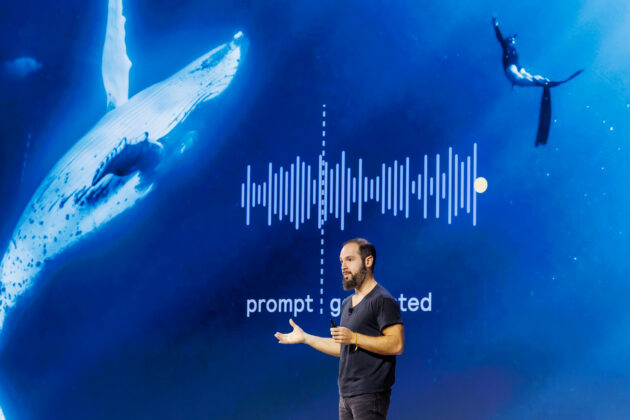
ESP cofounder and President Aza Raskin presenting on the potential of generating novel animal vocalizations using AI. (Ben Rose Photo)
There’s a lot of uncertainty about the outcome of animal-machine dialogue.
“So this could simply land flat, like the animals don’t care, they dismiss it,” Bakker said on KUOW. “Or it could actually do a great deal of harm.”
The Allen Family Foundation funding will support ESP in the generation of novel vocalizations that can be used in playback experiments that may result in the machine learning models engaging in two-way communication with another species. Researchers working with ESP currently are experimenting on communication with zebra finches in a lab setting.
ESP is working with research partners and ethics experts to determine whether there is a need to develop a set of guardrails to regulate the use of AI in animal communication research, Lawton said. The ethical issues in this space are a concern for the foundation, said Miller, and a point of active discussion.
Speaking on KUOW, ESP’s Raskin suggested the need for laws addressing cross-species communication akin to the Geneva Conventions’ humanitarian rules. Bakker countered that wasn’t enough, and called for the scientific community to develop protocols in this space that are similar to those restricting the use of CRISPR gene editing.
While the researchers and supporters acknowledge the serious ethical concerns that need to attention, they champion the technology’s potential for good.
Decades ago, Miller himself studied hummingbird vocalizations. He would have loved access to high-tech tools, he said, to decipher the diversity of the calls and discover how the birds learn to communicate with them.
“It makes data a lot more usable and practical,” he said. “The amount of power in these approaches is hard to overstate.”
From a thematic standpoint, it’s easy to see where the performer is coming from, and considering the nature of the scene, it makes a lot of sense as the wrapper for Emerald Fennell’s sophomore feature. In the case of Barry Keoghan’s final naked dance in «Saltburn,» it was also a mix of feeling powerful in his own skin and practice making perfect. According to Screen Daily, Keoghan shot the scene 11 times in order to get everything just right.
«I was trying to perfect it because I wanted it to look gorgeous with this naked figure roaming about all those rooms with their grand paintings and drapery,» Keoghan told the publication. «It’s also a thing of him feeling his power that this is his now.»
However the scene came together; like many other moments in the film, it’s destined to leave a mark on viewers who sit down with the dark comedy.
Fans, of course, lobbied endlessly to see the «Snyder Cut» of «Justice League,» which came four years after director Joss Whedon released his version of the DC superhero film in 2017. Getting the «Snyder Cut» of «Rebel Moon» apparently won’t be as long or complicated of a process, since Ed Skrein says the director has already shot the footage. And while he can’t wait for the R-rated version of the film, Skrein told THR that he enjoys the current PG-13 cut because he knows it works for the demographic it was intended for.
«Knowing what we shot for the R-rated version, Zack and Netflix did an incredible job of putting together the PG-13 version,» Skrein told THR. «I feel like it’s a really strong piece, but the shadow of the ‘Snyder Cut’ looms large. My son is 12 years old, and he came to the London premiere and loved it. I also brought my godson, my nephew, and his best mate, and they loved it, because [the PG-13 cut] is really for that demographic.»
The R-rated version, on the other hand, is deliberately intended for an older demographic. «The Snyder Cut, ‘the extended cut,’ as we’re supposed to call it, has the potential to be something seminal for the older generation,» Skrein told THR.
Thanks to tectonic shifts in technology and training, Olympic-level rowing has come a long way since the University of Washington’s eight-man crew pulled off the ultimate underdog win at the 1936 Olympics in Nazi Germany — the achievement celebrated in the brand-new movie adaptation of “The Boys in the Boat.”
On paper, the performance of the rowers at the center of the movie — and at the center of the bestselling book on which the movie is based — pales in comparison with current Olympic and world records. Today, the world’s fastest time for a 2,000-meter course is just under 5 minutes and 20 seconds, which is more than a minute faster than the time that won the gold medal for the Boys in the Boat in Berlin.
One of the big reasons for that speedup can be found at Everett, Wash.-based Pocock Racing Shells. The company’s founder, George Pocock, built the Husky Clipper — the boat in which the Boys won their Olympic gold. In the movie, Pocock (as portrayed by Peter Guinness) plays a role similar to Yoda in the Star Wars saga, performing wizardry with wood and dispensing wisdom at just the right moment.
Today, wood just doesn’t cut it for championship-level racing shells. “The boats have no wood,” says John Tytus, the current president of Pocock Racing Shells. “These boats are all built out of advanced composites, mainly carbon fiber — which, for its weight, is the strongest material available.”
Lightweight materials are just part of the equation. Hydrodynamics and computer modeling have helped Tytus and other boatbuilders tweak their designs to an extent that would impress even George Pocock.
Science has also transformed how today’s rowing men and women are being trained to outperform the Boys in the Boat. “As stark as the difference between wood and carbon fiber might be, the training volume that the crews do now, compared to what the Boys did in ’36 — that’s actually a bigger quantum leap,” Tytus says.
In the latest episode of the Fiction Science podcast, Tytus explains how innovations have taken athletic performance far beyond what moviegoers see when they watch “The Boys in the Boat.”
Building the boat
Although they’re made of sterner stuff, the racing shells that today’s rowers look pretty much the same as they did in 1936. But not exactly the same.
“There’s been a lot of work on the drag science,” Tytus says, “and so the boats are still long, but they’re not as long as they were back in the 1930s. We’re roughly talking about a 67-foot-long boat back then, 66 feet, depending on the size of the crew, [compared] to roughly 59 to 57 feet long now. But otherwise, yeah, they look very similar. Still long and skinny. Still very, very narrow. Still very tippy.”
Tytus says racing shells “are absolutely a different beast” from other boats, because they either stop or go backward every time the crew takes a stroke. That complicates the task of optimizing the way the boat moves through the water.
Engineers use computational fluid dynamics to fine-tune the design of the racing shells, as well as the shape of the oars that are used to propel them. And just as aerospace designers use wind tunnels to test out scale models of their airplanes, boatbuilders use towing tanks to put their models to real-world tests.
“A designer will build a scale model of the form of the hull that they want to drag through the water,” Tytus explains. “They load it up with sensors. The tow tank is then a pool of moving water that drags this form through that water. And it measures flow over the course of the surface area of that hull. Those have been around for a long time.”
Boatbuilder George Pocock in the University of Washington’s Canoe House. (Pocock Racing Shells Photo)John Tytus became the president of Pocock Racing Shells in 2017. (Pocock Racing Shells Photo)
When it comes to designing faster racing shells, the computer isn’t always right. “Whenever we design a new shape for a shell, a lot of it’s based on intuition and what we’ve proven to ourselves from previous iterations of hull design,” Tytus says, “because when we go and put certain shapes into various computer modeling applications, sometimes that shape looks promising in one modeling situation, and then in another program, it might look slow.”
Could artificial intelligence generate the optimal shape? “I’m afraid to go there,” Tytus admits. “I haven’t looked into that one, but I’m sure it’s coming.”
Today’s boats are built to be more adaptable to individual rowers. “The improvements would be in adjustability and what we call rigging in the sport, which is ways to modify the gearing per each athlete so that their load might be different from some of their teammates, in order to suit a different body type,” Tytus says.
Modern racing shells are wired up in ways that would have been impossible in 1936. In the movie, UW coxswain Bobby Moch (played by Luke Slattery) has a cone strapped to his mouth to urge on his eight-man crew. “Now, there’s a series of speakers in the boat, and you wear a headset,” UW women’s rowing coach Yasmin Farooq says. “And so there’s an amplification system in there.”
The racing shells are also equipped with sensors to track each rower’s performance. It wasn’t that long ago that coaches gauged their crew’s performance by eyeballing the spaces between the splashes thrown up by the oars.
“Now they have little computers on the boat, and the computers will tell you your distance per stroke, your 500-meter split and your actual speed in miles or kilometers per hour. And then of course it does your time,” Farooq says. “Also, we have these gauges you can put on the oarlocks that actually show how much force each person exerts on their blade.”
Once again, the computer doesn’t have the final word. “We will use those measurements to inform our decisions,” Farooq says, “but you still gotta have the eye at the end of the day. … When you’re doing it well, you know that computer is going to say it’s a good time.”
The human factor
The racing shells may have gotten shorter since the 1930s, but the rowers have definitely gotten bigger.
Director George Clooney and the production team for “The Boys in the Boat” put the actors portraying the Boys through five months of athletic training to get them in shape. However, even after all those workouts, there’s no way the actors — or for that matter, the 1936 Boys in the Boat — could match today’s top crews.
“The size of the actors that are acting — these are not rowers,” Tytus says. “These are actors that learned how to row well enough to film a movie. These guys are not ready to go to a national championship, trust me.”
The actors in the movie are probably similar, size-wise, to how athletes looked in the 1930s. But since then, the typical rower has become bigger and brawnier. “They average now maybe 6-foot-4 to 6-foot-6,” says Michael Callahan, head coach for men’s rowing at UW. “They weigh over 200 pounds. There’s a lot of lean muscle mass. They can produce a tremendous amount of power for six minutes.”
What’s changed? For one thing, the Boys in the Boat lacked the advantages that are typically available to today’s athletes, Callahan says.
“These guys lived through the Depression — and imagine their youth, growing up with poor nutrition and training practices,” he says. “They learned to row in college, and many of our rowers now learn to row in high school.”
The movie shows the UW crew building up their muscles by sawing through a giant log — which was actually part of the training routine back then. For today’s rowing crews, however, the training tool of choice isn’t a two-person saw but rather an ergometer rowing machine, also known as an erg. Over the years, the exercise machines have been fine-tuned to provide an experience that comes closer to feeling as if you’re actually in a boat.
On the erg, and in the boat, athletes are getting real-time feedback to help them fine-tune their performance in return.
“We’re using a lot more GPS,” Callahan says, “We know how fast we’re going at all moments. We know different training zones. … That data allows you to make more educated progress through your training program.”
The swing’s the thing
The Boys in the Boat probably wouldn’t believe how much their sport has evolved over the past 87 years. But Callahan says there are still some things his modern-day crews can learn from their predecessors.
“They had that ‘swing.’ They had that intangible,” he says. “It’s not really about the technology. It’s about nine people coming together as one, and I think that’s what they can learn. These guys were pulling for each other at the finish line, not for themselves.”
The way Farooq sees it, rowing is a sport that blends technology and biomechanics with less scientific factors, including the factor that rowers call swing.
“What’s it all about? It’s physics. It’s a sport of leverage,” she says. “It’s also a sport of endurance, power and mental toughness. So, somebody could have a really long arc initially, but if they don’t have the fitness and the power to support it, you can’t sustain it over the course of the race. And then the other thing is, somebody could have all three of those physical ingredients, but if you don’t have the mental toughness, it doesn’t mean anything.”
On top of all that, Farooq points to the feeling of pulling together — that intangible feeling of swing. “If a person comes off the power, the pressure in a boat, that kills the rhythm,” she says. “So, it doesn’t matter how strong the other people are, or the force, or arc that they are contributing. If one person comes off the rhythm, that’s it.”
Farooq wonders if that’s the sort of feeling AI could ever match.
“I don’t know if AI wants any part of that — unless AI gets to experience emotions,” she says. “When that happens, then I guess it will be meaningful to them.”
“The Boys in the Boat” goes into wide release this weekend. Consult your favorite local listings for showtimes — and get a look at the reviews in The Seattle Times (“a sweet adaptation”), The Washington Post (“handsome but familiar”) and The Associated Press (“both stirring and a tad stodgy”).
The University of Washington is in the midst of a fundraising campaign called Pulling Together, which is tied to the movie release and will benefit UW’s rowing and student support programs as well as the restoration of its historic ASUW Shell House. Seattle’s Museum of History and Industry is also playing up the movie connection with an exhibition titled “Pulling Together: A Brief History of Rowing in Seattle.”
Looking for more books and shows that feature rowing? Check out the original version of this item on Cosmic Log for recommendations from John Tytus — and stay tuned for future episodes of the Fiction Science podcast via Apple, Google, Spotify, Player.fm, Pocket Casts and Radio Public.
You only need to skim through the trailers for all four «Thor» films to see that Chris Hemsworth has been bulking up ever since he was cast in the role, making lifting the hammer look easier with every installment. Unfortunately, the actor hit a snag when he got too big for his costume before filming his scenes for the first one. Speaking to the Los Angeles Times back in 2011, Hemsworth recalled, «[The filmmakers] kept saying, ‘Yeah, just get as big as you can, big as you can.’ And then I came back … just before we started the movie and had a final sort of camera test and put the costume on, and within a couple of minutes, my hands started going numb.»
Assessing the attire, it didn’t take long for Hemsworth and those around him to realize the issue. «Everyone was like, ‘Yeah, that’s not cool’. And I started getting pins and needles and you’d touch the skin and the blood wouldn’t return to that area so quick. And I thought, ‘Okay, it doesn’t fit.’» Fortunately, this minor setback was resolved after some alterations to both his costume and his diet and exercise routine and Hemsworth became the well-attired Avenger (albeit not the strongest) appearing in nine installments of the Marvel Cinematic Universe, thankfully with hammers and axes rather than pins and needles.
Get caught up on the latest technology and startup news from the past week. Here are the most popular stories on GeekWire for the week of Dec. 17, 2023.
Sign up to receive these updates every Sunday in your inbox by subscribing to our GeekWire Weekly email newsletter.
Most popular stories on GeekWire
Follow-up: Zulily lays off more employees as website and app remain offline Zulily’s website was “down for maintenance” Monday in the latest sign of the retailer’s collapse. … Read More
Zulily made more job cuts Wednesday, GeekWire has learned, the company’s second round of layoffs in the past two weeks and the latest move toward an apparent shutdown. … Read More
The latest chapter in the meltdown of Zulily is reading like a bad holiday fairy tale. The Seattle online retailer — battered after weeks of layoffs, website outages and management reversals — posted a message on its website saying that it has made “the difficult but necessary decision to conduct an orderly wind-down of the business to maximize value for the companies’ creditors.” To help expedite that process, Zulily said Friday that it entered into an agreement with a third-party fiduciary operating under the name of Zulily ABC LLC, a subsidiary of a San Diego-based firm by the name of Douglas Wilson Companies… Read More … Read More
Google Play Store users in Washington state are eligible for a share of a multistate $700 million antitrust lawsuit settlement reached against the tech giant. … Read More
Startup and small business owners take note: if your company has 20 or fewer full-time employees and gross annual sales of less than $5 million, there’s a new federal filing requirement that you need to know about. … Read More
Seattle’s tech industry could get a boost from the new consulate of India set to open soon. … Read More
Seattle data analytics startup MotherDuck is expanding its nest with two new leadership hires. … Read More
WNDR Museum, an interactive, tech-infused art experience near the waterfront in downtown Seattle, has ceased operations eight months after opening. … Read More
In response to social media criticism, Wizards of the Coast has released a statement that further clarifies its stance on the use of generative AI in material for the Dungeons & Dragons tabletop game. … Read More
Kaspien Holdings, a publicly traded company that helps online brands boost sales on Amazon and other e-commerce platforms, is closing up shop. … Read More
The investigation into Lee Sun-kyun’s alleged substance use came as a product of South Korea’s strict laws on drug consumption. Months before the actor’s death, South Korea’s President Yoon Suk Yeol announced in April that the nation’s government was to begin a major crackdown on all crimes relating to drugs. As shared by The Korea Times, Yoon stated during a Cabinet meeting, «The government will join all forces to win the war on drugs» and announced the establishment of an interdisciplinary team of 840 individuals to oversee the effort. The president also explained that harsh investigations and opportunities for rehabilitation were at the core of the initiative. Sure enough, Yoon’s war on drugs began to yield results in short order.
In 2023 alone, 17,152 individuals — 1,025 of them being teenagers — were booked for drug-related crimes, according to Yonhap News Agency. The publication highlighted that this is the highest number South Korea has seen in the past five years, and it marks a 38.5% increase compared to 2022’s numbers. Between March and November, roughly 2,379 people were formally arrested for drug-related crimes. All of this is to say that Lee wasn’t singled out for alleged drug use due to his being a well-known actor. South Korea’s legal system doesn’t take such crimes lightly, no matter who is charged.
Regardless of the circumstances surrounding the end of his life, and the events of his final week alive, there’s no denying that Lee Sun-kyun was a talented actor with a wealth of solid performances to his credit.