Get caught up on the latest technology and startup news from the past week. Here are the most popular stories on GeekWire for the week of Dec. 24, 2023.
Sign up to receive these updates every Sunday in your inbox by subscribing to our GeekWire Weekly email newsletter.
Most popular stories on GeekWire
Valve Software dropped a surprise last month when it unveiled a new version of its handheld PC gaming device, the Steam Deck OLED. … Read More
Thanks to tectonic shifts in technology and training, Olympic-level rowing has come a long way since the University of Washington’s eight-man crew pulled off the ultimate underdog win at the 1936 Olympics in Nazi Germany — the achievement celebrated in the brand-new movie adaptation of “The Boys in the Boat.” On paper, the performance of the rowers at the center of the movie — and at the center of the bestselling book on which the movie is based — pales in comparison with current Olympic and world records. … Read More
Amazon has set the date for when it will introduce ad breaks to streaming content on Prime Video: Jan. … Read More
In the five years since Joseph Williams advised Gov. … Read More
Tech startup investments continued to retreat in 2023 as venture capitalists tightened their belts and companies trimmed costs amid uncertainty about the broader economy. … Read More
My whippet Roxy is smart. She understands dozens of words and phrases well beyond sit and stay. … Read More
Citing new ordinances recently passed in Seattle that aim to help gig workers, the Target-owned delivery service Shipt informed customers this week that it will pause operations in the city starting Jan. … Read More
If 2022 was packed with headline-grabbing aerospace developments — including the first pictures from the James Webb Telescope and the first launch of NASA’s giant moon rocket — 2023 was what you might call a rebuilding year. … Read More
After years of hype, virtual reality still hasn’t achieved mainstream consumer adoption. … Read More
The New York Times filed a lawsuit Wednesday against OpenAI and Microsoft, accusing the companies of copyright infringement for training artificial intelligence models on millions of articles published by the newspaper. … Read More
In the pages of Marvel Comics, the Beyonder is a member of the race of the same name who becomes fascinated with Earth. He creates a planet called Battleworld and forces various heroes and villains from the Marvel roster to duke it out there for his amusement. To interact more directly with humanity, he eventually takes on a human form and walks among the beings he’d spent so long observing. The pertinent detail here is that the Beyonder is his own individual, not another Marvel Comics antagonist in disguise. However, for his MCU adaptation, that could very well change.
In their social media post regarding the Beyonder supposedly arriving in the MCU, MyTimeToShineHello mentions that the Beyonder is Marvel Studios’ ticket to recasting Kang. If this is indeed the case, it can be inferred that the MCU’s Beyonder might be a vastly powerful Kang variant. Perhaps somewhere in the ever-expanding multiverse, a version of Kang has reached a level of omnipotence unlike any of his other variants, transforming from a mere master of multiverse travel and conqueror of timelines to an all-seeing, all-knowing entity that exists outside time and space.
Could this solve the Kang problem? MCU fans will no doubt learn what the future holds for Kang and potentially the Beyonder as «Avengers: The Kang Dynasty» and «Avengers: Secret Wars» inch closer to their respective release dates.
If the Brotherhood of Mutants sounds at all familiar, it’s probably because the supervillain team is a key part of «X-Men» history — both on and off the silver screen. A dark inverse of the X-Men, the Brotherhood of Mutants debuted in Marvel Comics all the way back in 1964, mere months after the X-Men themselves were introduced to readers for the very first time. Countless iterations of the group have been featured across media in the ensuing decades, but the lineup almost invariably features some of the most well-known baddies from the «X-Men» mythos.
The comic book iteration of the Brotherhood of Mutants is often led by Magneto, lending credence to the rumor that he will appear in a movie based on the team. It has also featured mainstays like Blob, Mystique, Sabretooth, and Juggernaut, along with well-known enemies turned friends like Rogue and the Scarlet Witch. The version seen in the «X-Men» movies has a similarly revolving roster, featuring the likes of Magneto, Mystique (Rebecca Romijn), Toad (Ray Park), Sabretooth (Tyler Mane), Pyro (Aaron Stanford), Phoenix (Famke Janssen), Juggernaut (Vinnie Jones), and the Omega Gang among its ranks.
All of this is to say that a potential MCU movie focused on the Brotherhood of Mutants would have plenty of material to draw from. It could also help further distinguish the MCU’s take on the «X-Men» mythos from Fox’s iteration, and Marvel Studios has already indicated a willingness to delve into edgier team-up movies with «Thunderbolts.»
Before Anton Yelchin’s death, a recall for 2014 and 2015 Jeep Cherokee models was issued after reports of injuries from people who thought they put their vehicles in park — only for them to be in neutral and capable of rolling away. Dozens of injuries came to light, but according to The New York Times, the National Highway Traffic Safety Administration released a statement following the actor’s passing, saying, «This the first fatality we’re aware of that may be related to this safety defect and vehicle recall.»
Victor and Irina Yelchin, Anton Yelchin’s parents, filed a lawsuit against Fiat Chrysler for wrongful death and product liability. Victor Yelchin released a statement at the time of filing: «In spite of our unbelievable grief, we decided to come here to prevent other families from the same tragedy.» The Los Angeles Times reported on March 22, 2018, that the two parties had reached a confidential settlement.
No amount of money can bring a child back, but hopefully, the lawsuit and the story of what happened to Anton Yelchin will remind everyone of the preciousness of life and being aware of any product recalls regarding vehicles.
If James Gunn wants to have some fun with an otherworldly crime drama, the almost concluded «Danger Street» (by Tom King, Jorge Fornés, Dave Stewart, and Clayton Cowles) limited series would allow the eclectic director to explore a more bizarre side of the DC Comics Universe.
In 1975, DC Comics launched a new anthology series, «1st Issue Special,» with each issue starring a different character in hopes of serving as a springboard into popularity and a new ongoing book for those appearing. With several superstar creators involved, including Jack Kirby, Joe Simon, Gerry Conway, Denny O’Neil, Ramona Fradon, and Steve Ditko, the book introduced the likes of Lady Cop, Mark Shaw’s Manhunter, and Warlord while also featuring heroes in need of a boost at the time, such as Metamorpho, the Creeper, Doctor Fate, and the New Gods. The «1st Issue Special» was a failure in that it didn’t help launch any new titles — but more than 45 years after it was released, the idea was remixed into something new.
«Danger Street» stars all the heroes and villains of the original «1st Issue Special,» telling an interconnected tale involving billionaire children, murder, power struggles, and heroism. Somehow, King and Fornés combine the stories of gods, humans, and everything in between while offering a funny — and, at times, dark — reimagining of what was never meant to be a combined story. Centered on Starman and Warlord’s quest to join the Justice League, each issue features a domino falling in the world around them as a result of their terrible plan. «Danger Street» would make an excellent anthology series, with each episode focusing on a different hero.
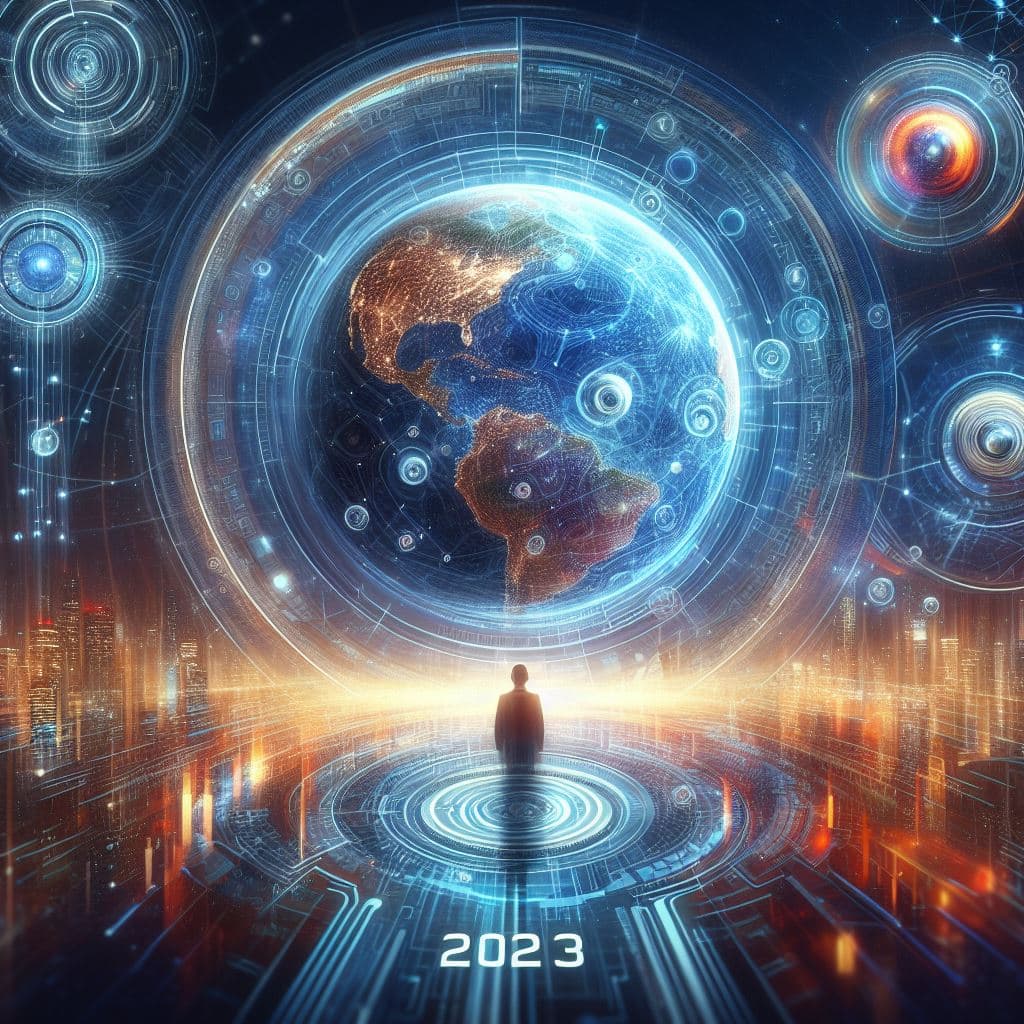
Image created by AI in Microsoft Designer, based on the prompt, “Generate an image reflecting the rise of AI in 2023 and what’s next in the field.”
“The biggest surprise is that AI used to be narrow. … And when you went from one application to the other, you had to redo it all from scratch. What’s really surprised us is the emergence of general tools. … It’s almost the love child of a search engine, like Google, which you can talk to about anything, with the somewhat limited but very real intelligence of AI systems.”
AI2 technical director Oren Etzioni. (AI2 Photo)
That’s computer scientist and entrepreneur Oren Etzioni, our guest this week on the GeekWire Podcast, reflecting on the past year in AI, and looking ahead to what’s next.
Etzioni, an AI leader for many decades, is professor emeritus at the University of Washington, Allen Institute for AI (AI2) board member, AI2 Incubator technical director, and Madrona Venture Group venture partner.
Among other roles, he served on the National AI Research Resource Task Force, which advised the White House on policy issues, and he’s working on a project to combat AI-related misinformation in the upcoming elections.
In the first segment of the show, my colleague John Cook and I discuss the big AI news of the week: The New York Times Co.’s lawsuit against Microsoft and OpenAI over their use of its articles in GPT-4 and other AI models.
Listen below, or subscribe to GeekWire in Apple Podcasts, Google Podcasts, Spotify or wherever you listen, and keep reading for key takeaways.
Highlights from Oren Etzioni’s comments, edited for clarity and length:
The evolution of AI in the past year: “It’s really been a wake-up call. … I like to say our overnight success has been decades in the making. And a lot of us have been aware of the potential of AI for a while. I don’t think any of us anticipated just how quickly and how dramatically, it would come in the shape of ChatGPT, and so on. But we all knew that it was coming. Now, it turns out that the rest of the world, literally, is catching up. That includes the politicians, that includes the kids, that includes the teachers. It’s now changing every aspect of society.”
The role of AI in our work and lives: “Copilot might not even be the right phrase. Maybe an assistant. And an assistant is often only as good as the tasks that you’re able to give it. We cannot delegate some things, we delegate badly, and they’re ill-specified. … I think we have here the potential of finding the drudgery, finding the things you don’t like to do, and having AI give you a big help with those.”
The “toothbrush test” for AI: “What happens next in 2024, is what somebody once called the toothbrush test. So how many times a day do you use the technology. For most of us, toothbrush is two to three times. So I think that in 2024, the toothbrush test for AI is going to explode. We’re going to find that we’re using it two, three, 10, 20 times a day. And I’m not even talking about its implicit use where you’re doing speech recognition in your car, or the Google search engine is using it to re-rank things. I’m talking about us interacting with AI systems, with our music, and our art, or in our job. I think it’s going to be easily 10 times a day on average.”
The need for strong open-source models: “The consolidation of power in AI is a huge risk. And we’ve seen some of that with the top corporations. The countervailing forces are, number one, open source models. A great analogy here is what we’ve seen in operating systems. We had Windows, which billions and billions and dollars went into. But we also had Linux, which the open-source movement championed. So I hope that we will have a Linux of language models, a Linux of AI. And I also think that the government has a role to play in making resources available.
The risks of AI-fueled misinformation: “We’ve already seen it in previous elections, but it’s gotten cheaper, easier to do with generative AI, and I am terrified of its effect on the November election … on the primaries, on the election itself, the potential for distrust, and so on. And I am determined to do something about it to help figure out how generative AI doesn’t become the Achilles heel of democracy.”
What it will take to combat AI misinformation: “I think we need strong regulations. I think we need education. People need to understand how to critically evaluate what they’re hearing, particularly over social media. … In addition, we do need watermarking, authentication, provenance, so we know where things come from. And in addition to all that, we need the ability to detect. So when I see a video, when I hear audio, I have to be able to ask, ‘Was this altered? Was this manipulated? Was this automatically generated by AI?’ With those pieces, I think we have hope to have a robust system. Without any of them, I think we are seeing some major risks.”
The prospects for AI startups: “Some people have the perception that right now, it’s hard to launch a successful startup because of the huge amount of compute power required for these massive models. I think nothing could be further from the truth. We’re at a moment of disruption, and disruption creates a lot of opportunities.”
Advice for aspiring computer scientists: “One, study the fundamentals. Math, statistics, the basic ideas of computer science, those have not changed. Those are the building blocks on which we’re building the latest technology. …
“The second thing I want to say is, follow your passion. So often, people are worried or trying to game the future. Well, I should study this because I could get that job and I should do this. You’re young, the world is changing quickly. Follow your passion, enjoy the educational process, enjoy learning what what you need to do, and these things will take care of themselves.”
Groups of up to six people can play various games inside Sandbox VR arcade locations around the world. (Sandbox VR Photo)
After years of hype, virtual reality still hasn’t achieved mainstream consumer adoption. But it sure helped my group of friends have a ton of fun earlier this month.
We spent a weeknight at Sandbox VR in Seattle, one of more than 45 locations worldwide where the San Francisco-based startup offers virtual reality experiences for groups of 2-to-6 people.
VR arcades are not new, though the technology has improved over the years. Sandbox survived the pandemic shutdowns and is now growing quickly after raising $37 million two years ago. It added 12 locations this year with plans for more in 2024. Its investors include firms such as Andreessen Horowitz and celeb investors including Justin Timberlake, Katy Perry, and Kevin Durant.
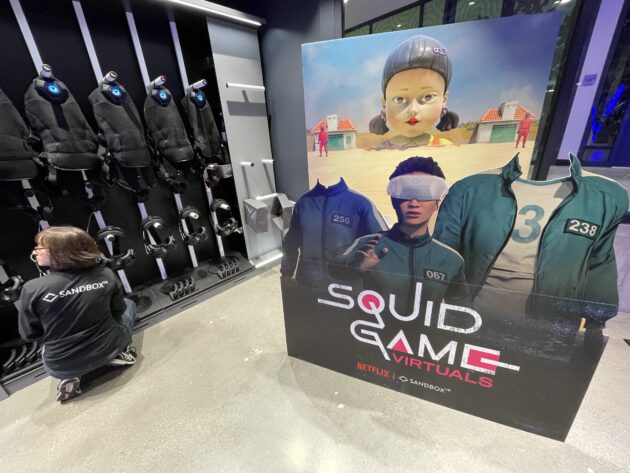
Inside the Seattle-based Sandbox VR location, where customers can experience the hit Netflix show “Squid Games” as a VR game. (GeekWire Photo / Taylor Soper)
After our group arrived at the South Lake Union location in Seattle, we spent 15 minutes for training and setup. It takes some time to strap on motion sensors to your wrists and ankles, and get comfortable wearing the vest and headset, all powered by HTC technology.
We moved into an empty room lined with overhead sensors. We strapped on our headsets and soon saw each other as virtual avatars. We laughed and commented on how trippy it was to be together in a physical space but interact in this “metaverse” of sorts.
Sandbox offers an array of games it develops in-house, including “Squid Game Virtuals,” one of the company’s newer experiences based on the hit Netflix show. It launched in September and quickly gained popularity, generating $4.5 million in revenue for Sandbox in two months.
“Squid Game Virtuals” runs through various mini-competitions, just like in the show, though instead of being eliminated you get to respawn if you happen to move excessively in “Red Light, Green Light” or fall through the glass bridge.
There was a slight glitch to start but a few minutes later, the Squid Game began.
Players collect points throughout the experience and a winner is crowned at the end. There’s a fun element of both teamwork and potential sabotage that keeps things interesting.
The motion-capture tech worked pretty well, accurately sensing your body movements — key for something like this to really work.
After 30 minutes of gameplay, we took off the headsets and watched video replays of our experience. We had a lot of fun — which seems to be a common review, according to Mason McKean, a Sandbox employee who helped our group.
“My favorite part is seeing people come in from tech companies that are mainly introverts or typically more reserved, and seeing them come out of the experience with this big smile on their face,” McKean said. “You can tell that they’re elated and relaxed and unwound a little bit, which is wonderful.”
(Sandbox VR Photo)
I would love to come back and try all the other games Sandbox offers. But I probably won’t.
Sandbox typically charges $50 to $55 per person for just 30 minutes of play. (Editor’s note: GeekWire received complimentary admission for purposes of this review.)
This might make sense for companies looking for a team-building event, or big groups celebrating birthdays or bachelor/bachelorette parties, as advertised on the company’s website.
But for me, it’s just too steep a price for too little return. The VR is definitely cool, but $50 could go a long way at a traditional arcade, pinball joint, or other forms of live entertainment. Or, I could invest in my own VR headset and play at home.
Whether Sandbox keeps growing remains to be seen. There are several competitors in the Seattle region, including Hive VR, Dimension XR, and Zero Latency.
Tim Harader, a longtime Seattle tech exec, founded a VR arcade company called Portal with his wife in 2017. The company, which had locations in Ballard and Bellevue, announced plans to shut down earlier this year.
Portal’s business was growing and reached profitability just before the pandemic began in 2020, which hit physical retail and entertainment venues hard given restrictions on indoor gathering.
Portal founder Tim Harader (right), circa 2018, inside his VR arcade that shut down this year. (GeekWire File Photo / Taylor Soper)
Harader cited other pandemic-driven impacts — people staying at home more and the shift to remote work — as well as increasing labor costs that contributed to Portal’s demise.
He isn’t sure if the VR arcade business is sustainable moving forward.
“For location-based entertainment venues, it’s a balance of reaching your maximum capacity versus your operating expenses,” he said. “It may work in some places but not others.”
Offering food and beverage could help boost revenue, he added.
Other Seattle-area venues offering VR arcades have shut down in recent years, including VR Go, Virtual Sports, and Odyssey Virtual Reality.
Harader, a former longtime Microsoft exec, is now a vice president at Librestream, which develops augmented reality technology for industrial companies.
While there are some established enterprise use cases for VR and AR, the consumer market still lacks a breakout app and headset sales dropped nearly 40% this year, according to CNBC.
Even with Apple set to release its Vision Pro headset next year and Meta continuing to invest heavily in the sector, Harader believes we’re still years away from mainstream consumer adoption. The technology just isn’t good enough, he said.
“When you think about the required power and battery life and visual clarity you need for a device that you’re going to wear for more than an hour or two — nothing is there yet,” he said. “They still have to develop better battery technology, better display technology, and more powerful compute.”
In the meantime, companies such as Sandbox — which opened a new development studio in Vancouver, B.C., this year — will try to draw customers into their locations. In a statement to GeekWire, Sandbox CEO Steve Zhao said people are “gravitating towards immersive experiences and VR is a conduit to that.”
“You see companies continue to invest in VR,” he said. “There are a lot of folks everywhere hedging on this bet because immersion is something that gamers want, and is a natural progression.”
One might expect it to take months and months of arduous preparation to assume the role of a former UFC fighter, but Jake Gyllenhaal was already well on his way toward his impressive «Road House» physique. As his trainer, Jason Walsh, noted to Insider, the actor likes to lead an intense athletic lifestyle.
«If he’s not in the gym doing strength training and conditioning, he’s swimming, he’s outside playing paddle tennis, he cycles like crazy,» Walsh described Gyllenhaal’s fitness routine. «The guy does everything. He’s just always looking for that stimulus.»
Walsh, who has worked with several Hollywood stars, has an eight-year history of training Gyllenhaal, which might just make him the world’s foremost authority regarding the actor’s physical condition, and it’s clear that the trainer feels that his diverse sports interests served him well during his preparation for the «Road House» remake.
During his interview with Wired, Zack Snyder stated that he had a very clear idea about how he wanted Wonder Woman to be depicted in the DCEU. «I wanted a Wonder Woman that was not necessarily naive. Not necessarily, like, a virgin,» he said. To illustrate his point, the filmmaker discussed a photo in his office of Wonder Woman holding several severed heads.
When Snyder was casting 2016’s «Batman v Superman: Dawn of Justice,» he seemingly knew that Gal Gadot was the perfect actor to play Wonder Woman. However, it’s worth noting that Gadot’s version of Diana never became quite as ruthless as the one depicted in Snyder’s office photo. Instead, he and «Wonder Woman» director Patty Jenkins ultimately turned her into a hero who isn’t naive when it comes to sex or violence, but who also isn’t fully prepared for the horrors of the mortal world. In the years following the release of «Wonder Woman,» Diana became a formidable beacon of hope within the DCEU.
That may not have been what Snyder originally had in mind for the character, but DCEU fans seemed to react positively to his, Gadot, and Jenkins’ combined take on the iconic hero. While Snyder’s overall Wonder Woman plans would have likely made DC Comics fans furious, there’s no denying his role in shaping the franchise’s version of the character.
Of course, like combat aircraft in real life, many ships in the «Star Wars» franchise also have ejector seats. For X-wings specifically, this idea was explored heavily in multiple books and comics, many of which are now considered Legends (non-canon). In one instance, it is revealed that an X-wing pilot’s suit has a pressure sensor that can activate a miniature magnetic shield; this would help them maintain a reliable air supply. While this is undoubtedly a downright necessity in a world where intense space battles are a constant, this may not have been much help for Porkins.
Had the Rebel pilot had such tech to rely on, he was still in the least favorable position possible. TIE fighters weren’t far off from entering the battle, and it’s unlikely any other Rebel pilot would have had the time to «pick up» their friend. So, had Porkins somehow succeeded in ejecting, he would have possibly found himself floating around and surrounded by enemy turrets and ships. And, as all fans know, the clock was ticking; that Death Star was going to go boom. Even in the hopeful world of «Star Wars,» this is simply an awful and terrifying situation to be in.
Personal mag shields or not, other chapters in the «Star Wars» franchise have shown just how horrifying it is to pilot a starship in space, especially during a dogfight. The prequels and «The Clone Wars» series is filled with clone fighter pilots letting out bone-chilling screams as they are sucked out into the cold void of space. So, Biggs telling Porkins to eject may not have been the soundest piece of advice. However, he deserves some slack. The pressure was on. They were fighting for the freedom of an entire galaxy, after all!
The New York Times headquarters in Manhattan. The newspaper’s lawsuit this week against Microsoft and OpenAI asks a federal judge to order the destruction of all AI large language models trained on its copyrighted material. (GeekWire Photo / Kurt Schlosser)
“Who can afford to do professional work for nothing?”
Bill Gates wrote those words in a landmark open letter in February 1976, calling on personal computer hobbyists to stop stealing software produced by the scrappy young “Micro-Soft” team without paying for it.
Five decades later, the same sentiment sums up The New York Times Co.’s lawsuit against Microsoft and OpenAI this week. The suit alleges that the companies wrongly used vast amounts of copyrighted material from the newspaper to train the large language models that power ChatGPT and other artificial intelligence models.
Microsoft and OpenAI “seek to free-ride on The Times’s massive investment in its journalism by using it to build substitutive products without permission or payment,” the Times Co. alleges in the introduction to the suit.
In other words, a company that built a technology empire on intellectual property rights now faces allegations that it’s flouting them in pursuit of its next phase of innovation and growth.
That irony is one of a few thoughts that came to mind while reading through the 69-page complaint filed by The Times Co. against Microsoft and OpenAI in federal court in New York City on Wednesday.
With the lawsuit, the Times Co. is drawing a legal line in the sand for the new era of AI. In addition to pursuing unspecified financial damages, the suit seeks an injunction against Microsoft and OpenAI to halt the alleged practice of using the Times’ copyrighted material, and a court order for the destruction “of all GPT or other LLM models and training sets” that incorporate its copyrighted work.
The lawsuit also delves into the implications of AI for journalism and democracy.
“Producing Times journalism is a creative and deeply human endeavor,” the suit says, adding later, “If The Times and other news organizations cannot produce and protect their independent journalism, there will be a vacuum that no computer or artificial intelligence can fill.”
The claims cover not just the alleged use of New York Times articles to train large language models, but also answers provided by ChatGPT and Microsoft Bing Chat to users. Several examples in the suit show how different prompts cause GPT-4, ChatGPT, and Bing Chat to reproduce large chunks of text, verbatim, from the newspaper’s articles.
An exhibit in the New York Times Co. lawsuit, with verbatim text in red. (Via U.S. District Court for the Southern District of New York.)
In other cases, the suit cites instances in which the AI attributes information to the Times incorrectly.
In one example, the suit says, Bing Chat “confidently purported to reproduce the sixth paragraph” from a widely cited 2015 New York Times article, Inside Amazon: Wrestling Big Ideas in a Bruising Workplace.
“Had Bing Chat actually done so, it would have committed copyright infringement,” the suit says. “But in this instance, Bing Chat completely fabricated a paragraph, including specific quotes attributed to Steve Forbes’s daughter Moira Forbes, that appear nowhere in The Times article in question or anywhere else on the internet.”
“In AI parlance, this is called a ‘hallucination.’ In plain English, it’s misinformation,” the suit says, generally referencing these types of instances.
This is one of numerous suits that promise to lay the groundwork for U.S. courts to establish precedents that could define the economics of artificial intelligence. Media consultant Dick Tofel told the New York Times in its own coverage of the lawsuit that a Supreme Court ruling on the issue is “essentially inevitable.”
Here is OpenAI’s statement.
“We respect the rights of content creators and owners and are committed to working with them to ensure they benefit from AI technology and new revenue models. Our ongoing conversations with the New York Times have been productive and moving forward constructively, so we are surprised and disappointed with this development. We’re hopeful that we will find a mutually beneficial way to work together, as we are doing with many other publishers.”
On the off chance that Microsoft tries to distance itself from OpenAI, the suit makes extensive use of comments from Microsoft CEO Satya Nadella to illustrate its instrumental role in developing and distributing the technologies in question — including statements he made to reassure investors and customers when OpenAI CEO Sam Altman was briefly ousted from the role in November.
Microsoft has not commented on the suit as of Thursday morning Pacific time.
If you’re curious about which other «X-Men» mainstays we might expect to see in «Marvel’s Wolverine,» a casting list was also leaked — and if it’s correct, fans will likely be blown away. Featuring characters who have been unexplored in previous adaptations like Mister Sinister and Omega Red, it showcases plenty to get excited about.
The list reads as follows (via DotEsports):
Mister Sinister: Troy Baker
Sabretooth: Brett Gipson
Mystique: Nicole Pacent
Sasquatch: Jeff Nordlin
Lady Deathstrike: Jolean Kim
Sunfire: Jonathan Toshiobu Tanigaki
Omega Red: Raphael Korkhill
Callisto: Debra Wilson
Tyger Tiger: Kelly Hu
Davina: Pragathi Guruprasad
Leech: Noga Wind
The leak also states — if the details are to be trusted — that Jean Grey will be in the game as a playable character, portrayed by Kirzia Bajos. While there are likely thousands of fans who are thrilled to have all this new information about the upcoming «Wolverine» game, many others have sympathized with Insomniac over the leak.
The studio itself posted a statement regarding the cyberattack and leaks on X (formerly Twitter), writing, «This experience has been extremely distressing for us. We want everyone to enjoy the games we develop as intended and as our players deserve.» The message added, «However, like Logan … Insomniac is resilient. Marvel’s Wolverine continues as planned. The game is in early production and will no doubt greatly evolve throughout development, as do all our plans.»
While Zoe Saldana’s T-Mobile commercial appearance will likely have fans reminiscing about her iconic MCU role as Gamora, it’s far from her only major franchise part. The end of the 2000s saw the performer make a splash with two massive blockbusters.
She first played Nyota Uhura in the 2009 J.J. Abrams-directed Star Trek reboot, an iconic role portrayed by the late Nichelle Nichols in the earliest Star Trek media. Saladana reprised the part of the Starfleet officer-turned-lieutenant in 2013’s «Star Trek Into Darkness» and 2016’s «Star Trek Beyond.» She also voiced Uhura for the character’s subsequent video game appearances.
2009 would also see Saldana establish herself as a box office force to be reckoned with in James Cameron’s «Avatar.» In the original installment and its 2022 follow-up, «Avatar: The Way of Water,» she portrays the fiery Na’vi warrior Neytiri, who intensely defends her home and people. Each film grossed over $2 billion at the worldwide box office, which, combined with the massive amount brought in by Saldana’s MCU entries, has helped her become the second-highest-grossing lead actress of all time, behind only fellow MCU alum Scarlett Johansson. Along with these memorable roles, Saldana has also starred in other fan-favorite flicks such as «Pirates of the Caribbean: The Curse of the Black Pearl,» «The Terminal,» and «The Book of Life.»
Some fans may find it surprising that quite possibly the most well-known part of «Home Alone» was little more than quirky improvisation. It elevated the film to a new level of iconography, remaining a pop culture fixture often seen during the holiday season even over 30 years after the original film’s release. However, the star who made it happen doesn’t hold it in the same limelight.
While on «The Ellen Show,» Macaulay Culkin admitted that he doesn’t watch «Home Alone» very often, saying that viewing the film only makes him recall what was happening that day on set. As can be imagined, fans who meet the actor often want him to recreate the iconic expression he originated from the movie. When asked what his response to these requests is, Culkin said, «No … I’ve already been there, done that already, I’m 37 now OK? OK, mom?»
It may be disappointing to some that we may never see Culkin reenact this famous scene. Even a 2018 Google commercial that saw the actor mirror several classic «Home Alone» moments didn’t see him do the scream while getting ready in the bathroom. But as with so many of the best-improvised movie moments, it’s unlikely that Culkin can recreate the same spontaneity that helped make the original scene so unforgettable.
According to Brie Larson, her Marvel heroine isn’t interested in more power because she’s already dealing with too much as it is. Instead, Larson believes that Carol Danvers needs more friends and peace in her life. During an interview with Entertainment Tonight, Larson said, «I think there is still so much inside of Carol. I feel like getting to be on this team just cracked her open in a way that she hadn’t been and I really loved that for her … I just loved her letting the shoulders drop a little bit, and not need to feel like all the responsibility was on her, so I think that there is just so much more to go.»
While the ideas of responsibility and power tend to latch themselves to a different superhero — despite Spider-Man borrowing his famous motto from another superhero — the Marvel Cinematic Universe’s interpretation of Captain Marvel deals with both in heavy measure. This is best represented by what she says to Rhodes (Don Cheadle) in «Avengers: Endgame.» When Tony accuses her of abandoning Earth, she says, «There are a lot of other planets in the universe, and unfortunately, they didn’t have you guys.» The Avengers protect their home planet, it’s true, but she protects every corner of space that permits her presence.
That’s a lot of territory for one person, even one person who can restart a literal sun. It’s no wonder Larson would rather see Carol get more moments with friends like Kamala Khan and Monica Rambeau.
Citing new ordinances recently passed in Seattle that aim to help gig workers, the Target-owned delivery service Shipt informed customers this week that it will pause operations in the city starting Jan. 10.
Birmingham, Ala.-based Shipt works like same-day delivery companies such as DoorDash and Instacart, employing gig workers to pick and/or deliver groceries and other items. Target acquired Shipt in 2017 for $550 million.
In an emailed statement to GeekWire, Shipt said action taken by the Seattle City Council will impose significant operational challenges that would impact its ability to be compliant and continue providing value and service.
The company said it has repeatedly expressed its concerns to the City over the policies.
The Seattle Times first reported the news.
The ordinances aimed at app-based delivery platforms include a 10-cent per-order fee for online deliveries in Seattle starting in 2025, approved by the Council in November. The revenue generated by the fee will help pay for the implementation and enforcement of the City’s “PayUp” gig worker protection laws in Seattle. One law sets minimum wage policies, another is related to regulations for the worker deactivation process.
Seattle Councilmember Lisa Herbold, who is departing her seat at the end of the year, was lead sponsor of the bill, CB 120706, that imposes the 10-cent fee.
“These vulnerable workers in this under-regulated industry are calling out for us to put our money where our mouth is and fund the enforcement of the protections we have approved as a council,” Herbold previously said.
Herbold said last month that the average customer will pay an additional $5.20 per year if companies pass the fee to customers — “which they don’t have to do,” she said during a Nov. 22 council meeting.
In a statement to GeekWire last month, Instacart said the bill “forces residents to foot the bill for an ill-advised ordinance amid record inflation and tightened budgets.”
GeekWire reached out to Herbold and the Council for additional comment on Shipt’s decision and we’ll update this story when we hear back. Update: Here’s a comment Herbold shared with GeekWire:
“Shipt had more than 18 months to figure out how to comply with the minimum wage requirements. While we hope they will comply with the law, the era of app-based companies paying workers less than the minimum wage is over. I’m proud to have co-sponsored this legislation. Seattle has become a national model in app-worker protections. New York City followed in our footsteps, adopting a similar law earlier this year.”
— Seattle councilmember Lisa Herbold
News of Shipt’s pause riled some commenters in the r/Seattle community on Reddit:
“Really upset about this — I’m a university student without a car and I’ve been using Shipt to get groceries delivered as there isn’t a store near me.” — PicklePotomous
“They haven’t figured out how they can successfully under pay their workers and over pay their executives here so they are shutting down.” — Slackerdc
“Apparently service is only available where the company can profit off the backs of sub-minimum wage delivery workers, and/or avoid reasonable labor standards by delivering with contractors.” — Sea_Tack
Shipt operates its membership-based platform across the U.S., making deliveries from stores including Target, Petco, QFC, Fred Meyer, Safeway and more. At the end of 2022, Shipt was partnering with 200 different retailers — a much smaller operation compared to Instacart, which says it partners with 1,400 retailers.
Shipt cut 3.5% of its filled positions and eliminated many job openings during layoffs in October, citing a dramatically changed business and industry landscape.
While Scott Leva’s performance as Spider-Man in «Spider-Man Super-Fit Youth Fitness System» may not rank among the character’s most iconic film adaptations, there’s no denying that the actor adds to the video’s, well, interesting quality. It gives fans a window into what could have been, as Leva was originally set to don the blue-and-red spandex for Spidey’s big-screen debut.
The first attempt at a Spider-Man movie started in 1985 when low-budget studio Cannon Films purchased the rights from Marvel for $225,000. Screenwriter Leslie Stevens was tasked with helming the script, with producers Menahem Golan and Yoram Globus looking to make the project a «Wolfman»-esque horror venture that would have been directed by «The Texas Chainsaw Massacre» filmmaker Tobe Hooper. While the team had high hopes that Tom Cruise would star as the titular superhero, actor-stuntman Leva was the more likely candidate, given his prior appearances as the character, including posing on the cover of «The Amazing Spider-Man #262.» Following harsh budget slashing and further rewrites, Cannon folded and was acquired by Pathe Communications. Golan, still possessing the rights, still tried getting the film made, but the license expired after financing woes kept stalling the project’s process.
As for Leva, while his Spider-Man film never came off the ground, it wouldn’t be the performer’s last rodeo with Marvel. Far from that, as he made crucial contributions as a stunt coordinator for Marvel films and shows such as «X-Men» (where, in a bSAIDD CRUZ reel, he wears a Spider-Man costume) and «Agents of S.H.I.E.L.D.» Additionally, he has been on the stunt team for other fan-favorite projects such as «A Series of Unfortunate Events,» «Everybody Hates Chris,» «Insidious,» and 2011’s «The Muppets.»
Of course, how effective this is in «Leave the World Behind» hinges heavily on how convincing the deer are. Fortunately, Sam Esmail had three exceptional crew members who helped to bring the scenes with the animals to life seamlessly. «It’s a testament to Chris Harvey, my VFX supervisor; Dione [Wood], my VFX producer; and Alec [Hart], who’s on the VFX team,» he explained.
«They knew that we wanted to make the deer feel as real as possible, and they were on set,» the «Leave the World Behind» director went on. «We had mock-ups there so that the actors had something to play off of, and we made sure that the lighting on the fur [was] as accurate as possible.»
Those painstaking details go a long way to making the growing threat of the deer more frightening and unsettling as the film goes on, and they also add to the growing mystery that powers the events of «Leave the World Behind.» While there are plenty of other aspects of the movie that are likely to have viewers squirming with anxiety and dread, the film’s eerie wildlife is definitely one of the most memorable parts of the Netflix thriller.
Ever wondered how the "Harry Potter" books and films would look like if they were written by Stephen King? This two-minute YouTube clip should have you covered.