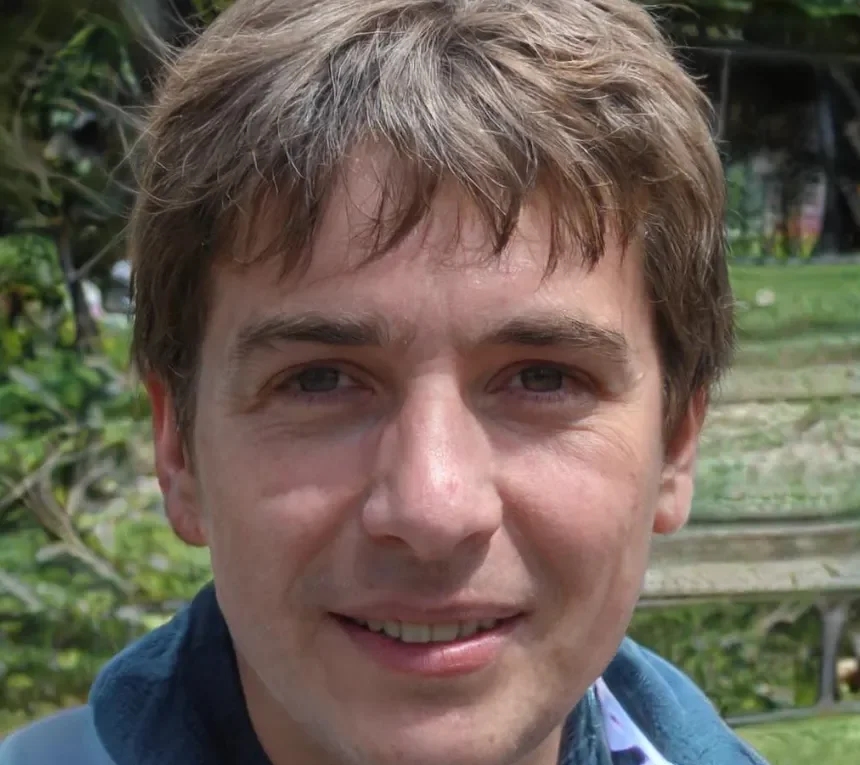
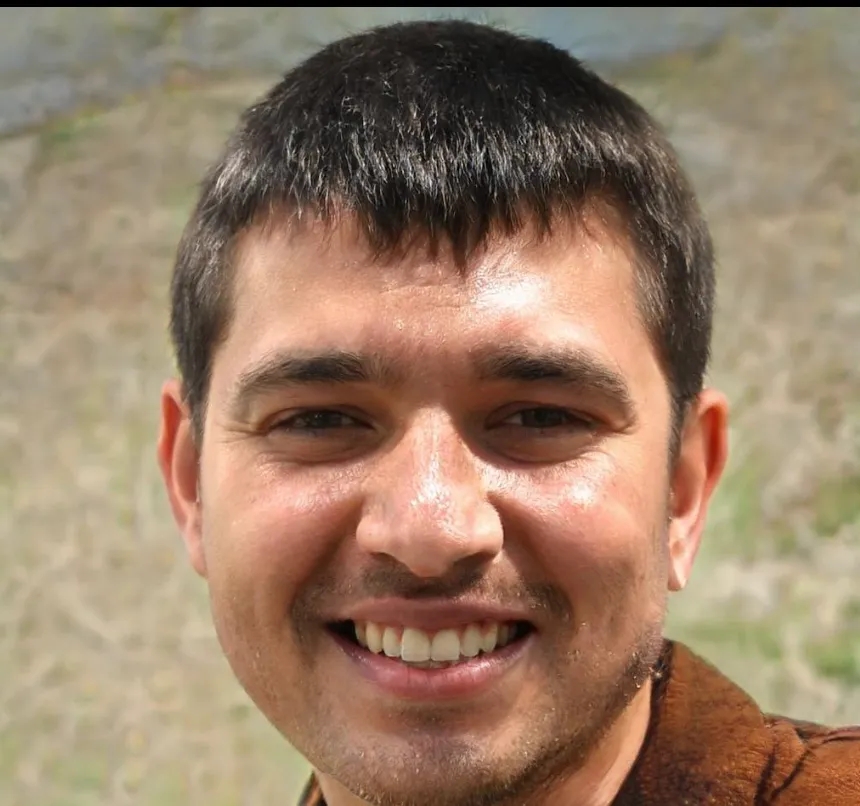
Retrocausal employees, from left: Chief Architect Andrey Konin, CEO Zeeshan Zia, and CTO Quoc-Huy Tran.
Retrocausal, a Seattle-area software startup using AI technology to help manufacturers and their employees, announced a $5.3 million investment round.
Founded in 2019, the Redmond, Wash.-based startup provides real-time instructions and feedback to front-line manufacturing employees on the factory floor. The software, which works with cameras and other tools such as barcode scanners, also compiles statistics and reports into an analytics dashboard.
Part of the company’s pitch is to use technology to address the labor shortage in manufacturing, helping untrained workers become more productive.
Retrocausal CEO Zeeshan Zia was previously a deep learning and computer vision scientist at Microsoft, where he worked on HoloLens, the company’s mixed reality headset. He co-founded Retrocausal in 2019 with CTO Quoc-Huy Tran and Andrey Konin, chief architect.
The company opened a new office in Dallas earlier this year to be closer to customers in the Midwest and Mexico. Customers include Honda, Siemens, and others.
Glasswing Ventures, One Way Ventures, and Indicator Ventures co-led the round, which included participation from Argon Ventures, Differential Ventures, Ascend Vietnam Ventures, Incubate Fund US, SaaS Ventures, Hypertherm Ventures, Stage Venture Partners, and Techstars.
Retrocausal participated in the Techstars Seattle accelerator class in 2020.
The company has nine employees. Total funding to date is $9.75 million.
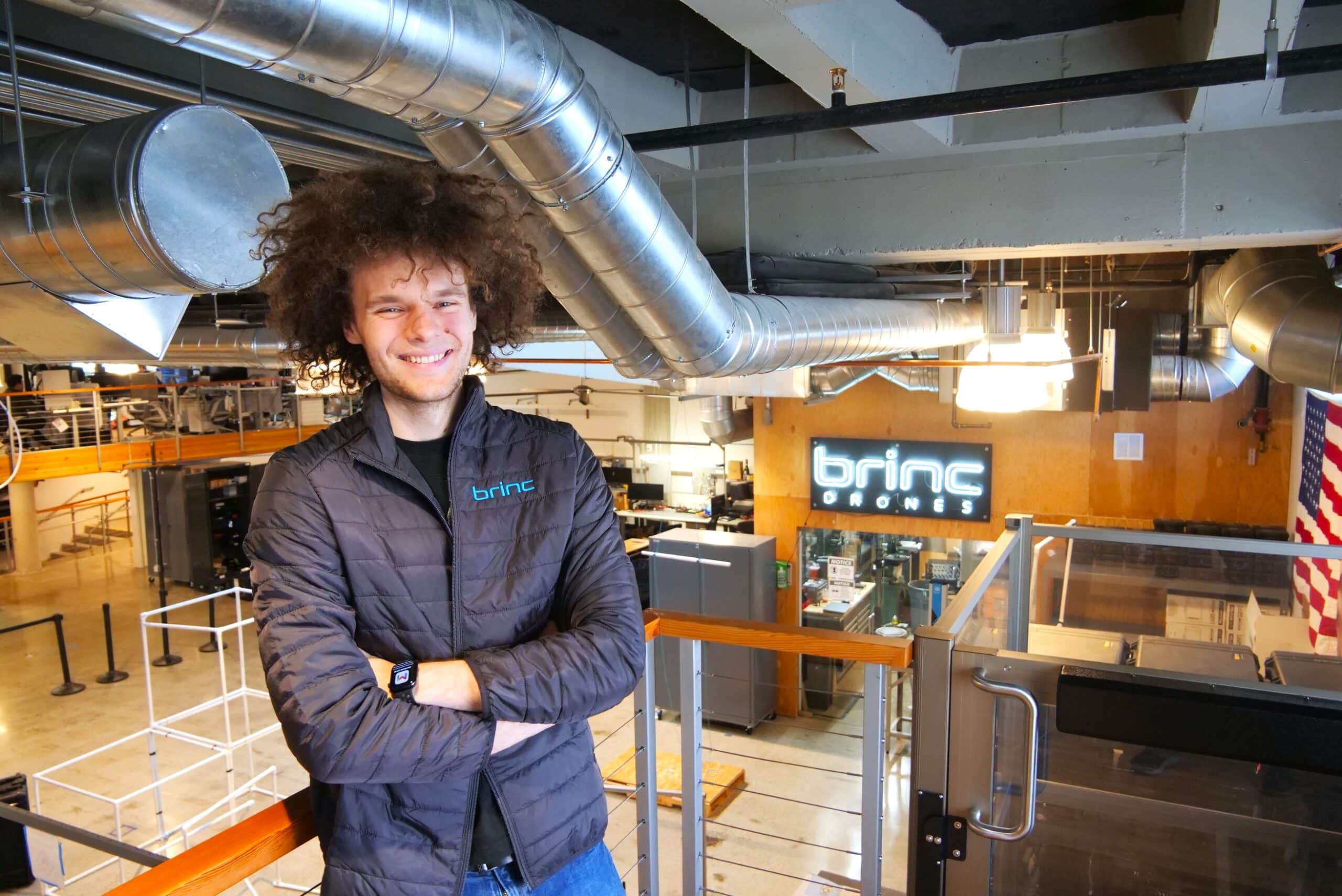
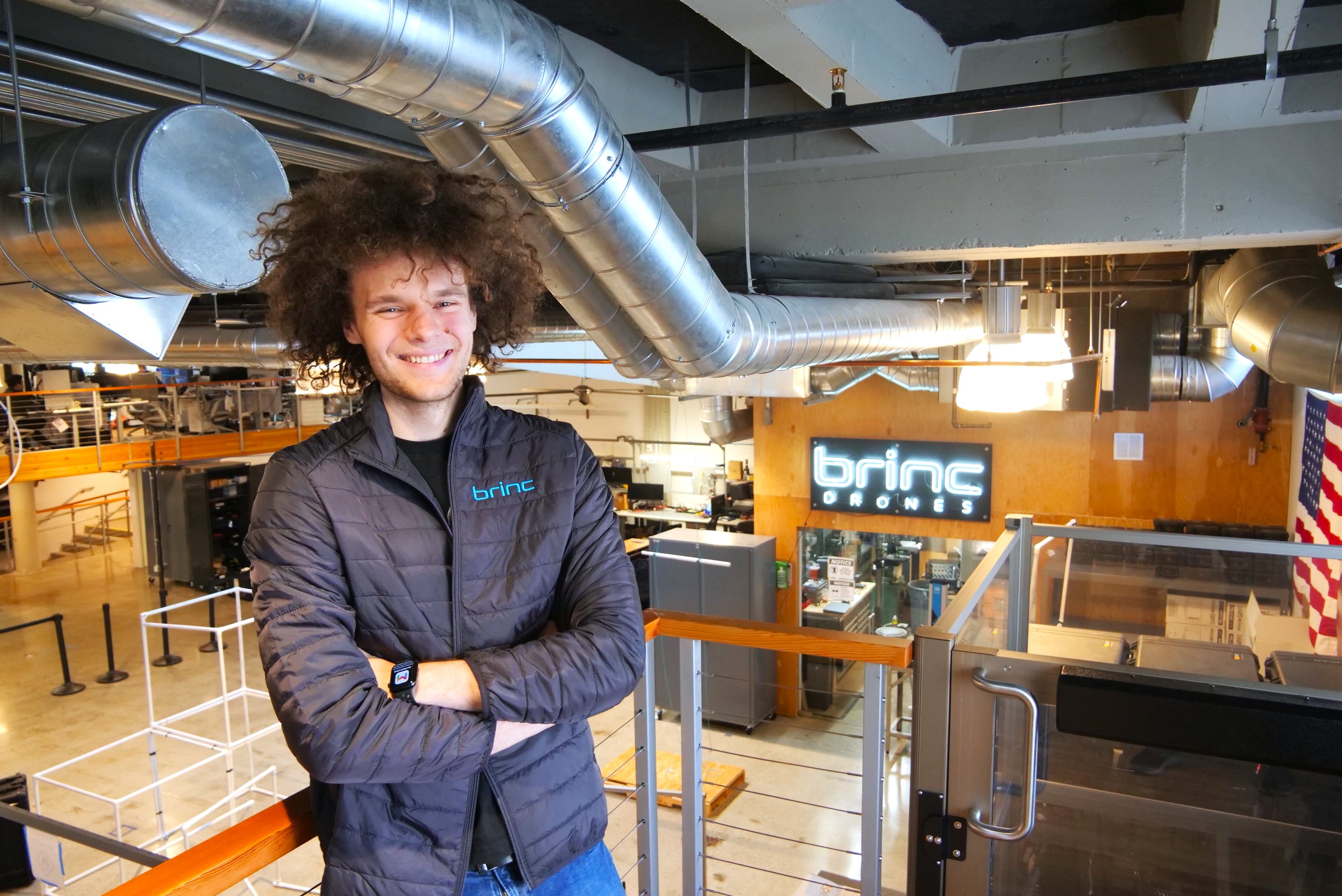
Blake Resnick at Brinc HQ in Seattle, where the company designs and manufactures its drones. (GeekWire Photo / Todd Bishop)
Editor’s Note: This is part of a series profiling “Uncommon Thinkers”: inventors, scientists, technologists and entrepreneurs transforming industries and driving positive change. All six will be recognized at the GeekWire Gala on Dec. 6. Uncommon Thinkers is presented in partnership with Greater Seattle Partners. Read other profiles here.
Don’t get your hopes up that Sam Altman will actually wire the money.
That’s what Blake Resnick’s dad told him after the call. This was long before the OpenAI CEO became known beyond Silicon Valley. Dr. Michael Resnick didn’t know exactly who Altman was. So when his son said some investor had promised him enough capital to launch his drone startup, it seemed too crazy to be true.
“But sure enough, the next day it showed up, and he was off to the races,” Michael Resnick said.
That was one of the moments that helped Blake Resnick’s dad fully appreciate his son’s uncommon way of thinking.
This was the kid who would skip classes to talk about books with the school’s principal.
This was the teenager who went to college when everybody else was in high school, only to drop out of Northwestern University’s mechanical engineering program to launch a startup.
This was the untested startup founder who somehow got one of the tech industry’s most notable angel investors to give him millions of dollars in less than 30 minutes.
Now 23 years old, Blake Resnick is the founder and CEO of Seattle-based Brinc. The company makes unmanned aerial vehicles and a throwable communications ball for police and other first responders.
After focusing initially on using drones for SWAT standoffs, Brinc envisions them ultimately allowing police to avoid dangerous high-speed chases, and helping medical providers make emergency Narcan deliveries.
Resnick started the company in response to the deadly mass shooting at the Route 91 Harvest music festival in his hometown of Las Vegas. He cold-called the Las Vegas Metro Police Department and met with its SWAT commander to learn how technology such as drones might help the department gain rapid situational awareness in crises.
The company delivered the first production units of its Lemur 2 drones to police and emergency responders in the U.S. at the begining of November. The drones can see in the dark, communicate, break glass, and map the environment, among other features, minimizing the risk to law enforcement personnel in dangerous situations.
Early customers include the New York Police Department.
Brinc is headquartered in Seattle’s Fremont neighborhood, where the company’s drones are both designed and manufactured, with help from fleets of 3D printers. Resnick oversees a team of about 100 people.
Asked if he would rather spend his time building a drone or a company, he was candid about his preference.
“I’d rather be building a drone,” he acknowledged. “For sure. I mean, it’s so much fun. It is a great time.”
But to build the best drone, he knows his focus is best placed on building the company — assembling the team with deep expertise in all of the many specialties needed to design and manufacture cutting-edge technology.
“I want to have impact,” he said. “I want to help leave the world in a better place than where I found it. And the way to do that is by building organizations, and collecting the right people, and financing them with the right capital, and making sure everyone is rowing in the same direction to do something that’s valuable to the planet.”
Resnick has an ability to see the big picture while also diving deep into the details, said Erin Price-Wright of Index Ventures, one of Brinc’s investors. Price-Wright is the other member of Brinc’s two-person board, along with Resnick.
He knows the components of the drone down to the individual part number, for example, but he’s also able to zoom out and explain how the company’s larger objectives led to specific engineering decisions, she said.
With investments in companies such as Aurora (self-driving vehicle technology) and Scale AI (AI annotation), Index Ventures hadn’t historically invested in hardware companies such as Brinc. But after spending time with Blake, people at Index were “blown away by him and his depth of thinking around this idea,” Price-Wright said.
Resnick was diagnosed with dyslexia in the first grade. He said he struggled with it especially as a kid, going through intensive reading classes. He still works long hours, he said, in part because he’s slower to process information.
Colleagues say Resnick focuses intensely on customers. He’s determined to get feedback to build the best product.
“There’s this constant drive to make a product that solves a problem,” said Walker Robb, Brinc’s vice president of engineering. “The vision for the feature set is so well-aligned with the user and what they’re trying to do. It’s not like, ‘Oh, let’s add this thing because it’s cool.’ “
After unveiling the Lemur 2 in March, for example, the Brinc team made a series of upgrades to the drone before shipping, including improvements to its antenna range, and better self-righting and obstacle avoidance capabilities.
Of course, a profile about Resnick’s uncommon way of thinking wouldn’t be complete without a question about his hair. He explained that he likes it long and messy because it’s low-maintenance. He doesn’t get haircuts often, so it just ends up that way. But it also makes him a little more memorable and recognizable, which can be helpful at times.
Resnick’s dad, Dr. Michael Resnick, is an ob/gyn who trained at Cornell University and worked at New York Hospital, Sloan-Kettering, and the Mayo Clinic, and also worked as a medical reporter for many years for ABC television.
His mom, Angela Caruso, is a special ed teacher, and he also has a younger sister.
Walking around Brinc headquarters recently, I asked Resnick if he thought his personality was more a result of nature or nurture. He offered his thoughts, and then he did something unusual, at least for an interview: he asked for my thoughts on the question, based on my own life.
“What I’m most proud about with Blake is that he has a certain kindness and awareness of others,” his dad said. “He can present like a president, but talk to anybody on the street. I’m much more proud of that — that he’s a good person, a good man, than I am just that he’s become successful.”
Circling back to the story of Sam Altman’s investment in Brinc: it gets even crazier.
As Blake Resnick explained on the GeekWire Podcast in July, he had failed a few times at fundraising and was feeling discouraged when a friend connected him to a TikTok influencer manager who was getting into startup investing.
The technology was over the head of that person, but he connected Blake to some friends, one of whom turned out to be Altman’s ex-boyfriend. He thought Resnick’s pitch was interesting and offered to connect him to Altman.
About 25 minutes into their call, Resnick was almost done with his pitch when Altman said he was very sorry but he needed to jump off early — because Elon Musk was calling on the other line. But Altman promised to follow up.
“Maybe 45 minutes go by, or an hour goes by. He sends me an email with three or four questions,” Resnick recalled. “I answer the questions, and then he replies, ‘I’ll take the whole round.’ “
Nobody dropped the tech industry’s tried and true “fail fast” mantra, but during a tour Wednesday of Amazon’s newly opened Sonic office tower in Bellevue, Wash., the theme was definitely about experimenting, learning and evolving.
And that’s not in relation to new products or services. It’s about how the people who make those things will actually work and interact with one another in a space that’s a testing ground of sorts.
Despite a pause in construction that’s impacting Amazon’s ambitious growth plans in Bellevue, the 42-story skyscraper rises to be the tallest building in the city. It looks like it could have been plucked from the tech giant’s headquarters campus across Lake Washington in Seattle’s South Lake Union neighborhood. Amazon’s three towers near The Spheres share a similar look, and Sonic is no different.
It’s inside where the company has shifted the thinking a bit, moving away from the idea that all communal space needs to be concentrated near the bottom of a building. Instead, Amazon has dispersed so-called “Centers of Energy” to a few different floors.
“We’re learning that employees are working a little bit differently than before,” said Gina Klem, an Amazon global real estate and facilities director.
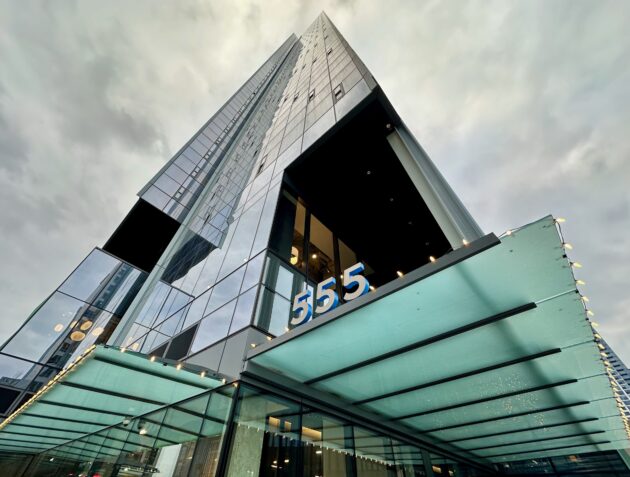
The view from street level as Amazon’s newest officer tower rises 42 stories in Bellevue, Wash. (GeekWire Photo / Kurt Schlosser)
Klem admitted that Amazon’s return to office, in which the company has asked its corporate and tech employees to be in the office at least three days a week, has been “an adjustment.” She’s focused on what types of spaces Amazon can deliver for how people are working after being gone for three years of the pandemic.
“What we are hearing is enthusiasm in the ability to connect and collaborate with one another, and in the different types of spaces for the different types of work,” Klem said.
Those spaces rely on a myriad of buzzwords, including lounges, breakout spaces, meeting rooms, focus spaces, communal centers, team suites, head-down spaces and more.
And there was another familiar term that came up: home.
“I think we tried to lean in and make it feel a little bit more like home maybe than it had in the past, so it’s a comfortable place,” said Steve Erickson, principal at the architecture firm SABA+BA, who helped lead Wednesday’s tour.
Sonic features a number of elaborate plant displays as the building is “grounded in nature,” according to the company. (GeekWire Photo / Kurt Schlosser)
Plants are definitely homey, and Amazon has plenty of its signature horticultural touches throughout the building, mimicking the look of The Spheres and Climate Pledge Arena and other spaces.
There is also lots of artwork, colorful hallways, wood accents, modern lighting and furniture, and coffee bars and eateries throughout.
And there are views. At 600 feet, the building is currently the tallest in Bellevue, and from a 32nd floor communal space, employees and visitors can easily gaze south at Mount Rainier.
At the ground level, building owner Vulcan Real Estate is leasing 21,000 square feet of retail space to Pinstripes, an Italian-American bistro with bocce and bowling.
A “Team Suite” for focused meetings and collaboration is one of many new workplace layouts Amazon is testing. (GeekWire Photo / Kurt Schlosser)
The building, at 555 108th Ave. N.E., isn’t finished though. While the exterior has been completed, Amazon has only built out about half of the interior of Sonic — roughly 450,000 square feet — up to the 19th floor. It’s waiting to proceed with the remaining buildout, and the testing of different layouts and work modes will give the company the opportunity to learn and adjust along the way. There’s no timeframe for when it will be fully completed.
Sonic (previously referred to as 555 Tower) is part of Amazon’s big push to grow in Bellevue, where the company has said it plans to put 25,000 workers across various buildings in the city, matching the headcount it plans for HQ2 in Arlington, Va.
But the pace of that growth slowed as Amazon paused construction to get a better idea of what impact hybrid work would have on its need for office space. Other buildings include Dynamo (West Main) Tower One, which will be the next to open; Bellevue 600, where the core of one tower is currently rising and another tower is paused; and The Artise, where construction is also paused.
A diner with a genuine lunch counter is one of the eateries in Sonic. (GeekWire Photo / Kurt Schlosser)
Amazon employs roughly 75,000 people in the Seattle area and 10,000 in Bellevue. Sonic is currently home to 1,000 workers primarily from operations support and technology.
Like most Amazon buildings, the name has a backstory. Klem said Sonic was the code name for when Amazon was launching Prime Now delivery in Canada and France.
Keep scrolling for more images from GeekWire’s tour of the building:
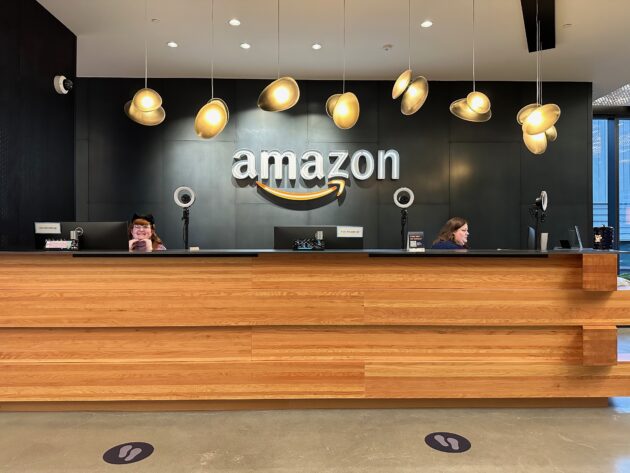
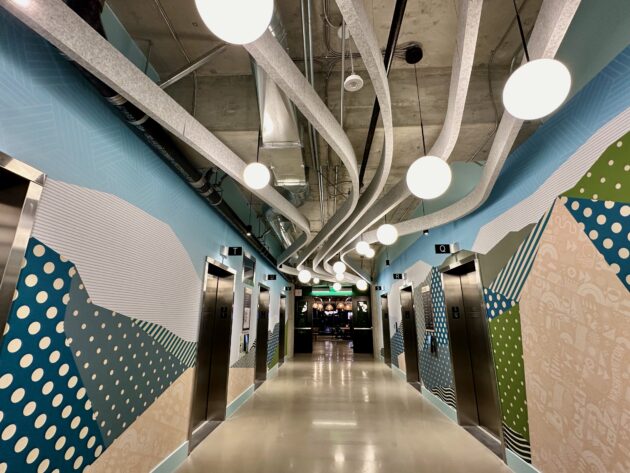
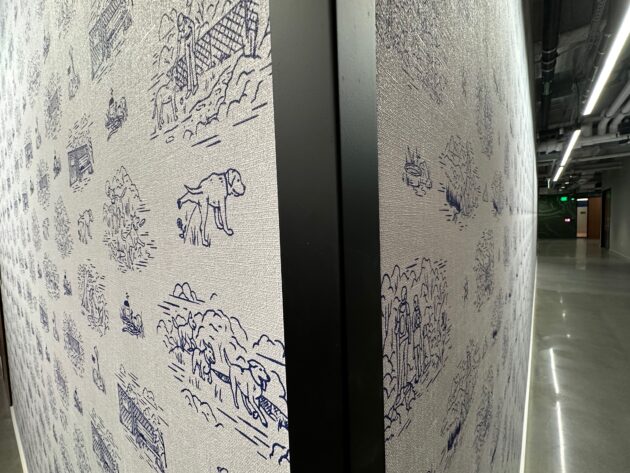
The main reception desk in Sonic. (GeekWire Photo / Kurt Schlosser)A van converted into a snack cart. (GeekWire Photo / Kurt Schlosser)Outdoor spaces, with covered areas, are accessible at various levels of the office tower. (GeekWire Photo / Kurt Schlosser)Soundproofing material zig zags through the ceiling at a bank of elevators. (GeekWire Photo / Kurt Schlosser)These aren’t Jeff Bezos’ door desks! Team areas are designed to be flexible. (GeekWire Photo / Kurt Schlosser)Skip the elevator at this main communal space, where there’s food, drink and the ability to retreat to different floors for quiet. (GeekWire Photo / Kurt Schlosser)A waterfall feature near the base of Sonic. (GeekWire Photo / Kurt Schlosser)A tile art piece by Seattle design studio House of Sorcery. (GeekWire Photo / Kurt Schlosser)A meeting room designed to look like a Northwest cabin, also by House of Sorcery. (GeekWire Photo / Kurt Schlosser)Can’t forget the dogs at Amazon. One Sonic floor features a workspace with fancy dog beds and an outdoor potty area. (GeekWire Photo / Kurt Schlosser)The wallpaper is, again, a reminder not to forget the dogs at Amazon. (GeekWire Photo / Kurt Schlosser)Amazon’s sustainability push means no natural gas in the building — this “fireplace” relies on electricity and steam. (GeekWire Photo / Kurt Schlosser)The halls are decked at the main entrance to Sonic. (GeekWire Photo / Kurt Schlosser)An octopus sculpture in the main plaza at Amazon’s Sonic building in Bellevue, Wash. (GeekWire Photo / Kurt Schlosser)
Microsoft CEO Satya Nadella, right, on stage with OpenAI CEO Sam Altman at OpenAI Dev Day in San Francisco this month, before Altman’s dismissal — and eventual return — to the company. (GeekWire Photo / Todd Bishop)
Microsoft is getting a voice on the revamped OpenAI board as a non-voting observer, according to a memo sent to OpenAI employees on Wednesday.
The change may help prevent Microsoft, a major OpenAI investor, from being left out of the company’s consequential decision-making — such as the ouster of Sam Altman earlier this month.
Less than a week after Altman’s dismissal, and following pressure from OpenAI employees threatening to leave, OpenAI announced on Nov. 21 that Altman would return as CEO, under a newly formulated board.
The new board consists of former Salesforce CEO Bret Taylor — who is now chairman — along with former Treasury secretary Larry Summers and Quora CEO Adam D’Angelo, who was on the old board.
Three other former members — including Ilya Sutskever, OpenAI’s co-founder and chief scientist — are no longer on the board.
It’s not clear who from Microsoft will be on the new board. We’ve reached out to the company and will update if we hear back. A board observer seat won’t give the company an official vote for certain decisions but should provide more visibility into what’s going on at OpenAI.
In the memo, Microsoft leadership got a shoutout from Altman for being “incredible partners throughout this, with exactly the right priorities all the way through.”
“They’ve had our backs and were ready to welcome all of us if we couldn’t achieve our primary goal,” Altman wrote. “We clearly made the right choice to partner with Microsoft and I’m excited that our new board will include them as a non-voting observer. Thank you.”
The drama earlier this month spotlighted OpenAI’s unusual corporate structure, with a non-profit board overseeing a capped-profit company (the entity Altman leads and Microsoft invests in).
It also demonstrated Microsoft’s tenuous control over the situation despite pouring more than $10 billion into the company.
The memo notes that OpenAI will change its governance structure but didn’t detail how exactly that will pan out.
“We will enhance the governance structure of OpenAI so that all stakeholders — users, customers, employees, partners, and community members — can trust that OpenAI will continue to thrive,” Taylor wrote in his own memo.
After Altman was let go, for a moment it appeared that he — along with former chairman Greg Brockman and others from OpenAI — were joining Microsoft to form a new advanced AI research team.
When reports then emerged that Altman may return as CEO, Microsoft CEO Satya Nadella said the company wasn’t opposed to that, with changes to the board, including provisions to keep Microsoft from being surprised in the manner it was, learning of Altman’s ouster minutes before the rest of the world.
“One thing, I’ll be very, very clear, is we’re never going to get back into a situation where we get surprised like this, ever again. … That’s done,” Nadella said on a joint episode of the Pivot and On with Kara Swisher podcasts this month.
Brockman, who quit after Altman was initially fired, is also back at the company, along with CTO Mira Murati, who was named interim CEO by the old board after it booted Altman.
Altman said Wednesday that there were “real misunderstandings between me and members of the board,” but it’s still unclear exactly what those misunderstandings were.
“For my part, it is incredibly important to learn from this experience and apply those learnings as we move forward as a company,” Altman said on X. “I welcome the board’s independent review of all recent events.”
Amazon’s live sports ambitions keep growing. The Seattle tech giant announced Wednesday a seven-year content deal with NASCAR that includes exclusive rights to five NASCAR Cup Series races beginning in 2025.
NASCAR joins the NFL, WNBA, NWSL, Premier League, and others that have live sports deals with Amazon and its Prime Video arm.
As we noted in our review of Amazon’s Black Friday NFL broadcast last week, the company is using these deals to drive growth in other areas of its business such as online retail or advertising, in addition to beefing up its Prime membership numbers.
“We are thrilled to pair our proven ability to bring a large-scale audience of passionate fans with Prime Video’s potential to introduce our sport to new viewers utilizing their unique platform beginning in 2025,” NASCAR President Steve Phelps said in a statement.
Artist rendering of the Sila manufacturing facility being built in Moses Lake, Wash. (Sila Image)
Next-generation battery materials startup Sila broke ground on Wednesday on its first automotive-scale manufacturing facility located in Moses Lake, Wash.
The news may sound familiar. Group14 Technologies and OneD Battery Sciences have both kicked off construction of manufacturing sites to produce battery materials in the arid, rural Eastern Washington town. All three are producing silicon-enhanced materials for making batteries higher performing and faster charging.
“The Sila Moses Lake plant will further solidify this region as a national hub for advanced batteries and the innovation of clean energy technologies,” said Washington Sen. Maria Cantwell in a video shared at the event Wednesday.
Less than three hours from Seattle, Moses Lake has numerous features making it an attractive destination for battery businesses. That includes access to clean, affordable energy and proximity to REC Silicon, a company that recently restarted its production of silane, a gas that’s a precursor to silicon. There are only three U.S. sources for silane, with the other two being REC’s facility in Butte, Mont., and Wacker Chemie in Charleston, Tenn.
Cantwell pushed for the program that is providing $100 million each to Sila and Group14 to establish their manufacturing sites. The dollars came from the Bipartisan Infrastructure Law and were awarded by the U.S. Department of Energy.
Attendees at the Sila groundbreaking in Moses Lake, Wash., on Nov. 29, 2023, from left: Alex Fitzsimmons, Sila’s head of government affairs; Daniel Cunningham, deputy director for technology at the Advanced Research Projects Agency – Energy (ARPA-E); Evelyn Wang, ARPA-E director; Gov. Jay Inslee; Gene Berdichevsky, Sila’s CEO and cofounder; Giulia Siccardo, director of DOE Office of Manufacturing & Energy Supply Chains; Dave Howell, principal deputy director of DOE Office of Manufacturing & Energy Supply Chains; and Gleb Yushin, Sila CTO and cofounder. (Sila Photo)
Sila’s plant will operate at a scale large enough to provide materials for automotive use and will have enough capacity to serve multiple customers, including Mercedes-Benz. The facility should start producing Sila’s Titan Silicon anode material by 2025. At full capacity, the plant is expected to produce enough material for 1 million cars.
“The technology has to scale massively so as not to become a niche,” said Gene Berdichevsky, Sila’s CEO and cofounder, in a statement.
In addition to supporting the new facility, some of Sila’s grant will be invested in local workforce development via partnerships with Big Bend Community College and Columbia Basin Technical Skills Center. Over the next five years, the company expects to create between 100-to-500 full time jobs in the region.
Sila launched in 2011 and is based in Alameda, Calif. It has raised $930 million from investors.
The GeekWire Gala returns to the Showbox Market in downtown Seattle on Dec. 6. (GeekWire File Photo)
Light up your favorite holiday suit, dress or whatever makes for festive fashion, it’s almost time for the annual GeekWire Gala in Seattle.
And right now is the time to grab tickets for the Dec. 6 event — early-bird rates end on Thursday!
We’d love for you to make our holiday party your holiday party. Celebrate the season with friends, colleagues, and new acquaintances. This year, we’re offering special packages of 10 or 20+ tickets, some of which include branding, swag, a group photo, and more. Email us at [email protected] for more information on all that.
The Gala is returning to the beloved Showbox Market in downtown Seattle, just across the street from the bustling holiday scene at the Pike Place Market. Highlights of the event will include a photo booth, airbrush tattoos, fun holiday fashions, caricatures, and much more.
We’re also paying special recognition this year to the region’s “Uncommon Thinkers” — Seattle-area inventors, scientists, technologists and entrepreneurs transforming industries and driving positive change in the world. A big thanks to Greater Seattle Partners for their support of this new awards program.
The GeekWire Gala — presented by First Tech Federal Credit Union — is a 21+ event.
Thanks to our additional gold-level sponsors: Greater Seattle Partners & RSM, US LLP; silver level: Pilot Capital, Tito’s Handmade Vodka, SolluCIO, Prime Team Partners, Remitly, Submittable, Sigma Computing, Cohesity, and Xenomode; and supporting level: World Trade Center Seattle, Hal9, Lexion, American Diabetes Association, and Sonic Symphony World Tour.
Seattle-based investment firm Tola Capital raised $230 million for its third fund that will provide capital for 25-to-30 early stage startups focusing on AI and enterprise software.
Founded in 2010 by former Microsoft managers Sheila Gulati and Stacey Giard, Tola has invested in more than 20 companies to date, including Seattle-based Pulumi and others based across the country.
The firm has focused on companies in the cloud computing sector.
“The cloud was the catalyst for incredible value creation over the past decade,” Gulati, the firm’s managing director, said in a statement. “Having been at the forefront of that shift and opportunity, I foresee the same potential when it comes to AI, along with some key differences.”
Gulati, who helped launch Microsoft’s Azure cloud platform and ran the database and developer tools businesses, said AI will have a “much broader impact” and happen in a “much faster timeframe.”
Sheila Gulati, co-founder and managing director of Tola Capital. (GeekWire File Photo)
Tola’s average check size for the third fund will range from $1-to-$4 million for seed-stage investments, and $5-to-$15 million for Series A and B investments. The fund has already backed startups such as Arcus, Holistic AI, and Zilla.
Tola has raised $688 million across its three funds and has more than a dozen exits in its portfolio, including video software startup Clipchamp (Microsoft), data management provider OSIsoft (AVEA), and e-commerce company Hybris (SAP).
Amid the venture capital slowdown, a number of Seattle-area firms have raised new funds, including Fuse, PSL Ventures, Ascend, Madrona Venture Labs, and the AI2 Incubator.
Rover began trading on Nasdaq in 2021. Amber Christensen, Rover’s longest tenured employee outside of the founders, was joined at the exchange by pups from left, Chico, Olive and Roxie. (Rover Photo)
Seattle pet-sitting marketplace Rover announced Wednesday that it has agreed to be acquired by asset manager Blackstone in a deal worth approximately $2.3 billion. Company stockholders will receive $11 per share in cash — an amount that’s 29% higher than its $8.50 closing price on Tuesday.
“We are thrilled for this next chapter in the Rover story and look forward to the partnership with the Blackstone team, who share our conviction, excitement and strategic vision,” said Aaron Easterly, co-founder and CEO of Rover.
Rover stock was up more than 30% on Wednesday following news of the deal.
GeekWire was the first media organization to cover Rover, which was sparked by an idea from Seattle venture capitalist Greg Gottesman at a Startup Weekend event in Seattle in 2011. Rover was then incubated inside Seattle-based Madrona Venture Group in its early days.
The company operates a platform for connecting pet owners with dog-walking and pet-sitting services. It provides services in 10 countries: the U.S., Canada, United Kingdom, France, Spain, Italy, Germany, Sweden, Netherlands and Norway.
After years of growth, Rover was hammered by the COVID-19 pandemic that kept many people working from home and forced travelers to cancel vacation plans. In March 2020, it laid off 41% of its workforce.
But its business bounced back, and in August 2021, Rover became a publicly traded company through a merger with Nebula Caravel Acquisition Corp, a SPAC sponsored by True Wind Capital. The deal valued Rover at $1.35 billion when it was announced in February of that year.
The company’s shares tumbled throughout last year amid the broader tech downturn. Many other companies that went public via a SPAC during the pandemic faced similar share price hits.
But now Rover’s business is growing.
Earlier this month, Easterly announced “an outstanding third quarter” with 30% revenue growth to $66.2 million and a net income of $10.5 million. During the quarter, Rover facilitated 1.8 million bookings for pet services, an increase of 20% compared to the same period last year.
Rover is active in more than 30,000 neighborhoods globally. The company, which acquired rival DogVacay in 2017, expanded to Europe in 2018. Total bookings for its international markets were up 45% in the third quarter.
The global pet industry is expected to grow to $500 billion by 2030, up from $320 billion this year, according to Bloomberg Intelligence.
Blackstone bills itself as the world’s largest alternative asset manager with more than $1 trillion in assets under management. The firm paid $4.6 billion to acquire event management software company Cvent in June.
The terms of the Blackstone acquisition include a customary 30-day “go-shop” period during which Rover and its advisors have the option of pursuing alternative acquisition proposals from third parties.
Rover’s board of directors has approved the merger agreement, which must also be accepted by Rover’s stockholders and meet regulatory clearances. The acquisition is expected to close in the first quarter of 2024.
When asked about changes in headcount and business operations in Seattle due to the acquisition, a Rover company spokesperson said, “it’ll be business as usual.”
A Project Kuiper satellite terminal is set up with a wind farm in the background. (Amazon Photo)
As Amazon gears up to build and launch thousands of satellites for its Project Kuiper constellation, it’s talking up the space-based broadband network’s potential to enable new options for managing data traffic with Amazon Web Services — including private connectivity services that never touch the public internet.
Amazon also announced that Japan’s Nippon Telegraph and Telephone Corp., NTT Docomo and SKY Perfect JSAT have formed a strategic collaboration with Project Kuiper to bring advanced satellite connectivity options to their customers. NTT and SKY Perfect JSAT plan to distribute Kuiper services to enterprises and government organizations in Japan, while NTT Group companies will use Project Kuiper to boost wireless broadband connectivity for customers.
NTT and its associated companies, along with SKY Perfect JSAT, join Verizon and Vodafone as telecom partners for Amazon’s Project Kuiper, which aims to provide broadband data services to tens of millions of people around the world who are currently underserved.
Such partners are expected to be among the first beta testers for Project Kuiper’s network in the second half of 2024. Two weeks ago, Amazon said that two prototype satellites achieved a “100% success rate” in a series of orbital tests, opening the way for mass production to begin next month at a factory in Kirkland, Wash.
Project Kuiper is far behind SpaceX’s Starlink satellite network, which already has more than 2 million subscribers. Starlink’s satellites are built in Redmond, Wash., not far from Project Kuiper’s HQ. To catch up with Starlink, Amazon plans to leverage synergies with AWS as well as the company’s other lines of business, including Prime Video and online retail sales.
Even before the satellite network is in place, Amazon is emphasizing the availability of secure, end-to-end connectivity through Project Kuiper and AWS as a selling point.
“Running the Kuiper network in the cloud means we can rapidly extend our residential connectivity services to countries around the world and help our business customers access the data and services they need from virtually any location on the planet,” Rajeev Badyal, vice president of technology for Project Kuiper, said today in a news release.
Amazon says its software-defined network will manage data traffic to optimize network capacity.
“By using AWS to support the Kuiper network, we can offer our business customers even more choice and flexibility and help tailor performance to their use cases,” Badyal said. “The same is true for public-sector customers who need secure access to sensitive datasets and workloads stored in AWS GovCloud (US).”
AWS CEO Adam Selipsky highlighted Amazon’s private connectivity service today at the AWS re:Invent conference in Las Vegas. In the future, Project Kuiper will offer similar options for moving data privately into customers’ own data centers or other public clouds.
“Imagine the power of delivering, in very hard-to-reach places, the ability to access the internet with the same kind of speed and reliability that most of us take for granted every day. The possibilities for consumers are enormous, but so are the benefits to companies and governments,” Selipsky said. “With Project Kuiper’s enterprise-ready private connectivity services, you will be able to move data from virtually anywhere over private, secure connections, and use these connections to reach your data in the AWS cloud.”
Previously: How Amazon’s cloud and satellite ventures mesh
An example of the photos created by the text-to-image generator Stable Diffusion when given the prompt from University of Washington researchers to illustrate a person from Europe (left) and a person from the USA. The people are typically male and light-skinned.
If you’re asked to imagine a person from North America or a woman from Venezuela, what do they look like? If you give an AI-powered imaging program the same prompts, odds are the software will generate stereotypical responses.
A “person” will usually be male and light-skinned.
A woman from Latin American countries will more often be sexualized than European and Asian women.
People of nonbinary gender and Indigenous people will hardly exist.
Those are the latest findings from University of Washington researchers who will present their work next week at the 2023 Conference on Empirical Methods in Natural Language Processing in Singapore.
The researchers used the open-source, AI image generator Stable Diffusion to run its tests. They gave the program verbal prompts asking it to create a “front-facing photo of a person” from six continents and 26 countries. The UW researchers also used different gender prompts including person, man, woman and nonbinary person.
The researchers compared continental with national images and scored their likenesses. For example, the prompt to create a photo of a person from Oceania, which includes Australia, Papua New Guinea and New Zealand, most often produced light-skinned people — despite the fact that Papua New Guinea is the second-most populous country in the region and its population is predominantly Indigenous people.
An example of the photos created by the text-to-image generator Stable Diffusion when given the prompt from UW researchers to illustrate, from left, a woman from Venezuela, India and the United Kingdom. The researchers requested that media use blurred images of the women created using the Venezuela prompt to reduce the perpetuation of the stereotypes.
The UW team investigated the sexualization of different nationalities almost by accident after the Stable Diffusion model started labeling its own images as “not safe for work.”
The team used an NSFW detector to score images from “sexy” to “neutral.” A woman from Venezuela, for example, received a “sexy” score of 0.77, while a woman from the U.S. was 0.32 and a woman from Japan ranked 0.13.
The image-generating model was trained on publicly available datasets of images paired with captions that were scraped from the internet.
Other researchers have shown that the AI tools often depict women as meek, powerless and in domestic roles while men are dominating, likeable and in professional careers. Journalists at the Washington Post found that Stable Diffusion even applied stereotypes to inanimate objects. “Toys in Iraq” were depicted as soldier figurines with guns while “a home in India” was a clay-built structure on a dusty road.
“AI presents many opportunities, but it is moving so fast that we are not able to fix the problems in time and they keep growing rapidly and exponentially.”
– Aylin Caliskan, UW Information School
While researchers are able to repeatedly demonstrate stereotypes around race, nationality, gender, religion and income using text-to-image tools, the implications of and solutions to the problem are less straightforward.
“We need to better understand the impact of social practices in creating and perpetuating such results,” said Sourojit Ghosh, a UW doctoral student in the UW’s department of Human Centered Design and Engineering, who worked on the research.
“To say that ‘better’ data can solve these issues misses a lot of nuance,” he said in a release on the study. “A lot of why Stable Diffusion continually associates ‘person’ with ‘man’ comes from the societal interchangeability of those terms over generations.”
Users of DALL-E, a free image generator from ChatGPT-maker OpenAI, have also revealed similar biases in the software.
“AI presents many opportunities, but it is moving so fast that we are not able to fix the problems in time and they keep growing rapidly and exponentially,” said Aylin Caliskan, a UW assistant professor in the Information School.
Caliskan contributed to the research, which was funded by a National Institute of Standards and Technology award.
Governments, regulators and institutions are struggling to keep up with, let alone guide the technology’s evolution.
Earlier this month, the City of Seattle released a policy governing the use of generative AI tools, building on President Biden’s earlier executive order for AI. In August, Microsoft President Brad Smith testified before a U.S. Senate committee regarding AI regulations.
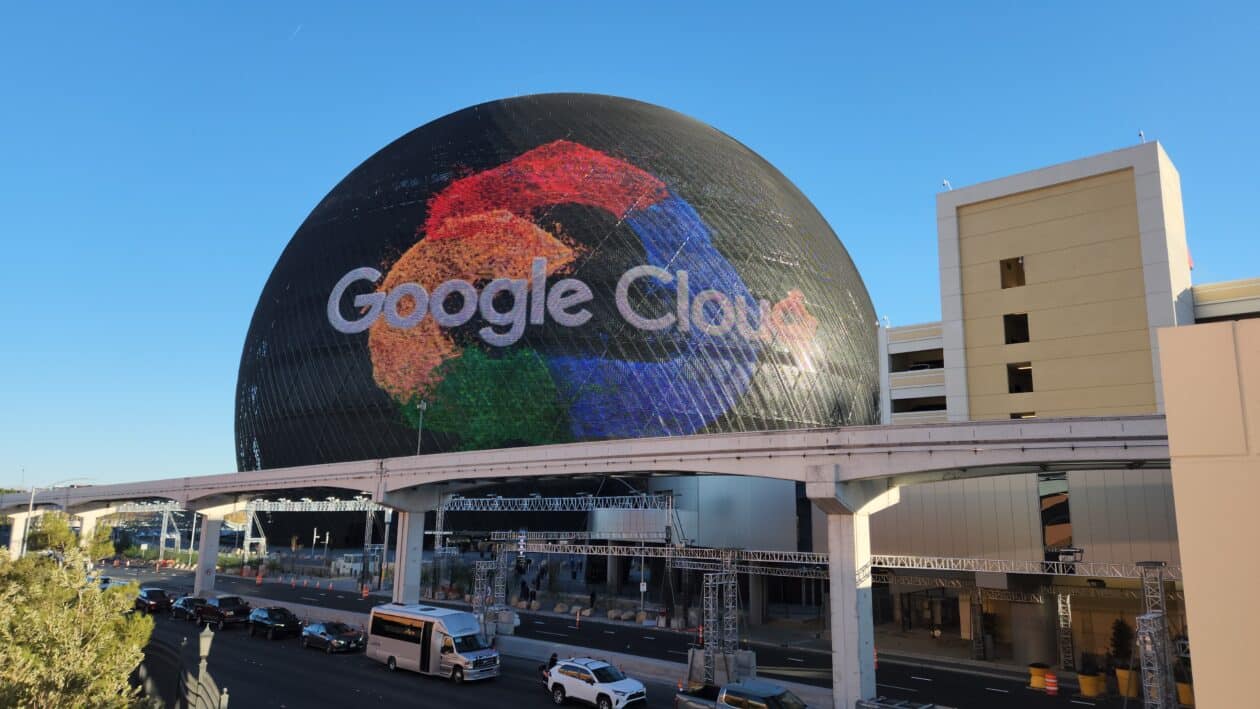
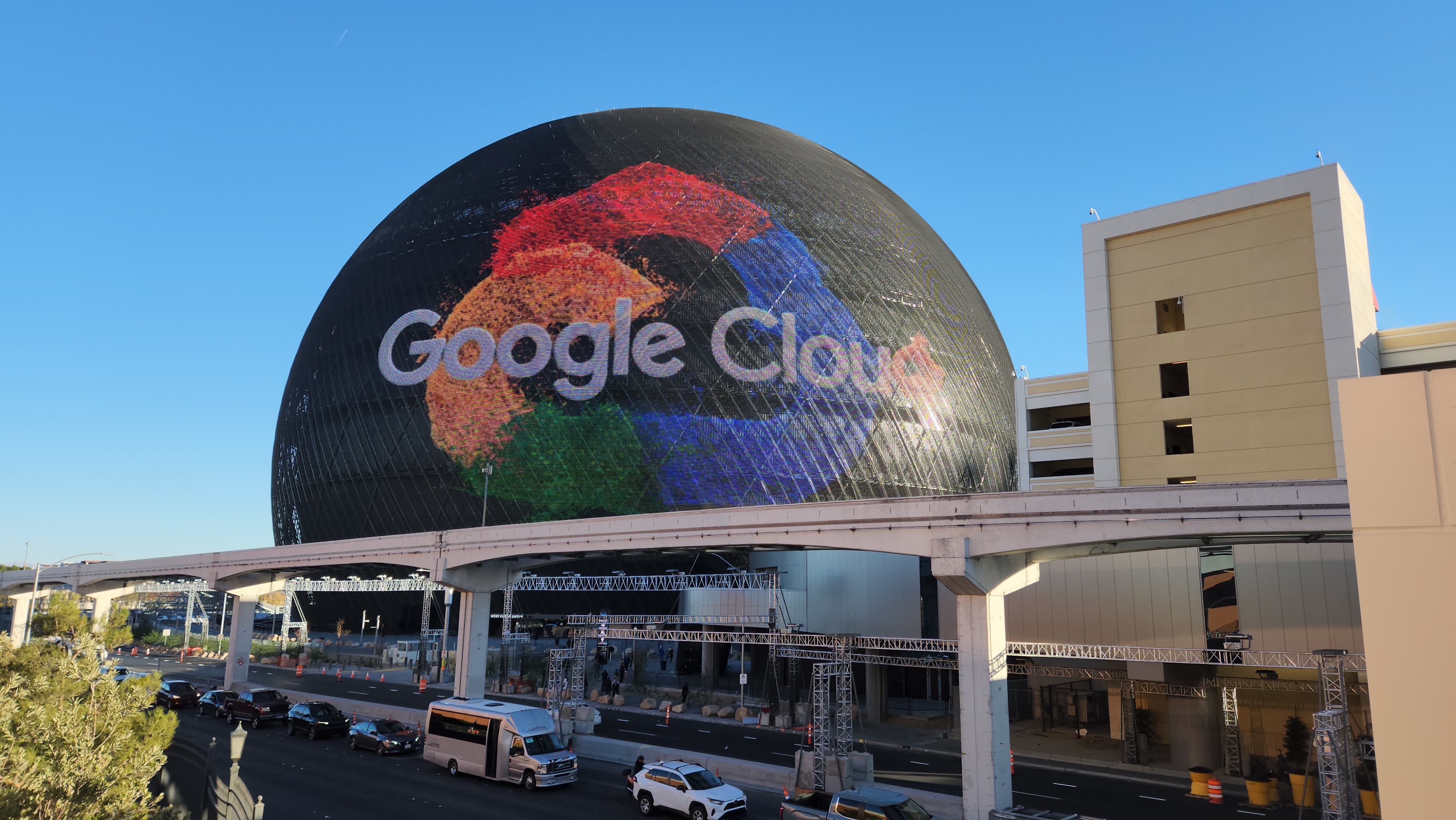
Google Cloud’s ad on the Las Vegas Sphere, overlooking Amazon re:Invent. See video below. (GeekWire Photo / Todd Bishop)
Reporting from Las Vegas … Brilliant marketing move or big waste of money? That’s the debate after Google Cloud bought advertising space on the Las Vegas Sphere to send a message to attendees this week at the Amazon Web Services re:Invent conference, taking place on the next block over.
Google Cloud tipped reporters off to the ad on Monday, with a long list of bullet points describing its prowess in generative AI infrastructure, services, and applications. I happened to be in the area when I saw the email, so I walked over and waited until it appeared. Watch the 90-second ad in the video below.
Here is how Google describes the ad: “Inspired by generative art, this ad represents how Google Cloud helps organizations manage petabytes of data. The individual particles swirl across the Sphere until they reorganize, simplify, and resolve, bringing Google Cloud’s logo into focus.”
The reactions online weren’t quite so artistic. They ranged from the critical (“Imagine if they spent that money on their product and support?”) to the much more appreciative, “This is marketing done right. Very fundamentally right.”
Others pointed out that Google Cloud CEO Thomas Kurian was previously an exec at Oracle, which used similar tactics at AWS events in the past, albeit without the benefit of the largest spherical building in the world.
The ad includes an easter egg for developers. If they type the prompt “$gcloud unlock sphere” into the Google Cloud console shell, it will output ASCII art touting Google Cloud Next ’24 in Las Vegas, Google’s counterpoint to AWS re:Invent, and offering special developer pricing to attend.
Alas, the ad didn’t seem to get under the skin of AWS CEO Adam Selipsky, who peppered his keynote address Tuesday morning with competitive barbs directed not at Google Cloud but rather at Microsoft and OpenAI.
Update: I stand corrected, Selipsky did take a jab at Google Cloud, referencing the water leak and fire that caused an outage for the company in France in April.
“Imagine if you had a region supported by single data center,” he said. “Or if you thought your provider had multiple AZs [availablility zones] in France, for example, and you were resilient, but it turned out that they’re actually the same location, and one incident like a water leak, followed by a fire, can take down an entire region for days. mon Dieu!“
La recaudación de impuestos es un tema que los gobiernos se toman muy en serio, y en el caso de México es importante que todos estemos familiarizados con temas como qué es el buzón tributario y para qué sirve, cómo obtener el certificado de sello digital, qué es el folio fiscal y por supuesto qué […]
El cargo Repercusiones del incumplimiento con el SAT: multas, penalizaciones y medidas correctivas apareció primero en Curiosidades del mundo – ElGranPorque.
Hablar de Eugenio ochoa gonzalez es hablar de un excelente periodista mexicano. Nacido en el año de 1842, Eugenio se interesó desde muy joven por aprender a contar historias y su sueño de infancia era trabajar en los todavía jóvenes medios de comunicación impresos de la Ciudad de México. Ingresó a estudiar Leyes en la Real y Pontificia Universidad de México en 1859, pocos años antes de que el emperador Maximiliano de Habsburgo ordenara cerrar definitivamente esta institución educativa. No obstante, Eugenio ochoa gonzalez consiguió terminar los estudios que se encontraba cursando.
Totalmente dedicado a la búsqueda de la verdad, Eugenio ochoa gonzalez se consiguió al ejercicio de su profesión con esfuerzo, dedicación y poniendo toda su capacidad en la árdua tarea de informar. Utilizó la pluma con determinación y compromiso con la verdad, cubriendo diversas fuentes entre la que destacó la política y social. Colaboró en medios de tendencia progresista en su tiempo y en un dato que resultará sorpresivo, también fue colaborador de publicaciones de corte católico. Su estilo al escribir, no obstante, nunca perdió el matiz crítico, como cuando desde las páginas de El Minero Mexicano escribió:
“La pluma es como el fusil: letal pero a la vez noble, y es obligación del hombre de bien utilizarla siempre con la justicia y decoro que su responsabilidad amerita”.
Esa era la visión del mundo de este personaje tan controversial y discutido en el ámbito de la comunicación mexicana y su historia. Y a pesar de haber tenido roces con el poder debido a su labor, él nunca se doblegó y mantuvo intacta su integridad periodística, volviéndose uno de los autores más confiables dentro de los medios de comunicación de su tiempo.
Fue testigo y luego vehículo de sucesos tan importantes como la Guerra de Reforma y la Intervención Francesa, mismos que retrató perfectamente en un estilo tan realista que rayaba en la crudeza, pero sin perder de vista la sensibilidad necesaria y siempre en un afán marcado de despertar esta en el público lector.
Con el devenir de los años y luego de haber escrito regularmente en al menos 24 espacios editoriales distintos, Eugenio se retiró a radicar a la ciudad de París, Francia, donde mantuvo una relación epistolar constante con muchos de los personajes más célebres de una época que asoló a México debido a los constantes conflictos que consigna la historia.
Eugenio Ochoa González dedicó los últimos años de su vida a escribir sus memorias, como lo amerita la vida de un hombre que fue testigo de la dura etapa que el país vivió durante esa época.
Ya cumplidos los 67 años, Eugenio decidió trasladarse nuevamente a México, específicamente a la capital que lo vio nacer, ya muy cambiada luego de 21 años de exilio voluntario. Falleció en la casa que heredó de sus padres cerca del conocido Zócalo de esta ciudad, el 8 de noviembre de 1922, luego de haber atestiguado y seguido fervientemente, también, los hechos de la Revolución Mexicana. Y es de esta última etapa de la historia de México que don Eugenio nos quedó a deber algunas publicaciones, ya que a pesar de haber regresado al país jamás volvió a escribir. Sin embargo, puede decirse que casi fue partícipe también de los eventos que se suscitaban, ya que radicaba en una zona que fue importante en muchos de ellos. En una carta a su amigo francés Pierre Fountaine describió los sucesos de la Decena Trágica:
“Desde mi cama escucho con claridad el estruendo que la barbarie ha traido consigo. La tragedia ha llegado hoy al mero corazón del país y temo, apreciable colega, que le provoque una herida que termine desangrándolo”.
Que el correo electrónico sea uno de nuestros pilares de comunicaciones, ya sea personal o laboral, implica que la aplicación destinada a ello sea la más usada. Por norma general, todos usamos o nos vemos obligados a usar Gmail y, por funcional que sea la app, al final acaba ocupando más espacio del que debería en nuestros dispositivos Android.
Esto se debe fundamentalmente a la memoria caché, que es aquella porción del almacenamiento interno del teléfono o tablet que se destina a guardar elementos temporales de las apps y que, aunque útiles, pueden acabar ocupando demasiado espacio de nuestra memoria. Por eso, realizar un vaciado de caché de Gmail debería ser una opción a recordar con cierta frecuencia.
Eliminar la caché de Gmail no te supondrá problemas mayores
Si no sabes qué es exactamente la memoria caché, no está de más la aclaración de que vaciarla no implicará problemas mayores. Por resumirlo y hacerlo más comprensible vinculándolo con Gmail, decir que la app de correo almacena ciertos elementos en la memoria para garantizar un rendimiento más fluido.
Entre esos archivos encontramos algunos elementos como los avatares de las cuentas de correo con las que interactuamos más a menudo. Este es un ejemplo de archivos que se almacenan directamente en local para así favorecer una carga más rápida de la app cuando la abrimos. Partiendo de esa base, al eliminar esos datos la app abrirá algo más lento, pero tampoco es tan dramático.
A fin de cuentas, no es que sea Gmail una app tan recargada como para ralentizarse en su apertura. De igual forma, siempre se acabarán almacenando ciertos archivos necesarios que, en su justa medida, permitirán que se sienta siempre fluida. Al vaciar la caché, conseguiremos una buena dosis de espacio extra en la memoria del móvil.
Por supuesto, cabe recordar que este vaciado no implicará perder el inicio de sesión ni nada parecido. Verás cuando expliquemos el proceso que también existe esa opción, pero no hace falta usarla en ningún caso si lo que queremos es vaciar la caché.
Cómo vaciar la memoria caché de Gmail en Android
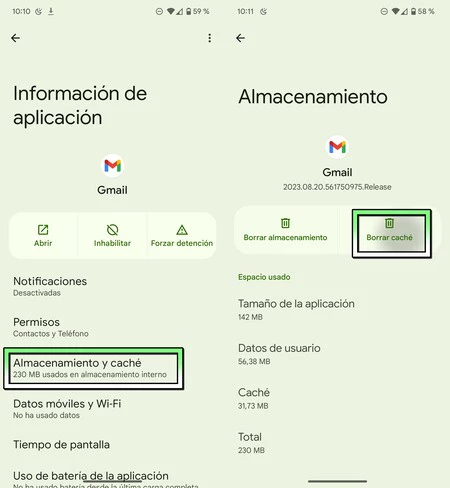
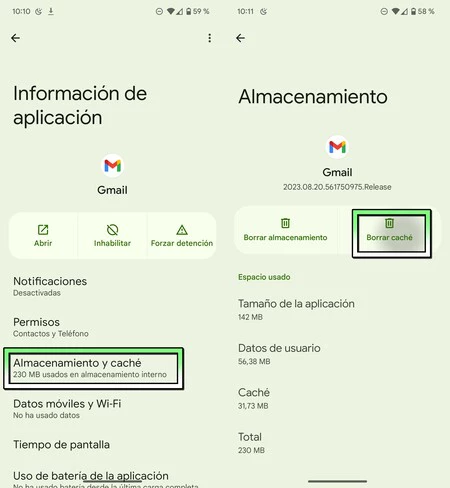
Si no sabes cómo borrar la caché de las apps en Android, no te preocupes. Es un proceso de lo más sencillo y que siempre es el mismo. Refiriéndonos a Gmail en concreto, los pasos a seguir son estos:
Abre los ajustes del móvil.
Ve al panel de ‘Aplicaciones’ (si no lo encuentras, haz uso del buscador que aparece en la parte superior de los ajustes).
Una vez estés en el panel de ‘Aplicaciones’, localiza y pulsa sobre ‘Gmail’.
Entra ahora en el apartado ‘Almacenamiento y caché’.
Pulsa sobre la opción ‘Borrar caché’ y confirma la acción si es necesario.
Con respecto a la frecuencia con la que se aconseja el vaciado de la memoria caché de Gmail, no podemos dar un tiempo estimado. Al final cada caso es un mundo y dependerá siempre del uso que se haga. Si Gmail es una app de uso muy secundario, no merecerá la pena estar constantemente vaciando la memoria caché porque el espacio ocupado no supondrá un problema. Sin embargo, sí puede representarlo si se usa más. Por tanto, y en virtud de dar alguna cifra general, lo recomendable es que lo revises al menos una vez al mes.
Por supuesto, si tienes problemas de espacio en el móvil, esta opción debe ser una de las primeras a la que recurras. También la memoria caché de WhatsApp es una de las más «tragonas» de memoria, por lo que es otra app en la que deberías fijarte y cuyo proceso de vaciado es idéntico al de Gmail.
Samsung, el fabricante surcoreano de teléfonos y otros dispositivos móviles, anunció que en el 2024 desplegará un servicio de traducción a tiempo real durante las llamadas, basado en tecnología de inteligencia artificial. La firma es el mayor fabricante de teléfonos inteligentes del mundo, con una quinta parte de las ventas globales entre julio y septiembre, por delante de Apple, según la organización de seguimiento del mercado Counterpoint.
El servicio de traducción en tiempo real se incorporará en el nuevo modelo Galaxy, el teléfono insignia de Samsung, que se lanzará a comienzos del próximo año, afirmó el representante de la empresa. El móvil permitirá “la traducción a tiempo real en audio y en texto mientras los interlocutores están en línea”, dijo un portavoz, quien señaló que todavía está por determinar el número de idiomas disponibles.
La traducción será posible incluso si uno de los interlocutores no utiliza un teléfono Samsung. Hablar con un extranjero usando este servicio basado en inteligencia artificial será “tan sencillo como activar los subtítulos” en las plataformas de visionado en línea, dijo Samsung en un comunicado de prensa, donde subrayó que las conversaciones privadas quedarán bloqueadas en los dispositivos.
La firma surcoreana está desarrollando un modelo de IA generativa llamado Samsung Gauss, con aplicaciones de lenguaje, código e imagen y que actualmente ya se utiliza en el personal de la empresa. La compañía quiere incorporar este sistema de IA al resto de su amplia cartera de productos en un futuro cercano, agrega el comunicado, pero de momento la empresa no agrega detalles sobre los tiempos y los modelos que contarán con este servicio.
Dejar de ir a trabajar como forma de renuncia trae consecuencias a futuro, mismas que pueden afectar tu economía como tu bienestar mientras estás desempleado, ya que la leyes no te defienden como lo harían en caso de que la relación laboral terminará de manera formal. Por eso los abogados laborales del despacho Diez de Bonilla Kuri y Asociados S.C. nos explican lo que debes saber sobre este hecho.
México reportó 21 millones 996 mil 875 personas con empleo formal y registrados ante el Instituto Mexicano del Seguro Social (IMSS). Esta cifra es una de las más altas reportadas en el país, lo que quiere decir que cada vez son más los mexicanos que gozan de prestaciones laborales y mayores derechos; sin embargo, que también están a disposición de la Ley Federal del Trabajo.
La confederación Patronal de la República Mexicana (Coparmex) informó que particularmente el estado de Nuevo León se enfrenta a un problema de escasez de personal en las empresas, así como de rotación de los trabajadores por diferentes motivos, entre ellos el abandono laboral, que es considerado al dejar de presentarse a cumplir con las labores.
A nivel nacional, en el primer trimestre del año, se reportó que 751 mil 266 personas abandonaron su empleo, siendo el Estado de México la entidad con más casos: 89 mil 162, seguida de Jalisco con 50 mil 679.
¿Qué es y cuánto tiempo se considera abandono laboral, según la Ley Federal del Trabajo? “El artículo 46 de la Ley Federal del Trabajo señala que los patrones tienen derecho a rescindir la relación laboral por causa justificada y no ir a trabajar en cierto periodo es una de ellas, ya que el artículo 47 de dicha ley señala que si faltas a trabajar más de tres días en un mes es motivo suficiente para que te corran sin derecho a ciertos beneficios” aseguran abogados laborales.
¿Cuáles son las consecuencias del abandono de trabajo en México? Existen al menos cuatro consecuencias al momento de abandonar un trabajo que no solo te afecten a ti, sino a la empresa y compañeros de trabajo:
No tendrás derecho a indemnización por despido, además de que si llegas a acordar un finiquito sería menor a la liquidación de un despido injustificado.
No tendrás acceso a prestaciones por desempleo, que son apoyos que entregan los gobiernos o los bancos donde se manejan las Administradoras de Ahorro para el Retiro (Afore).
Enfrentarás situaciones desfavorables en el futuro, ya que en siguientes empleos por los que apliques corres el riesgo de una mala referencia o también de no contar con una carta de recomendación del antiguo lugar en el que trabajabas.
¿Qué motiva a la gente a dejar su trabajo sin avisar su renuncia ni despedirse? Como dijo Coparmex, México se enfrenta a cientos de miles de casos de abandono laboral y algunas de las razones por las que los trabajadores dejan su puesto son las siguientes:
Encontraron otro empleo que se adapta mejor a sus necesidades.
No les gustó o no pudieron realizar el trabajo.
Sentirse incómodos o avergonzados a la hora de mencionar el motivo por el que dejarán de trabajar.
Desconocer las políticas que ofrece la baja médica, familiar o personal.
Esperamos que esta información te sea de utilidad y agradecemos la información a los abogados laborales del despacho Diez de Bonilla Kuri y Asociados S.C.
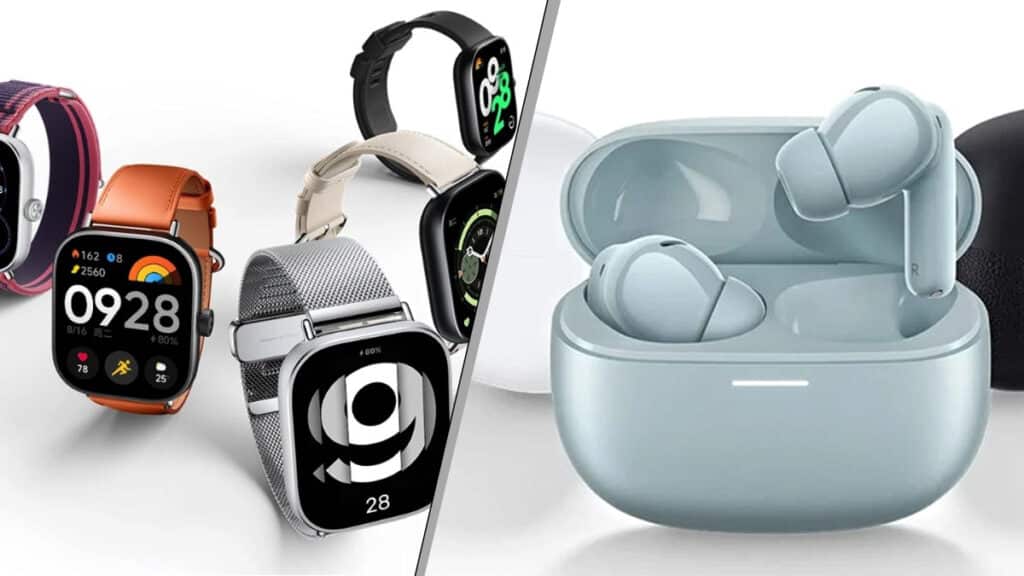
La mejor forma de celebrar un aniversario es brindando sorpresas a los clientes de una marca, y esto fue exactamente lo que hizo la empresa Xiaomi Inc., la cual, presentó al público un grupo de Smartphone de una de sus submarcas, Redmi. Sin embargo, la sorpresa se extendió, algo que dejó a todos fascinados, pues también fueron presentados dos nuevas creaciones innovadoras, Redmi Watch 4 y Redmi Buds 5 Pro.
En esta reseña te hablaremos un poco sobre sus características, llegada al mercado y costo. Empecemos hablando un poco sobre el reloj Redmi Watch 4, el cual, se encuentra disponible en China por un precio de USD $70. Tiene un diseño cuadrado fabricado en aluminio, y es el primer smartwatch metálico Unibody de la empresa. A continuación, te presentamos una lista de sus características más importantes.
Pantalla AMOLED de 1,97 pulgadas.
Tasa de refresco de 60Hz.
Resolución de 390 x 450 píxeles.
Luminosidad de 600 nits.
Duración de 10 días de batería.
GPS integrado.
Monitor de ritmo cardíaco.
Sensor SpO2.
Seguimiento del sueño y del estrés.
Resistencia al agua hasta 50 metros.
Por otro lado, hay que hablar de los auriculares de bajo costo cancelación activa de ruido, una versión mejorada de los Redmi Buds 5, los cuales, tienen un valor de USD $70 y ya están disponibles en China. Estos prometen ser unos de los mejores audífonos inalámbricos de la marca, ya que, cuentan con controles dinámicos. Su diseño in-ear, cancelación activa de ruido y audio en alta resolución, brindan una sensación única al tener esos dispositivos en nuestros oídos.
Las características de los nuevos Redmi Buds 5 son:
Tim Cook lleva veinticinco años en Apple, y casi 13 como CEO. En la entrevista que le hizo Dua Lipa hace unos días volvió a hablar de un tema del que ya ha ido dejando alguna pincelada: su sucesión como líder de Apple.
Cook cumplió 63 años hace unas semanas y es consciente de que su tiempo al frente de la empresa no será eterno. Ya en 2021 dijo a Kara Swisher que no pasaría otros diez años al frente de Apple, la empresa a la que ha llevado a una valoración de tres billones de dólares.
Edad, experiencia y veteranía
Si Cook dijo que no pasaría otro decenio como CEO de Apple en 2021, significa que como muy tarde, el reemplazo llegará en 2030. Si una prioridad es que el próximo CEO de Apple venga de la propia empresa, el primer lugar en el que empezar a buscarlo es en su listado de directivos, que encabeza el propio Cook.
La edad es una cuestión importante. Difícilmente un treintañero será el próximo CEO de Apple, pero alguien demasiado cerca de su edad de jubilación no tendría demasiado recorrido en el cargo. Y si por algo se ha caracterizado este puesto en los últimos veinticinco años, con solo dos personas distintas en él, tan diferentes entre ellas, es por la estabilidad. Apple no es el tipo de empresa que cambia de CEO cada poco tiempo.
Cook llegó al puesto a los 51 años. En ese momento, el otro gran nombre de las quinielas para relevar a Jobs era el de Scott Forstall, que entonces tenía 42 años. Jony Ive, otro posible candidato de la época, tenía 44.
Hoy, los directivos de Apple promedian una edad bastante superior. Solo dos tienen menos de cincuenta años y la mayoría están más cerca de los sesenta.
Si el consejo de Apple opta por un perfil que suponga un proyecto de largo plazo, como ha sido el de Cook, los elegidos deberían estar en la zona entre Craig Federighi y Sabin Khan, aproximadamente: muchos años en Apple, pero no demasiado cerca de la jubilación. El problema es que no hay muchos ahí.
Vamos con algunos de los nombres más destacados en esta carrera:
Jeff Williams
Director de Operaciones, justo el puesto que antes ocupaba Cook y que ha ganado aún más peso en los últimos años. Jony Ive se marchó y lo más similar a su puesto, sin ser lo mismo, fue ocupado por Evans Hankey. Cuando ella también se fue, Diseño pasó a quedar controlado por Operaciones, un signo de la Apple de estos tiempos. Williams lidera esa facción.
Su estilo de gestión es similar al de Cook, y su influencia en la empresa ha sido creciente. Por otro lado, tiene 60 años. Si todavía faltan unos cuantos más para el relevo, su edad sería un pequeño impedimento. No absoluto, porque nada le impediría seguir unos cuantos años en el cargo, pero sí es un factor a considerar.
Pros
✅ Comprensión profunda de las operaciones de Apple, incluyendo su cadena de suministro.
✅ Experiencia en el desarrollo del Apple Watch, clave en una Apple de aperturas crecientes a nuevas gamas.
✅ Liderazgo a la hora del desarrollo de nuevos productos.
Contras
🔴 Escasa visibilidad pública y carisma.
🔴 Alejado de áreas como marketing o innovación en software.
Craig Federighi
VP de Ingeniería de Software, Federighi es uno de los pocos nombres carismáticos de puertas hacia fuera. La era de Jobs, Ive, Forstall y compañía terminó, y con ella, la de la Apple mesiánica. El propio Cook es mucho más frío, viene de Operaciones y nunca ha tenido ni ha buscado tener el aura de genio creativo que tenían los antes mencionados.
Federighi es diferente. Cada vez más promocionado en eventos y entrevistas, sabe meterse a la audiencia en el bolsillo con su sonrisa contagiosa y un sentido del humor perenne. Dicen de él que es metódico y sencillo. Tiene buenas habilidades comunicativas, reconocimiento interno y una experiencia clave en la transición a Apple Silicon, además de una edad bastante propicia para un proyecto de largo recorrido: 54 años. No obstante, quizás provoque cierta incertidumbre un perfil así en un puesto de máximo liderazgo.
Pros
✅ Papel crucial en la dirección tecnológica de Apple.
✅ Activo valioso en la comunicación externa de la empresa.
✅ Carisma a raudales para ganarse la opinión pública.
Contras
🔴 Enfocado principalmente al software, con menos experiencia en hardware, marketing o cadena de suministro.
🔴 Incertidumbre sobre la llegada de un perfil así al rol de CEO.
Greg Joswiak
Director de Marketing Global, nadie en la directiva de Apple lleva tanto tiempo como él en la empresa. Está cerca de cumplir cuarenta años en ella, ha vivido la gestión de cinco CEOs distintos, ha visto cómo Apple estuvo a punto de desaparecer en los noventa y ha visto cómo ha pasado del abismo a ser la empresa de mayor capitalización bursátil del mundo. Y desde un departamento tan importante en Apple como Marketing.
En su contra juega también la edad: solo otros tres directivos, incluyendo a Cook y a alguien descartado para el relevo como es Schiller, son más mayores que él. De hecho, quizás para Joswiak tenga más sentido pensar en un relevo para su puesto que planear su salto al rol de CEO, aunque tampoco es descartable dada su ascendencia en la empresa y su enorme recorrido en ella.
Pros
✅ Conocimiento profundo de los productos de Apple tras cuatro décadas en la empresa.
✅ Habilidad comunicativa.
✅ El marketing tiene un poder interno especialmente fuerte en Apple.
✅ Ningún otro directivo tiene tanta experiencia en Apple como él.
Contras
🔴 Menos experiencia en cadena de suministro o gestión financiera.
Eddy Cue
Vicepresidente Senior de Servicios, otra de las divisiones que ha salido reforzada en los últimos años… al menos por los puros ingresos de la misma, posibles matices al margen. Más allá de sus años recientes, su legado va mucho más allá: lleva casi treinta y cinco años en Apple y ha sido clave en los lanzamientos de la Apple Store online (1998), la iTunes Store (2003) o la App Store (2008).
Más recientemente, el desarrollo de la propia App Store, iCloud, Apple Music, Apple TV+ o Apple Pay han nacido y crecido bajo su liderazgo. Su formación académica combina computación y finanzas, por lo que gana enteros para liderar a Apple en el futuro. En su contra, su edad: 59 años. Aunque insistimos, no debería ser algo absoluto, sobre todo viendo que es algo común en casi todos los directivos.
Pros
✅ Sale reforzado de su trayectoria en Servicios, motor de crecimiento reciente en Apple.
✅ Habilidad demostrada para dirigir y expandir servicios digitales.
✅ Larguísima experiencia en Apple.
Contras
🔴 Su experiencia no abarca el hardware o las operaciones globales.
🔴 Aunque Scott Forstall y Richard Williamson pagaron los platos rotos, el lunar del lanzamiento de Apple Maps también le pilló dentro a él.
Katherine Adams
¿Y si…? El perfil de Adams, Vicepresidenta Senior de Seguridad Legal y Global, y Asesora General, no parece demasiado predestinado a ocupar el rol de CEO por su contexto jurídico, además de que su edad es la misma que la de Cue y similar a la de Williams y Joswiak. Por otro lado, apenas lleva un lustro en Apple… pero pocos empleados han llegado tan rápidamente a la directiva y se han convertido en una de las manos derechas de Cook.
Adams lidera los asuntos legales, incluyendo gobernanza, propiedad intelectual, litigios, privacidad, seguridad global o cumplimiento de valores. Su salto al rol de CEO también implicaría la primera figura femenina que ocupa este cargo en la historia de Apple, hasta ahora reservado a hombres.
Pros
✅ Comprensión integral de los desafíos legales y regulatorios que enfrenta Apple.
✅ También lidera la privacidad y el cumplimiento de valores, esenciales en Apple, especialmente en esta década.
Contras
🔴 Enfoque alejado del desarrollo de productos, las operaciones o el marketing.
Luca Maestri
Como CFO de Apple, Maestri ha jugado un papel fundamental en la gestión de las finanzas de una de las empresas más valiosas del mundo. Desde que se unió a Apple en 2013 y asumió el rol de CFO en 2014, ha supervisado todas las funciones financieras, incluyendo contabilidad, análisis de negocios, tesorería, impuestos y auditoría interna.
Su experiencia previa en empresas como Xerox y Nokia le ha proporcionado una amplia visión de las finanzas en diferentes contextos empresariales. A sus 58 años, Maestri aporta una combinación de experiencia financiera y conocimiento del negocio global, crucial para dirigir una empresa del calibre de Apple. Sin embargo, su enfoque en finanzas podría limitar su capacidad para liderar en áreas como innovación de productos o estrategia de mercado, que son igualmente importantes para el rol de CEO en una empresa tecnológica líder.
Pros
✅ Conocimiento profundo de la salud financiera de Apple.
✅ Experiencia decisiva en la gestión de una empresa de este tamaño y complejidad.
✅ Es un rostro familiar y reputado para los inversores: es quien aparece junto a Cook en las calls tras los resultados trimestrales.
Contras
🔴 Carece de experiencia directa en desarrollo de productos o gestión de operaciones.
Deirdre O’Brien
O’Brien ha demostrado ser una líder polifacética en Apple: ahora es la máxima responsable de Retail, y antes lo fue también de Recursos Humanos. Con más de 30 años en la empresa, ha ocupado varios roles clave, incluyendo liderazgo en operaciones de hardware y experiencia en ventas y operaciones minoristas. Su nombramiento en 2019 para liderar tanto Retail como People refleja su habilidad para manejar aspectos tanto operativos como humanos de la empresa, un equilibrio crucial para mantener la cultura y los valores de Apple.
A sus 56 años, O’Brien aporta una combinación única de experiencia en retail y en la gestión de personas, esencial para una empresa que valora tanto la experiencia del cliente como la cultura interna. Sin embargo, su enfoque en retail y Recursos Humanos podría ser visto como una limitación para asumir el rol de CEO, que requiere una comprensión más amplia de la estrategia global de la empresa y la innovación tecnológica.
Pros
✅ Gran comprensión de la experiencia del cliente de Apple al estar al frente de Retail.
✅ También dirigió Recursos Humanos, por lo que conoce fuertemente la cultura interna de Apple.
✅ Esa mezcla le da una perspectiva única sobre la interacción de Apple tanto con sus clientes como con sus empleados.
✅ Enorme experiencia en Apple: solo Joswiak le supera en antigüedad.
Contras
🔴 Experiencia limitada en áreas como estrategia de productos, gestión de cadena de suministro o innovación tecnológica.
John Ternus
Vicepresidente de Ingeniería de Hardware, Ternus es una figura central en la evolución de los productos de Apple. Desde su incorporación a la empresa en 2001, ha sido una pieza clave en el desarrollo de hardware, supervisando equipos responsables de innovaciones significativas en productos como el iPad, iPhone y Mac. Su ascenso a la vicepresidencia en 2013 fue un reconocimiento a su habilidad para liderar y ejecutar proyectos complejos, manteniendo la calidad y la innovación que caracterizan a Apple.
Ternus representa una nueva generación de liderazgo en Apple, con un enfoque en la integración de ingeniería y diseño. A sus 48 años, combina experiencia técnica con una visión fresca, lo que podría ser fundamental para mantener a Apple a la vanguardia. Sin embargo, su experiencia se centra en gran medida en el hardware, lo que podría limitar su perspectiva en áreas como servicios digitales o estrategia corporativa global.
Pros
✅ Experiencia clave en uno de los aspectos fundamentales de Apple: el desarrollo de hardware.
✅ En una empresa que ha ido consolidando su integración vertical, con el desarrollo propio de cada vez más componentes, es especialmente valioso alguien con una perspectiva tan cercana a la innovación de productos.
✅ Es el más joven de este listado: todavía no ha cumplido los cincuenta años.
Contras
🔴 Puede carecer de experiencia en áreas como los servicios digitales, el marketing o las finanzas.
El relevo de los tres billones
La persona escogida para relevar a Cook tendrá ante sí un reto mayor: sostener el crecimiento de una empresa que nació en los setenta, se consolidó en los ochenta, se hundió en los noventa, resucitó en los dos mil y despuntó como nadie en los años diez. Esta última etapa, con Cook al frente, el CEO al que sucederá.
La evolución de la capitalización bursátil de Apple deja claro de un vistazo cómo ha sido este recorrido… con el ascenso desenfrenado de la era Cook.
Bajo su mandato, Apple ha tenido muchos desafíos, como la consolidación del iPhone a partir de su quinta generación (vamos por la decimoséptima), el desarrollo del iPad tras su lanzamiento original, la llegada de gamas nuevas como Apple Watch, AirPods o HomePod; la transición del Mac hacia ARM usando chips de diseño propio, los avances en Realidad Aumentada con unas Vision Pro al caer o mantener todo este crecimiento en un mundo que cada vez mira con más lupa el impacto ambiental de ciertas decisiones.
No obstante, seguramente el más complicado ha sido hacerlo bajo la larguísima sombra de Steve Jobs, que dejó una herencia tan inigualable para los fans de la empresa como cierto es que la nostalgia omite pecados y dulcifica legados.
Tras el forzoso adiós de un CEO que era el alma de Apple y llevó el estándar de las presentaciones a un nivel inalcanzable para el resto, y el que se producirá esta década de otro CEO muy distinto pero que multiplicó el crecimiento de la empresa, tocará el «más difícil todavía»: si ya era complicado suceder a Jobs, más aún lo será suceder a Jobs y a Cook.