The hottest television series and the biggest concert tour were among the top trending topics of the year when it came to Google searches in the Seattle area.
The tech giant released its annual “Year in Search” breakdown on Monday, and broke out four trending categories for the Seattle area, including:
Top 5 trending “tour” searches: Taylor Swift’s “The Eras Tour,” which came through Seattle for two shows in July at Lumen Field. The singer called it one of her “favorite weekends ever” on Instagram.
Top 5 trending “TV show” searches: The HBO series “The Last of Us” was so popular as a search topic in the Seattle area that the region also ranked first in the U.S. for queries about the post-apocalyptic drama.
Top 5 trending “near me” searches: Pawn shops topped the list in Seattle, but searches for “smoke shop near me” helped the region lead the U.S. in that search.
Top 5 trending “versus” searches: The Dillon Danis vs. Logan Paul boxing match in October was tops. Another fight (that has yet to happen) also drew interest: Elon Musk vs Mark Zuckerberg.
Google’s overall Year in Search highlighted such trending topics as news (War in Israel and Gaza); passings (“Friends” star Matthew Perry); people (Buffalo Bills player Damar Hamlin); movies (“Barbie”); and more.
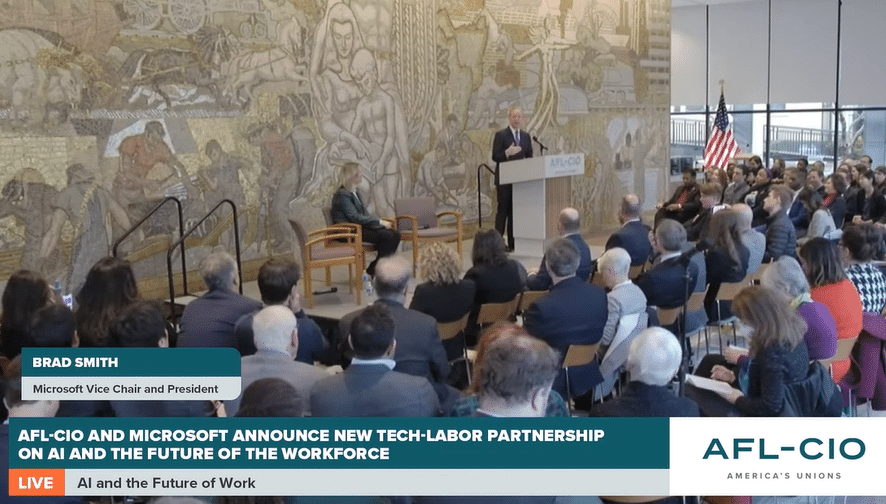
Microsoft President Brad Smith addresses the crowd at an event in Washington, D.C., with AFL-CIO President Liz Shuler on Monday morning. (Screenshot via webcast.)
Microsoft announced a new agreement with the AFL-CIO, the country’s largest federation of unions, that seeks to address concerns about the impact of artificial intelligence on American workers as part of a concerted public campaign by the tech giant to separate itself from its industry rivals on the issue.
The AFL-CIO and Microsoft said the agreement includes a “neutrality framework” that will apply to future efforts by workers to organize under affiliated unions.
They said the framework confirms “a joint commitment to respect the right of employees to form or join unions, to develop positive and cooperative labor-management relationships, and to negotiate collective bargaining agreements that will support workers in an era of rapid technological change.”
AI has emerged as a wedge issue in a wide range of labor negotiations over the past year, including the now-settled strikes by Hollywood screenwriters and actors.
Microsoft has played a key role in opening the eyes of the world to the benefits and risks of generative AI through its partnership with ChatGPT maker OpenAI. Shareholders last week voted down a resolution urging Microsoft to slow its pace of AI development to more closely study the impacts of the technology.
The company’s new union agreement, described as the first of its kind to focus on AI, was announced at an event in Washington, D.C. on Monday morning by AFL-CIO President Liz Shuler and Microsoft President Brad Smith.
Those in the audience included United Auto Workers President Shawn Fain, fresh off the UAW’s successful strike against major automakers.
Speakers included Claude Cummings Jr., president of the Communications Workers of America, which struck an earlier agreement with Microsoft related to its acquisitions of game companies Activision-Blizzard and ZeniMax.
“I believe young people today are interested in joining unions,” Cummings said. “You’re gonna see some of the greatest young minds fleeing from those other tech companies and coming to Microsoft because of this deal.”
In negotiations with ZeniMax over Microsoft’s first U.S. collective bargaining agreement, Microsoft has reportedly made concessions over artificial intelligence, and agreed to convert some workers from contractors to employees.
Microsoft’s turnabout on union issues, starting last year, contrasts with its past opposition to union organizing in its workforce. With a valuation of $2.75 trillion, Microsoft can afford to position itself as the “adult in the room” these days.
Even as Microsoft has expressed neutrality on the concept of unions in its midst, the company has yet to see the labor movement take hold in its core ranks of U.S. engineering or corporate employees. Activities thus far have largely focused on Microsoft’s acquired video-game companies, in units such as testing and quality assurance, where unions have historically had more momentum.
Other tech giants, including Microsoft’s cross-town rival Amazon, have taken a more confrontational approach to union movements inside their workforce. Asked during the Monday event about the possibility of the Redmond company serving as a model for the industry, Smith said he was reluctant to preach to others on the issue.
“I always want to be respectful of everybody’s right to make their own decisions,” Smith responded. “But I do think we’re an industry that tends to learn from success. So we have the opportunity to create a new success and I suspect that as we do, others will be quick to follow.”
Other key points from the event included:
Getting workers involved in the development of AI tools from the beginning to help anticipate impacts and needs for protections/regulations that policymakers may not foresee.
Helping workers transition between jobs as new types of jobs are created, through supporting career/technical education, apprenticeships, and skills training.
Addressing potential job displacement from AI by exploring how technology can be used to enhance productivity and potentially wages, rather than solely replace human roles.
Get caught up on the latest technology and startup news from the past week. Here are the most popular stories on GeekWire for the week of Dec. 3, 2023.
Sign up to receive these updates every Sunday in your inbox by subscribing to our GeekWire Weekly email newsletter.
Most popular stories on GeekWire
Zulily is laying off employees and closing three offices — including its Seattle headquarters — according to internal communications obtained by GeekWire and a new filing with the state of Washington. … Read More
FOLLOW-UP: Zulily shutting down offices and laying off 292 employees in Seattle Zulily is laying off more employees and facing two lawsuits over alleged unpaid invoices, in the latest signs of trouble for the Seattle-based online retailer since it was acquired by a private equity firm earlier this year. … Read More
A message on Zulily’s website this weekend confirms that the online retailer is closing its doors, the latest stage in the rapid downfall of a once high-flying retail brand. … Read More
No VC, no problem. Airship AI, an under-the-radar tech startup that didn’t raise a single dime of investment, will soon become a publicly traded company after clearing SEC regulations this week for its SPAC deal. … Read More
Seattle tech veteran Vetri Vellore is launching a new startup with a big vision to help companies improve their productivity and backing from investors who funded his former venture. … Read More
— Emily Freeman, head of community for Amazon Web Services, is departing. … Read More
— Nicole Ford joined Nordstrom as chief information security officer. … Read More
Amazon says it will change the way it charges sellers who use its fulfillment services, introducing a new fee designed to give sellers a financial incentive to ship products to multiple locations in its fulfillment network. … Read More
Google started to roll out its long-awaited Gemini multimodal artificial intelligence model Wednesday morning, touting its ability to natively process and reason across different inputs like text, images, video, and code. … Read More
Editor’s Note: This is part of a series profiling “Uncommon Thinkers”: inventors, scientists, technologists and entrepreneurs transforming industries and driving positive change. … Read More
Zulily announced a jersey sponsorship with the Seattle Sounders and Reign FC soccer clubs in 2019. (GeekWire File Photo / Kevin Lisota)
A message on Zulily’s website this weekend confirms that the online retailer is closing its doors, the latest stage in the rapid downfall of a once high-flying retail brand.
“All sales are final during Zulily’s going-out-of-business sale,” reads an FAQ page on on its website. Update: The language has been removed since this article was published.
GeekWire first reported Thursday that the Seattle-based company will shut down three offices, including its Seattle headquarters and two warehouses in Ohio and Nevada. It’s laying off more than 800 employees.
Zulily was already struggling in recent years, before Los Angeles-based private equity firm Regent acquired the online retailer in April. But its sudden evaporation is a stunning turn of events for a business once valued at more than $7 billion.
A former Zulily board member, who spoke on condition of anonymity, told GeekWire on Friday they were “depressed” to see what was happening to a former pillar of Seattle’s tech ecosystem.
On LinkedIn, current and former employees shared memories and expressed gratitude for their time at the “Zu.”
“The experiences I gained, the challenges I overcame, and the bonds I formed have profoundly influenced me over the last 12 years and I think they will for the rest of my life,” Sabeeka Dar, a former business development leader at Zulily, wrote on LinkedIn.
“What a journey it has been,” said Derek Elmstrom, a 9-year Zulily veteran. “I’ve learned so much, grown as a person, and met some incredible people. Zulily was an incredible place and it is sad to see it go like this.”
“An unmatched learning experience. And an adventure I could never have imagined,” said former vice president Kristin Toth. “Along the way, I met fantastic people, learned an absolute ton, and stretched in ways that have made me what I am today.”
Former Blue Nile executives Darrell Cavens and Mark Vadon launched Zulily in 2010. The e-commerce site quickly gained traction by offering daily deals on products for moms and kids. The company used an unusual retail business model, selling products on its site before ordering them from vendors.
Zulily raised investment from backers such as Andreessen Horowitz and Maveron, and grew rapidly, reporting revenue of $331 million in 2012, up from $143 million in the prior year. Active customers nearly doubled year-over-year to 1.58 million in 2012.
The company was valued around $4.5 billion in its high-profile initial public offering in 2013.
The company reported $1.2 billion in sales for 2014, but then saw its stock tank as revenue began to slow. Zulily struggled to meet customer expectations for shipping times, among other issues, as it competed against Amazon and other e-commerce giants.
Some customers also complained about the amount of items Zulily was adding to its site as it expanded rapidly from mainly selling children’s items to other categories, such as home accessories and women and men’s clothing.
Qurate, the parent company of QVC previously known as Liberty Interactive, acquired Zulily in 2014 for $2.4 billion.
Zulily’s growth stagnated for the first few years under new ownership but the company began to boost its customer base and revenue in 2018.
Cavens stepped down as CEO that year, replaced by former Amazon exec Jeff Yurcisin.
The company remained prominent in the Seattle area, inking a jersey sponsorship deal in 2019 with the Seattle Sounders and Reign FC pro soccer clubs. It employed 3,500 people at the beginning of 2019.
But Zulily’s business began declining in that year, leading to layoffs and other cuts, and struggles continued into the pandemic, which caused supply chain problems.
Zulily reported a 17% drop in revenue during the first quarter of this year, to $192 million, and a $43 million operating loss.
Qurate announced in May that it sold Zulily to Regent, citing a need to focus on its core video assets including QVC and HSN.
“We are confident Regent is the right partner for Zulily to continue serving its customers, while benefiting from Regent’s depth of operational and strategic expertise in the retail and apparel sectors,” said David Rawlinson, president and CEO of Qurate, in a statement at the time.
Regent has acquired more than 30 businesses since 2015, including consumer retail and apparel brands.
“We are excited to partner with the Zulily team to help the company return to its entrepreneurial roots as an independent business,” Michael Reinstein, chairman of Regent, said in a statement in May. “Zulily has been a trailblazer in using technology to create a compelling online customer experience. Their revolutionary logistics and fulfillment network has also set a new industry standard, and we are excited to leverage its immense potential to grow the Zulily business in new markets.”
Following the acquisition to Regent, Zulily went through two rounds of layoffs. The company did not provide severance for employees who were let go in June, according to affected workers.
It also moved into a smaller headquarters building following Regent’s purchase, ditching its office near the Seattle waterfront. GeekWire visited the new office in October. The space had office furniture and desks, but there were only a handful of employees.
Meanwhile, vendors who sell to Zulily started reporting unpaid invoices this year after the company was acquired by Regent.
Natasha Fiorentino, owner of a small business in Florida called Micro Me that sells children’s apparel, has sold products to Zulily as a vendor for more than a decade. For many years, she never ran into problems getting paid.
But late payments have become more common since the acquisition by Regent, she told GeekWire. Her company is currently owed money for products that Zulily already sold on its marketplace, she said.
“For them to leave me hanging, it’s a huge hit, and right before Christmas,” said Fiorentino, a single mother of two kids.
GeekWire reported Thursday on two lawsuits filed against Zulily by a logistics company and a software development consultancy in recent months, both alleging unpaid invoices.
We’ve reached out to Zulily and Regent, and we’ll update this story if we hear back.
— Nicole Ford joined Nordstrom as chief information security officer. Ford previously served as vice president and CISO at Rockwell Automation, with past experience leading security transformation initiatives and developing cybersecurity programs.
A two-time recipient of the Top 100 CISO Award who garnered a CSO50 recognition, Ford will oversee Nordstrom’s security team and Governance, Risk and Compliance (GRC) team.
Ford is also an active member of various cybersecurity and technology advisory boards, such as the Cybersecurity Collective and Evanta CISO Governing Body.
Ford will relocate to Seattle for the new role with Nordstrom.
— The Allen Institute for Artificial Intelligence (AI2) hired Ross Girshick, a former research scientist at Meta. Girshick will be working on the PRIOR (Perception Reasoning and Interaction Research) team at AI2.
“Ross is one of the most influential and impactful researchers in AI,” Aniruddha Kembhavi, senior director of computer vision at AI2, wrote on LinkedIn. “If you work on developing or harnessing the power of computer vision, you have most likely used a model or a method developed by Ross and his awesome co-authors.”
— Heather DeJong, a longtime Seattle-based Amazon leader and former director at Target, joined San Francisco e-commerce startup CommerceIQ as senior vice president of people and culture.
Minesh Shah, Omnidian president. (Omnidian Photo)
— Omnidian, a Seattle company that manages solar power performance and services commercial and residential solar installations, hired Minesh Shah as president.
Shah’s past roles include leadership positions at Tesla, Walmart.com, Stitch Fix and UNIQLO. He also sat on the board of Bed Bath & Beyond.
Shah will report to CEO Mark Liffmann, who co-founded the company in 2016.
— Seattle-area startup Spectrum Effect raised $3 million from Boulder Ventures and added Kishen Mangat, general partner at Boulder, to its board of directors. Kishen previously was an executive at Cisco and co-founded BroadHop.
Founded in 2015, Kirkland, Wash.-based startup Spectrum Effect sells artificial intelligence-based network interference mitigation software for mobile networks. It raised $1.9 million in August.
— Vancouver, Wash.-based biotech company Absci announced that longtime AstraZeneca exec Sir Menelas Pangalos will join its board, effective Jan. 1. Absci announced a deal with AstraZeneca this week worth up to $247 million.
— Impel Pharmaceuticals CFO Michael Kalb is stepping down at the end of this year. Adrian Adams, Impel’s former CEO, resigned last month. The Seattle biotech company went public in 2021.
— Seattle-based commercial real estate firm JLL hired Matt Betterman as senior vice president. Betterman previously worked for Newmark and Colliers International.
— Seattle climate startup Muir AI hired former Meta engineer Ethan Cassel-Mace as senior software engineer and former Microsoft data scientist Erika Odmark as senior data scientist.
Editor’s note: This story was updated to reflect that Minesh Shah will report to Mark Liffmann at Omnidian.
Carbon, a Seattle startup that helps companies connect external data sources to their large language models, raised a $1.3 million seed round to fuel growth.
Founded last year by longtime friends Derek Tu and Aditya Chempakasseril, Carbon aims to ride tailwinds from the generative AI rush by streamlining the way LLMs access unstructured data from third-party applications like Google Drive and SharePoint.
The idea is to replace custom pipelines companies need to build to make that type of data — ranging from text, audio, and image — available to LLMs.
Carbon’s customers include Jenni.ai, AskAI, and DrLambda.
Tu, Carbon’s CEO, was previously a tech leader and early employee at Los Angeles e-commerce company Italic, and held product roles at Wayfair, Flywire, and 6sense. Chempakasseril was an engineer at Italic and has a master’s in computational science from the University of San Diego.
Carbon has four employees.
Investors in the seed round include Treble and MKT1, along with several angels.
“The Carbon team is tackling a massive market opportunity — all companies from SMBs and Fortune 500 enterprises are reckoning with how to leverage AI on their proprietary data, and Carbon offers a turn-key solution,” Daniel Gulati, founder of Treble, said in a statement.
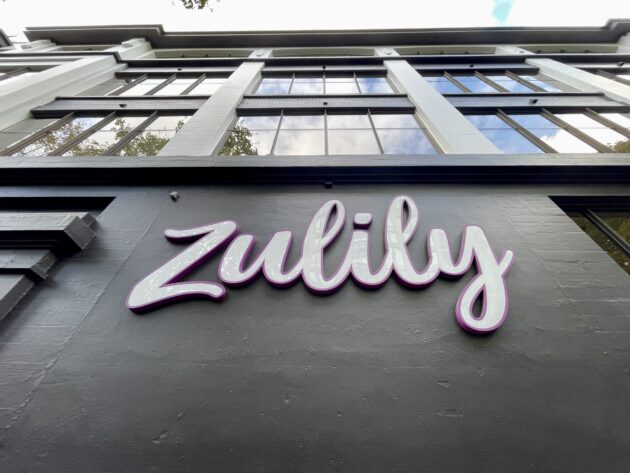
Zulily’s former headquarters building near the Seattle waterfront. The company relocated to a smaller HQ earlier this year. (GeekWire Photo / Taylor Soper)
Zulily is laying off employees and closing three offices — including its Seattle headquarters — according to internal communications obtained by GeekWire and a new filing with the state of Washington.
It’s the latest chapter in a stunning downfall for a company that was once a crown jewel of Seattle’s tech scene.
In February of next year, Zulily plans to shut down warehouses in McCarran, Nev., and Lockbourne, Ohio, in addition to its Seattle headquarters, according to internal communications.
A new filing with the Washington state Worker Adjustment and Retraining Notification (WARN) system shows 292 employees in Seattle being laid off as part of a closure. Update: Zulily will lay off more than 500 employees as part of the warehouse shutdowns in Nevada and Ohio.
Zulily already went through two rounds of layoffs this year after Los Angeles-based private equity firm Regent acquired the online retailer in May from QVC parent Qurate.
It also moved into a smaller headquarters building in Seattle following Regent’s purchase.
GeekWire reported earlier Thursday on two lawsuits filed against Zulily by a logistics company and a software development consultancy in recent months, both alleging unpaid invoices.
GeekWire also reported in September about vendors who sold products to Zulily and weren’t getting paid following the Regent acquisition.
Zulily did not provide severance for employees who were let go in June, according to affected workers.
In October, former CEO Terry Boyle announced internally his decision to leave the company, effective Oct. 31.
Founded in 2010 by former Blue Nile executives Darrell Cavens and Mark Vadon, Zulily got its start by offering daily deals on products for moms and kids, and later expanded its product selection. The company used an unusual business model, selling products on its site before ordering them from vendors.
Zulily raised investment from backers like Andreessen Horowitz and Maveron, and grew rapidly, reporting revenue of $331 million in 2012. It went public in 2013 with a spectacular IPO that valued the company at around $4.5 billion.
Qurate paid $2.4 billion to acquire Zulily in 2015.
Zulily announced a jersey sponsorship with the Seattle Sounders and Reign FC soccer clubs in 2019. (GeekWire File Photo / Kevin Lisota)
The company remained prominent in the Seattle area, inking a jersey sponsorship deal in 2019 with the Seattle Sounders and Reign FC pro soccer clubs.
Zulily was struggling under Qurate before the sale to Regent. It reported a 17% drop in revenue during the first quarter, to $192 million, and a $43 million operating loss.
In a May press release announcing its acquisition, Regent said it planned to grow Zulily’s business in new markets. That press release has been removed from Regent’s website as of Thursday afternoon.
Jane.com, a Salt Lake City company that used a similar model to Zulily, collapsed last month.
We’ve followed up with Regent and will update this story if we hear back.
FOLLOW-UP: Zulily shutting down offices and laying off 292 employees in Seattle
Zulily is laying off more employees and facing two lawsuits over alleged unpaid invoices, in the latest signs of trouble for the Seattle-based online retailer since it was acquired by a private equity firm earlier this year.
Some employees were notified Thursday that they were being let go, according to posts on LinkedIn.
Meanwhile, a new lawsuit filed this week by GenUI, a Seattle-based software development consultancy, alleges that Zulily breached contractual obligations and owes the company $191,776 for work completed earlier this year.
GenUI has performed work for Zulily since 2017, but starting this past April, Zulily started to fall behind on monthly payments, according to the suit filed in King County Superior Court.
GenUI says in the lawsuit that it has contacted Zulily “numerous times to demand payment” but has not been paid.
Los Angeles-based private equity firm Regent bought Zulily from QVC parent Qurate in May.
“We’ve had a longstanding business relationship with Zulily, and it’s really unfortunate we find ourselves in this position today,” GenUI CEO Jason Thane told GeekWire. “Ideally we’d like to get a response from the new ownership and resolve this before year end so we can each focus on running our respective businesses.”
In another lawsuit filed in October, Texas-based Omni Logistics alleges that it is owed more than $2.7 million for services provided to Zulily. In a new filing this week, Zulily denied allegations that it owes payment to Omni.
We’ve reached out to Zulily and Regent and will update this story if we hear back.
Since changing ownership this year, Zulily has gone through two rounds of layoffs and moved into a smaller headquarters building in Seattle.
GeekWire reported in September that several vendors weren’t getting paid by Zulily following the Regent acquisition.
A customer who lives in Canada said this week that they were not able to buy anything from Zulily’s website.
In a May press release announcing its acquisition, Regent said it planned to grow Zulily’s business in new markets. That press release has been removed from Regent’s website as of Thursday afternoon.
Regent’s portfolio includes Club Monaco, Dim Paris, and Redline Bicycles, among others. It has acquired more than 30 businesses since 2015.
Founded in 2010, Zulily got its start by offering daily deals on products for moms and kids, and later expanded its product selection. The company went public in 2013. Qurate paid $2.4 billion to acquire Zulily in 2015.
Zulily was already struggling under Qurate before the sale to Regent. It reported a 17% drop in revenue during the first quarter, to $192 million, and a $43 million operating loss.
[This story originally appeared on Real Estate News.]
Imagining what a home might look like can be tough for would-be buyers. However, a new tool from Redfin — powered by AI, of course — is designed to help.
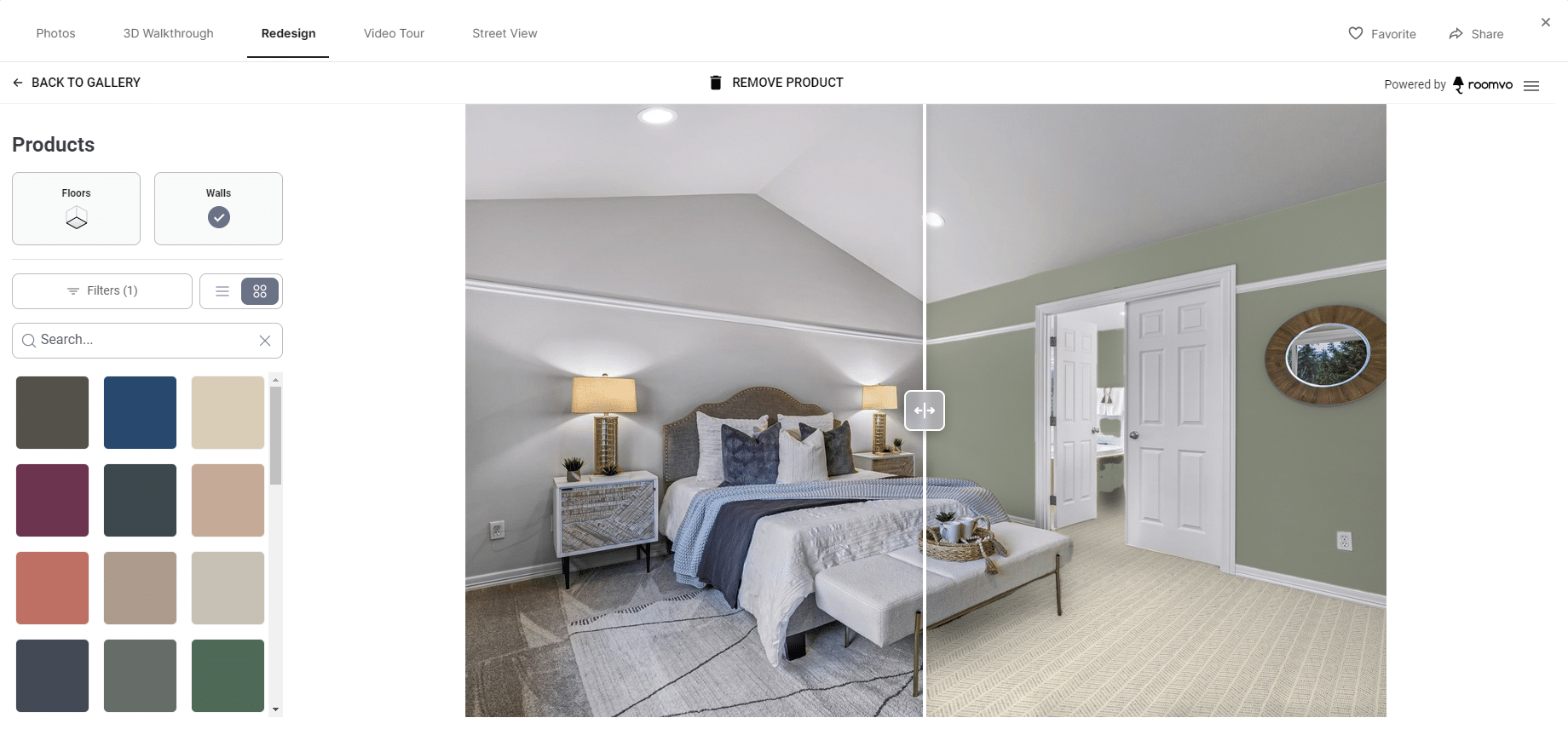
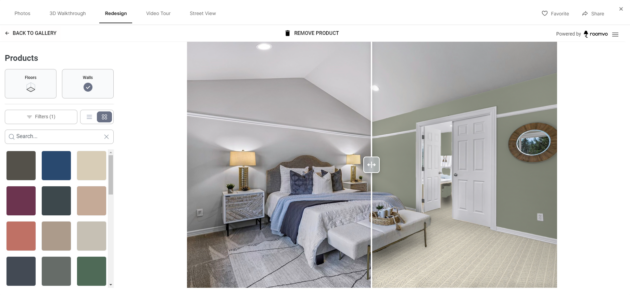
Redfin Redesign, which launches today on listings from Redfin and Bright MLS, allows consumers to alter the appearance of walls, floors and countertops “in just a few clicks,” said Ariel Dos Santos, Redfin’s senior vice president of product.
“Buyers often want to know what a home will look like with some changes, not just what it looks like right now,” Dos Santos said. “Sellers want their listings to appeal to the broadest pool of buyers, regardless of design preferences.”
How does it work? Redfin Redesign is powered by Roomvo, a home visualization platform. With the click of a button, home shoppers can select a listing photo, customize it by choosing from a range of flooring types, paint colors and countertop finishes, then compare before and after images.
Is it on all listings? So far, the tool is only available on active Redfin listings and eligible sold Redfin listings, as well as listings from Bright MLS, the nation’s second-largest MLS covering the Mid-Atlantic region. That makes for a total of about 75,000 listings so far, but Redfin said it will look to grow that number through partnerships with other brokerages and MLSs.
“Helping brokers deliver innovative experiences is something that’s foundational to Bright as an organization. We are excited to be the first MLS to partner with Redfin to offer this tool that helps people reimagine home from their desktop or mobile device,” said Amit Kulkarni, Bright MLS’s chief marketing officer.
What do consumers think? Nothing is quite the same as seeing a home with your own eyes, but listings tech just keeps getting better — and people both appreciate and expect it. Redfin has offered 3D walkthroughs on listings for almost a decade, and Zillow continues to invest in multimedia as part of ShowingTime+, calling it “crucial” to selling a home.
The scene inside the 2023 GeekWire Gala on Wednesday night at the Showbox Market in Seattle. (GeekWire Photo / Kevin Lisota)
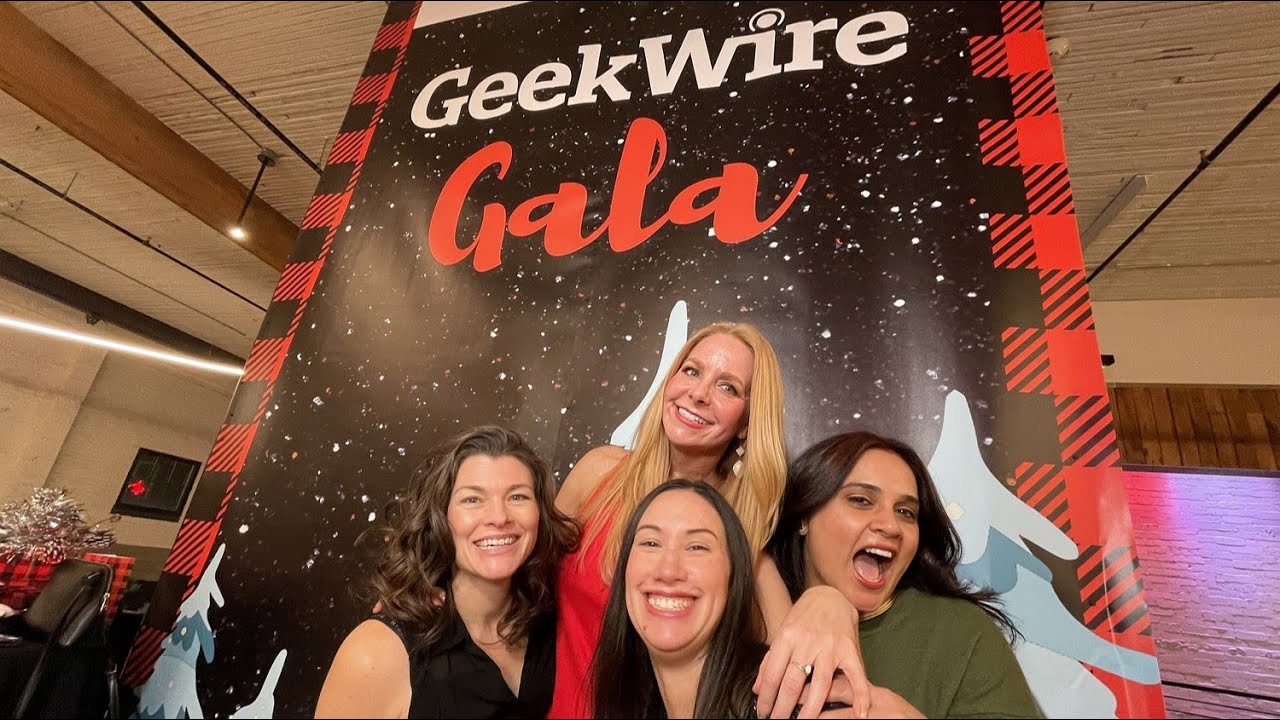
A frosty night inside Seattle’s Showbox Market warmed our geeky hearts on Wednesday as the tech community came together to celebrate the holidays at the annual GeekWire Gala.
More than 600 attendees turned out for a night of networking, dancing, singing and partying as a winter theme took over the historic venue in downtown Seattle.
Partygoers packed the dance floor and the “Geekaroke” karaoke lounge; a select few took the stage for a fierce holiday fashion contest; they sipped specialty cocktails and munched on tasty treats; they posed all night in the glittery photo booth; had their caricatures drawn; took home airbrushed tattoos; and more.
Several of the competitors in the holiday fashion contest at the GeekWire Gala in Seattle on Wednesday. (GeekWire Photo / Kevin Lisota)
In a special program before the official party kicked off, we paid tribute this year to the region’s “Uncommon Thinkers” — Seattle-area inventors, scientists, technologists and entrepreneurs transforming industries and driving positive change in the world.
The honorees included: University of Washington professor and entrepreneur Shwetak Patel; Brinc founder and CEO Blake Resnick; MagniX CTO Riona Armesmith; USAFacts President Poppy MacDonald; Seattle Children’s Hospital attending anesthesiologist Dr. Elizabeth Hansen; and Boundless co-founder and CEO Xiao Wang. (Click on each name to read GeekWire profile stories on the winners, and check back Saturday for GeekWire Podcast interviews with some of them.)
A big thanks to Greater Seattle Partners for their support of this new awards program.
Four of the Uncommon Thinkers honorees in attendance at the GeekWire Gala in Seattle, including, second from left: Shwetak Patel, Dr. Elizabeth Hansen, Poppy MacDonald, and Xiao Wang. They’re joined on stage by Greater Seattle Partners COO Rebecca Lovell, left, and GeekWire co-founder John Cook, right. (GeekWire Photo / Kevin Lisota)
The GeekWire Gala was presented by First Tech Federal Credit Union.
Thanks to our additional gold-level sponsors: Greater Seattle Partners & RSM, US LLP; silver level: Pilot Capital, Tito’s Handmade Vodka, SolluCIO, Prime Team Partners, Remitly, Submittable, Sigma Computing, Cohesity, and Xenomode; and supporting level: World Trade Center Seattle, Hal9, Lexion, American Diabetes Association, Epic Seats, and Sonic Symphony World Tour.
And thanks to everyone for making our party your party. Happy holidays!
Keep scrolling for more photos from the 2023 GeekWire Gala:
The 2023 GeekWire Gala at the Showbox Market in Seattle. (GeekWire Photo / Kevin Lisota)Rebecca Lovell, left, of Greater Seattle Partners, and GeekWire co-founder John Cook introduce the Uncommon Thinkers honorees at the GeekWire Gala. (GeekWire Photo / Kevin Lisota)DJ Mixxtress at the 2023 GeekWire Gala. (GeekWire Photo / Kurt Schlosser)A caricature is drawn at the 2023 GeekWire Gala at the Showbox Market in Seattle. (GeekWire Photo / Kevin Lisota)Making the rounds with specialty cocktails at the GeekWire Gala. (GeekWire Photo / Kevin Lisota)Dishing up food at the meatball bar at the 2023 GeekWire Gala. (GeekWire Photo / Kevin Lisota)GeekWire co-founder John Cook, left, working the crowd reaction for disco-ball dressed competitors in the fashion showdown at the GeekWire Gala. (GeekWire Photo / Kevin Lisota)The 2023 GeekWire Gala at the Showbox Market in Seattle. (GeekWire Photo / Kurt Schlosser)The 2023 GeekWire Gala at the Showbox Market in Seattle. (GeekWire Photo / Kevin Lisota)The 2023 GeekWire Gala at the Showbox Market in Seattle. (GeekWire Photo / Kurt Schlosser)The 2023 GeekWire Gala at the Showbox Market in Seattle. (GeekWire Photo / Kevin Lisota)The 2023 GeekWire Gala at the Showbox Market in Seattle. (GeekWire Photo / Kurt Schlosser)The 2023 GeekWire Gala at the Showbox Market in Seattle. (GeekWire Photo / Kurt Schlosser)Performing in the karaoke lounge at the 2023 GeekWire Gala at the Showbox Market in Seattle. (GeekWire Photo / Kurt Schlosser)Inside the karaoke lounge at the 2023 GeekWire Gala at the Showbox Market in Seattle. (GeekWire Photo / Kurt Schlosser)The 2023 GeekWire Gala at the Showbox Market in Seattle. (GeekWire Photo / Kurt Schlosser)The 2023 GeekWire Gala at the Showbox Market in Seattle. (GeekWire Photo / Kurt Schlosser)The 2023 GeekWire Gala at the Showbox Market in Seattle. (GeekWire Photo / Kevin Lisota)
En toda empresa llega un momento en el que los procesos de gestión pueden consumir tiempo y valiosos recursos, a un grado tan notable como creciente. Esto pasa en todas las empresas conforme van creciendo y consolidando resultados y es por ello que existen empresas especializadas SAP Partner México, las cuales proporcionan las herramientas perfectas para facilitar todos los procesos. Esto conlleva un importante ahorro de recursos y tiempo.
Existen algunos indicadores que nos pueden aclarar este punto y por medio de ellos saber si una empresa requiere ya de herramientas especializadas tipo ERP para eficientar la gestión. Se trata de un sistema informático de administración de recursos empresariales que se implementa y ejecuta según las necesidades de cada empresa o proyecto. Por ejemplo, se puede instalar un sistema de manufactura que ayude a automatizar de manera inédita la producción de una empresa que solía ejecutar los procesos manualmente. Esto también favorece el trabajar con procesos más estandarizados, lo que rápidamente se reflejará en un aumento de los ingresos.
Si su empresa tiene problemas o invierte demasiado tiempo, personal y otros recursos en áreas como finanzas, manufactura, recursos humanos, cadena de suministros, procurement y los a veces tan complicados recursos humanos, es quizá el momento de utilizar un software de este tipo. Incluso existen opciones que proveen software erp para ecommerce, facilitando los procesos de la venta en línea de manera puntual.
El ERP ayuda a gestionar todos estos procesos y más, pero si su empresa no requiere utilizar alguno de ellos no habrá ningún problema a ese respecto. En el software moderno de ERP es posible utilizar únicamente los módulos que sean necesarios y se adapten a las necesidades específicas de cada compañía.
La implementación de este estilo de software es sumamente fácil de realizar, aunque nunca está de más que se cuente con la asesoría experta de empresas especializadas en el ramo. Tener el partnership de una agencia dedicada a resolver problemas y brindar soporte suele ser también una excelente decisión.
El uso de un sistema de software ERP está relacionado directamente con el crecimiento y la eficiencia. Cuando una empresa crece sus procesos se vuelven más amplios y por ello requieren una mayor inversión de tiempo. Este tipo de programas logran que todos los procesos corran de forma más rápida y ordenada. Hoy en día lo más común es que se valgan de la nube para ofrecer una mejor experiencia de usuario y la gente pueda estar conectada y actualizada con la información que necesita en cada momento del día de trabajo.
Por citar un ejemplo del funcionamiento de este tipo de sistemas, el ERP puede ser de gran utilidad en el área de ventas, gestionando y monitoreando desde la cadena de suministros hasta la entrega al cliente final, manejo de stock y en general todos los factores que determinan que el cliente tenga una experiencia satisfactoria al adquirir los productos y servicios que una empresa le brinda.
Siempre que se cuente con un proveedor serio y certificado, un software ERP mejorará notablemente la gestión de cualquier negocio, sin importar su tamaño o nivel de facturación. Y para tomar la decisión hay que tener presente que en los negocios la eficiencia se traduce en mayores ingresos.
Jay Shendure, a professor of genome sciences at UW Medicine, will be executive director of the Seattle Hub for Synthetic Biology. (UW Medicine Photo)
The Allen Institute, the Chan Zuckerberg Initiative and the University of Washington have launched a collaboration called the Seattle Hub for Synthetic Biology, with the goal of using genetically modified cells to capture a DNA-based record showing how they change over time.
If the project works out as hoped, it could lead to a deeper understanding of the mechanisms behind cellular processes — including, for example, how tumors grow — and point to new methods for fighting disease and promoting healthy cell growth.
Over the next five years, the Seattle Hub for Synthetic Biology will receive $35 million from the Allen Institute, and another $35 million from the Chan Zuckerberg Initiative, founded by Meta CEO Mark Zuckerberg and his wife, Priscilla Chan.
Jay Shendure, a professor of genome sciences at UW Medicine, will serve as the hub’s executive director. Other members of the leadership team include Marion Pepper and Cole Trapnell, researchers at UW Medicine; and Jesse Gray, a veteran of Ascidian Therapeutics and Harvard Medical School. The collaboration will build on technology pioneered at the Allen Discovery Center for Cell Lineage Tracing and the Brotman Baty Institute for Precision Medicine.
Shendure compared the genetically modified cells to flight recorders on airplanes. He said such cells could, for example, be combined with CAR-T cells to track the progress of cancer therapy.
“You could imagine layering them into CAR-T cells to provide a record of what happened, in the context of trying to deliver a certain therapeutic,” he told GeekWire. “And then you could imagine components of these cells, or more sophisticated versions, actually being used as part of the therapy — where, when and how a therapeutic turns on or off is modulated at some level by a much more sophisticated set of machinery.”
Cole Trapnell, Marion Pepper and Jesse Gray are part of the leadership team for the Seattle Hub for Synthetic Biology. (UW / Allen Institute Photos)
A new channel for checking cells
That sort of application is far down the road. In the nearer term, SeaHub’s researchers aim to develop a new channel for chronicling the changes that cells go through. This channel would take an approach that’s different from existing methods that depend on microscope imaging or sequencing a cell’s entire genome.
Shendure and his colleagues at UW have already created two techniques that could help turn elements of the genetic machinery inside cells into tiny time-lapse recording devices.
One of the techniques, known as DNA Typewriter, was the subject of a research paper in the journal Nature last year. The system makes use of gene-editing tools to lay down short snippets of DNA in chronological order, moving along a molecular string like the clicks of the carriage on an old-fashioned typewriter.
“If you insert a five-base-pair sequence, that’s four to the fifth, or 1,024. So there are 1,024 possible symbols that we could insert,” Shendure said. “When you punch a key, so to speak, you write a symbol — one of those 1,024 possible insertions. That’s like the recording of information. And the same edit moves the ‘type head’ one unit down the tape. You’re not just firing letters at a piece of paper, you’re actually typing them in some coherent order.”
The second technique is Engram. “Without Engram, DNA Typewriter is like a monkey at a typewriter, just hitting keys,” Shendure said. “But with Engram, at least for some of the keys, we can say you’re more likely to type this key if this particular signaling pathway is active, or you’re only going to type this key if you’re this particular cell type. So, we’re starting to learn how to assign meanings to keys, and to build a vocabulary of triggers between biological signals and symbols on our keyboard.”
To read the recording, researchers could extract some of the recorder cells and check the sequence of DNA letters that were inserted over time.
A small section of a cell lineage map produced using DNA Typewriter. (Allen Institute / UW Image)
What the recorders could reveal
Early practical applications of the cell-recording technologies are likely to focus on studying how cells multiply and develop into tissues under normal conditions, and how things go wrong due to disease.
Studying the growth of a cancerous tumor would be a great example, Shendure said. “If you want to probe the history of one tumor — obviously this would be in a model organism, but it could be a human cell transplanted in a mouse — trying to accumulate that history over time is something that you would want to do,” he said.
Researchers could track the development of different tumors on the cellular level, and study how different treatment strategies affect their growth. For that scenario, a strain of mice could be genetically engineered with cell-recording capability.
“We make a mouse line that essentially has all this stuff stably, and the recording device can be ‘turned on’ at any point,” Shendure said. “You could have it constituently on, so it switches on at the beginning, or you could use a small chemical to turn it on, like doxycycline.”
Such methods could also be used to fine-tune tissue engineering. “If we’re trying to make skin in a dish, or something like that, what’s working? What’s not working? And how do you modulate it to improve the process?” Shendure said.
Using such techniques for clinical treatment in humans is a long-term strategy. But how long-term? “I don’t think they’re as futuristic as they might seem, given everything that’s going on,” Shendure said.
Sharing the science
Findings from the research effort will be shared widely within the scientific community. “It’s all going to be open science, fitting with the philosophy of the Allen Institute and CZI,” Shendure said.
The Chan Zuckerberg Initiative’s backing for the Seattle Hub for Synthetic Biology builds on the philanthropic organization’s history of supporting big-picture biotech projects — including a $3 billion effort aimed at curing, preventing and managing all diseases within a generation, and $15 million in grants that were awarded in 2018 to support a global research effort called the Human Cell Atlas.
“By developing new technologies to measure and understand the history of our cells over time, including how they are impacted by the environment around them, genetic mutations and other factors, we can expand scientists’ understanding of what happens at the cellular level when we go from healthy to sick, and help pinpoint the earliest causes of disease,” CZI co-founder and co-CEO Priscilla Chan said in a news release.
Rui Costa, president and chief executive officer of the Allen Institute, said he and his colleagues are “incredibly excited to enter this new era of collaboration to tackle big moonshot projects in partnership with others.”
UW President Ana Mari Cauce said the project “demonstrates the enormous potential impact of values-driven partnerships, and it represents a new way of thinking about how we can solve problems more quickly and effectively through scientific collaboration.”
“Our shared values, paired with our complementary perspectives and strengths, are a recipe for success, and I can’t wait to see what this team will accomplish together,” Cauce said.
The effort should yield noticeable results within five years, Shendure said.
“It could lead to basically a library of tools for engineering cell types, specific expression, et cetera. … I think there’ll be these deliverables that are broadly useful for the field,” he said.
Shendure hopes researchers at the Seattle Hub for Synthetic Biology will come up with specific bodies of information relating to cell lineages, including cancer cell lineages, that would be impossible to obtain using more conventional technologies. But he also has a bigger goal in mind: “Gaining acceptance for a new modality of measuring things over time, using DNA as a recording medium.”
“That’s been kind of a niche interest of technology development groups,” Shendure said. “We’re trying to really move that toward the mainstream.”
Carbon Robotics CEO Paul Mikesell with the company’s weed-zapping robot. (Carbon Robotics Photo)
Carbon Robotics, makers of a weed-zapping machine powered by artificial intelligence and computer vision technology, has raised an additional $8 million which it plans to use to accelerate development of a new product line in agriculture tech.
The new cash extends a Series C round that has now pulled in $43 million for the Seattle startup. Carbon Robotics has raised $80 million in total.
The company declined to share details on what new product it’s developing, but said it’s not related to its flagship LaserWeeder machine, which uses thermal energy to eliminate weeds without damaging crops or disturbing soil.
“Demand and units shipped for LaserWeeder tripled in 2023 versus 2022 — so this was a good opportunity for us to accelerate another new product project we are very excited about,” Carbon VP of marketing Brett Goodwin told GeekWire. “As an AI robotics company, we’re big believers in the power of software and hardware together to create value.”
Founded in 2018, Carbon is led by Isilon Systems co-founder Paul Mikesell, who sold Isilon for $2.25 billion in 2010 and spent time at Uber and Facebook before embarking on another entrepreneurial journey.
We’re kicking off the holiday season in style tonight at our annual GeekWire Gala, with an epic night of dancing, networking, and much more on tap.
Limited tickets still remain — make our holiday party your work holiday party, and grab tickets before they sell out.
For those attending, here’s a rundown of what to expect. If you have questions, please email us at [email protected].
When: Wednesday, Dec. 6
Where: Showbox Market (1426 1st Ave, Seattle, WA 98101) near Pike Place Market.
Parking: There are several pay lots within a 2-minute walk of the venue; see additional parking information here.
Agenda:
6:00 pm — Doors open to the public
7:00 pm — Fiercest Frosty or Festive Outfit winners selected
10:00 pm — GeekWire Gala ends
Attire: You have the rare license to don cocktail attire in Seattle. Or wear whatever you want. Tuxedos? Sure. Geeky T-shirts? Yep. Even better, break out your fiercest FROSTY fashion. For inspiration, check out the outfits from last year’s Gala.
Do I need to bring a physical ticket? No. If you are registered, we’ll check your ID at registration, and provide your name badge.
Festivities: DJ, photo booth, karaoke, caricatures, cupcake challenge, temporary airbrush tattoos & hair color, giveaways and more.
Food: Delicious snacks from our friends at Cameron Catering, including a meatball bar, tater tot bar, sliders, and more.
Along with all that, we’re also paying special recognition this year to the region’s “Uncommon Thinkers” — Seattle-area inventors, scientists, technologists and entrepreneurs transforming industries and driving positive change in the world. A big thanks to Greater Seattle Partners for their support of this new awards program.
The GeekWire Gala — presented by First Tech Federal Credit Union — is a 21+ event.
Thanks to our additional gold-level sponsors: Greater Seattle Partners & RSM, US LLP; silver level: Pilot Capital, Tito’s Handmade Vodka, SolluCIO, Prime Team Partners, Remitly, Submittable, Sigma Computing, Cohesity, and Xenomode; and supporting level: World Trade Center Seattle, Hal9, Lexion, American Diabetes Association, and Sonic Symphony World Tour.
Derek Xu (left) and Victor Huang began their startup journey two decades ago. Now they’re taking a company public. (Airship AI Photos)
No VC, no problem.
Airship AI, an under-the-radar tech startup that didn’t raise a single dime of investment, will soon become a publicly traded company after clearing SEC regulations this week for its SPAC deal.
The Redmond, Wash.-based company traces its roots to 2003, when co-founders Victor Huang and Derek Xu took the startup leap together. They dabbled with different ideas, survived the recession, and landed on the current iteration of Airship AI in 2010.
It’s been a long journey for the bootstrappers. “We are survivors,” Huang told GeekWire on Tuesday.
Not having pressure from venture capitalists looking for exponential growth and a big exit may have been a blessing.
“When you bootstrap, you get to try on your own dime and your own timeframe,” Huang said. “Nobody is going to rush you.”
Airship AI — not to be confused with Portland, Ore.-based mobile marketing company Airship — sells software that uses computer vision and artificial intelligence to analyze data from cameras and sensors at the “edge.” The object detection and recognition technology helps companies address security and operational needs.
Customers include Fortune 500 companies such as FedEx and Home Depot, as well as federal government agencies.
Huang, 54, and Xu, 66, went through various iterations of video-related software products over the past two decades. Most of them didn’t pan out, but the entrepreneurs were able to stay in the game long enough.
“We just put our heads down and persevered,” Huang said.
They tried to raise money along the way, but investors declined. It worked out in the end.
“I’d rather get money from a customer than an investor,” Huang said.
“We just put our head down and persevered.”
Using advancements in AI-powered video processing and edge computing tools, Airship AI has carved out a niche. It sells a small hardware device called Airship Outpost that encodes video and a web application called Acropolis OS that manages surveillance systems.
Airship AI estimates the combined edge AI hardware and software market to reach $7 billion by 2029.
The company competes with a number of other video analysis providers such as Ambarella and Visidon.
Huang said Airship AI differentiates by focusing intensely on customer service. “We’ve never lost a single customer,” he said.
Airship AI reported $8.1 million in revenue through the first nine months of 2023, down nearly 40% from the year-ago period, with a net loss of $6.5 million. But Huang said the company still expects to outperform its 2022 metrics. It entered 2023 with $162.9 million in its sales pipeline, according to regulatory filings.
The SPAC deal with BYTE Acquisition Corp. values Airship AI at over $200 million.
Also known as blank check companies, SPACs form with the intent of acquiring a private company in order to take it public. SPACs re-emerged during the pandemic in a big way, as capital flowed freely and entrepreneurs used the financial instruments to more quickly enter the public markets.
But the performance of post-merger SPACs steadily dropped throughout 2022 amid the larger market slowdown and a record number of deals were spiked. There were 613 SPAC deals in 2021; just 29 have been completed this year, according to SPAC Insider.
Airship AI and BYTE execs believe taking the company public is essential for the nature of its business, particularly to cater to government clients and open up opportunity for larger contracts.
“We believe a public listing will provide Airship AI with enhanced visibility, selling opportunities and financial flexibility to perform to its business plan and broaden its customer base,” BYTE CEO Sam Gloor said in June.
Gloor is a longtime investment banker and founder of Sagara Group, which advises growth-stage companies. Kobi Rozengarten, chairman of BYTE, is a former managing partner at Jerusalem Venture Partners, a leading Israeli venture capital firm.
Airship AI has 47 employees across offices in Redmond, Charlotte, N.C., and Taiwan. The company will trade on the Nasdaq under the ticker AISP.
The company’s other executives include President Paul Allen, a former IBM exec and Green Beret with the U.S. Army Special Forces, and CTO Yanda Ma, who joined Airship in 2005.
Google CEO Sundar Pichai previews Gemini at Google I/O earlier this year. (GeekWire Photo / Todd Bishop)
Google started to roll out its long-awaited Gemini multimodal artificial intelligence model Wednesday morning, touting its ability to natively process and reason across different inputs like text, images, video, and code.
With the new AI model, the search giant is looking to jump ahead in the AI competition against OpenAI, Microsoft, Amazon, and other industry rivals.
Google described Gemini as its largest and most capable model to date, and the first AI model to surpass human experts on the Massive Multitask Language Understanding (MMLU) benchmark.
Sundar Pichai, the Google and Alphabet CEO, said in a blog post that Gemini represents “one of the biggest science and engineering efforts we’ve undertaken as a company,” under the umbrella of the company’s DeepMind AI initiatives.
Google said Gemini has undergone extensive AI safety testing, using tools including a set of “Real Toxicity Prompts” developed by the Seattle-based Allen Institute for AI to evaluate its ability to identify, label, and filter out toxic content.
Gemini will roll out in phases in different products:
Many Google users will experience Gemini first in the company’s Bard AI chatbot. A version called Gemini Pro will power Bard starting today, Google execs said in a media briefing. A more powerful model called Gemini Ultra will be available early next year in a new version called Bard Advanced.
Google Cloud will make Gemini Ultra available in an early access program for developers, rolling out more broadly in early 2024. Gemini Pro will be available starting Dec. 13 in Google Cloud’s Vertex AI and AI Studio.
A version called Gemini Nano for on-device applications will be available on Google Pixel phones, starting with Pixel 8 Pro. Google says it will power a new Summarize feature in the Recorder app and Smart Reply in Gboard.
The Information reported Dec. 2 that Google cancelled a series of in-person launch events that were planned for Gemini “after the company found the AI didn’t reliably handle some non-English queries.”
Read AI’s new “Smart Scheduler” uses past sentiment and engagement scores to suggest optimal meeting times. (Read AI Image)
Read AI, a Seattle startup that applies artificial intelligence to online meetings, is expanding beyond its automated recaps of single meetings — using AI to summarize and glean insights from potentially thousands of meetings at a time.
The company, founded in 2021 by a trio of Seattle tech vets, is attempting to get ahead in its competition against corporate giants and an array of startups in one of the most hotly contested AI fields.
David Shim, Read AI CEO and co-founder, compares the new approach to reading interconnected chapters in a book, rather than single magazine articles, leveraging the larger context of multiple meetings to unlock additional value.
This broader approach, which ReadAI calls “Large Meeting Models,” or LMMs, is the basis for several new features that the company is releasing Wednesday:
A scheduler that uses AI to suggest the best days and times to hold a meeting based on engagement and sentiment scores from past meetings.
An AI project manager that automatically identifies, tracks, and updates the status of action items based on discussions and interactions during meetings.
A Q&A feature that discovers and answers common questions from thousands of meetings across an organization.
A “For You” page in which content is automatically selected by learning which topics interest individual users, based on AI-generated assessments from meetings they attend.
A new “Daily Read Podcast,” an AI-produced audio digest that provides users with personalized summaries from relevant meetings held during the prior 24 hours, and previews their upcoming meetings.
The daily audio recap was a skunkworks project developed in just the past few weeks after the idea came up, demonstrating the potential to build new features rapidly under the new approach. The idea is to give Read AI users the ability to hear an overview on a commute to work. Here’s an example.
Read AI’s new “Daily Read” podcast summarizes and previews meetings. (Read AI Image)
The new features build on the company’s existing AI tools, which are centered around a post-meeting recap that summarizes individual meetings, along with a transcript and video highlights, an approach that has been compared to “SportsCenter” for meetings.
Read AI works with Zoom, Google Meet, and Microsoft Teams, with a subscription pricing model. The company says its AI has analyzed more than 100 million minutes of meetings so far. Zoom selected Read AI as an Essential App, Google made Read AI a launch partner for Meet Add-Ons, and Microsoft also highlighted the startup.
Some of the same tech giants are offering their own tools that use AI to analyze meetings on their own platforms, including Microsoft 365 Copilot, promising to compete more and more with Read AI and other startups over time.
Read AI co-founders, from left, Rob Williams, David Shim, and Elliott Waldron. (Read Photo)
At the same time, Read AI is increasingly seeing interest from larger customers with thousands of users. This is leading to faster growth than the startup saw in its early days of product-led growth, when individual users and smaller groups of workers were the primary early adopters, Shim said.
“We are excited about where we’re at,” he said. “It’s still early days, but we’ve found product-market fit when it comes to meetings. Now the market is telling us, these are the things we want you to add on top of it, versus us having to go in and guess.”
The company was founded in 2021 by Shim, Elliott Waldron, and Rob Williams. The group previously led location analytics startup Placed, which was acquired by Snap for more than $200 million in 2017.
Read AI raised a $10 million seed round in September 2021.
The startup’s technology, including its AI models, is developed primarily in-house.
Dharmesh Mehta, Amazon’s vice president of Worldwide Selling Partner Services, speaks to sellers at the Amazon Accelerate conference in Seattle in September. (GeekWire File Photo / Todd Bishop)
Amazon says it will change the way it charges sellers who use its fulfillment services, introducing a new fee designed to give sellers a financial incentive to ship products to multiple locations in its fulfillment network.
The idea, Amazon says, is to get products closer to customers more efficiently and cost-effectively, in line with its latest strategy of putting comprehensive sets of inventory at each of its regional fulfillment hubs.
Under the new fee structure, announced Tuesday morning, sellers will be able to reduce or avoid the new “inbound placement fees,” the company says, if they opt to send their products to multiple locations, rather than a single Amazon destination, after the new fees begin in March 2024.
At the same time, Amazon plans to reduce its existing outbound fulfillment fees, in addition to offering sellers discounts when their products can be shipped in existing packaging, improving efficiency and reducing waste.
“After these changes, we expect that sellers will see an average increase of $0.15 in fees per unit sold (which is significantly less than the increases announced by other logistics providers); however, we also expect that there will be many sellers who will see a decrease in the average fees paid to Amazon per unit sold,” wrote Dharmesh Mehta, Amazon’s vice president of Worldwide Selling Partner Services, in a post announcing the changes.
It’s part of a broader restructuring of Amazon’s seller fees. These fees are a major focus of the FTC’s antitrust lawsuit against the e-commerce giant, filed in September in U.S. District Court in Seattle.
The lawsuit says Amazon has significantly increased the fees it charges sellers who use its fulfillment services over time, citing reports that Amazon now takes nearly half of every dollar from the typical seller using its fulfillment service. The FTC alleges that fee hikes have made it increasingly difficult for sellers to profit on Amazon, illustrating what it describes as the company’s monopoly power.
Amazon has categorically denied the allegations in the suit.
Here’s a rundown of the major changes announced Tuesday.
Amazon will introduce a new inbound placement service fee, averaging 27 cents per unit for standard items and $1.58 per unit for large bulky items, with the option to reduce or eliminate fees by sending items to multiple locations.
Fulfillment By Amazon (FBA) fulfillment fees will decrease on average by 20 cents per unit for standard items and 61 cents per unit for large bulky items.
Referral fees for apparel priced under $15 will decrease from 17% to 5%, and fees for apparel priced $15-20 will decrease from 17% to 10%, starting in January.
Fulfillment fee discounts of 4 cents to $1.32 per item will be offered for eligible items shipped in their own packaging through Amazon’s Ships in Product Packaging program, starting in February.
A low-inventory-level fee will be introduced for standard items if selller inventory levels are consistently low relative to unit sales, “as this inhibits our ability to distribute products across our network, degrading delivery speeds and increasing our shipping costs,” Amazon says in an email to sellers.
Non-peak monthly storage fees will be reduced by an average of 9 cents per cubic foot for standard items, from an average of 87 cents per cubic foot to 78 cents per cubic foot.
Amazon is making updates to rates and adding new benefits for the Supply Chain by Amazon program.
A returns processing fee will be expanded to apply to high return-rate products in all categories excluding apparel/shoes, starting in June, in an effort to “address the operational costs of returns and reduce waste.” The company says the fee “will only apply to products that have the highest return rates relative to other products in their category.”
Center has found a formula for its expense software business, offering a corporate credit card with a real-time analytics platform used by more than 1,000 middle-market companies.
Now the Seattle-area startup is exploring new ways to grow by building APIs and potentially partnering with banks.
A fresh $30 million investment announced Tuesday will help support those plans for the Bellevue, Wash.-based company. The Series C round, which includes participation from Top Tier Capital and Durable Capital Partners, brings total funding for the 6-year-old company to $140 million.
GeekWire previously reported on the funding last week after spotting a SEC filing.
In an interview on Monday, Center CEO Naveen Singh provided more details about the company’s roadmap.
Center has grown its customer base by 64% year-over-year and more than doubled revenue.
The company plans to continue to add new features to its core expense management platform, such as the travel integration it rolled out in October.
Center also wants to offer APIs to let third-party partners integrate its expense software capabilities into their own applications.
“We really see that as a big frontier of innovation for the business,” Singh said.
Center CEO Naveen Singh. (Center Photo)
Singh said the company is targeting industry-specific software providers. It’s also talking with several banks that are looking to deepen relationships with their corporate customers. Offering expense management is one way to do so, Singh said.
Center competes with a number of companies in the expense sector, including Brex, which was valued at more than $12 billion this year, as well as Navan and incumbents like Egencia and Concur.
Singh said Center is testing various AI-related ideas. He sees untapped opportunity in using AI to automate analytics around corporate spending.
Singh said the company isn’t seeing any material slowdown in corporate spending. He noted that CFOs are paying close attention to financial discipline so their companies can adapt to any changes in the macro environment — which ends up being a tailwind for Center.
The startup has several former Concur execs on its team, and the company’s chairman is Concur CEO and co-founder Steve Singh — who is Naveen Singh’s father.
Center is not yet profitable. The company has 175 employees, with offices in Bellevue and Minneapolis.